When selecting structural steel for industrial applications, understanding the angle vs channel steel comparison is critical for safety, compliance, and performance. This angle steel vs channel steel differences guide breaks down key distinctions—including load-bearing capacity, torsional rigidity, installation flexibility, and code compliance—tailored for engineers, procurement teams, safety managers, and project leaders. As a certified structural steel manufacturer and exporter from China, Hongteng Fengda ensures ASTM, EN, JIS, and GB-compliant products, helping global buyers make informed, risk-free material decisions.
Definition & Structural Identity
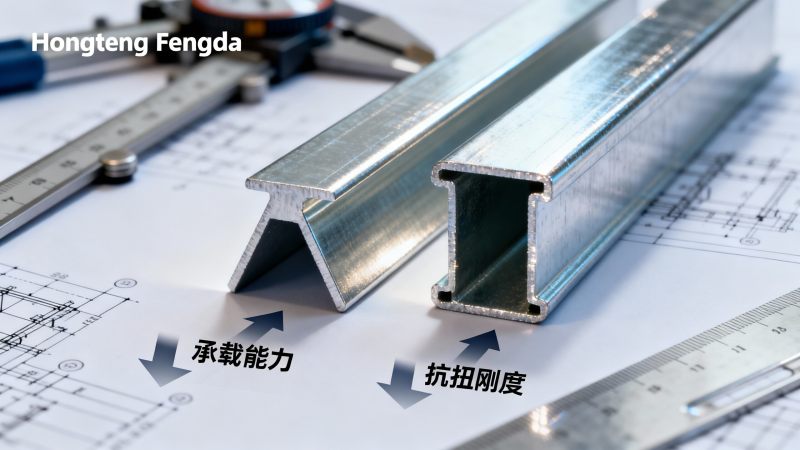
Angle steel and channel steel are both hot-rolled or cold-formed structural profiles widely used in load-bearing frameworks. Angle steel—commonly known as L-section—features two legs intersecting at 90°, forming an “L” shape. It’s available in equal-leg (e.g., 50×50×5 mm) and unequal-leg (e.g., 75×50×6 mm) configurations. Channel steel, by contrast, has a “C”-shaped cross-section with parallel flanges and a web connecting them—offering enclosed lateral support.
Both profiles serve as primary framing members but differ fundamentally in geometry-driven behavior. While angle steel excels in corner bracing and tension-only applications, channel steel delivers superior resistance to bending about its major axis and enhanced stability under compressive loads. These intrinsic differences directly impact structural integrity, especially where seismic resilience or fatigue endurance is mandated.
Technical Performance Comparison
Performance differentiation becomes most evident under mechanical stress. The following table compares core technical attributes relevant to industrial design and safety validation:
Standards & Certification Compliance
Global regulatory acceptance hinges on adherence to internationally recognized standards. For angle steel, ASTM A6/A6M (carbon/low-alloy), EN 10056-1 (European L-sections), and GB/T 706 (Chinese standard) govern dimensional tolerances, yield strength, and chemical composition. Channel steel follows ASTM A36/A572, EN 10279 (cold-formed), and GB/T 706–2016—with tighter controls on web-to-flange perpendicularity and residual stress limits.
At Hongteng Fengda, every batch undergoes third-party inspection per ISO 17025 protocols. Mill test reports (MTRs) verify compliance with ASTM, EN, JIS, and GB codes—ensuring traceability from raw billet to finished profile. This certification rigor matters most for safety-critical installations like offshore platforms, chemical plant supports, and high-bay warehouse frames where non-conformance risks operational shutdowns or regulatory penalties.
Procurement Guide for Global Buyers
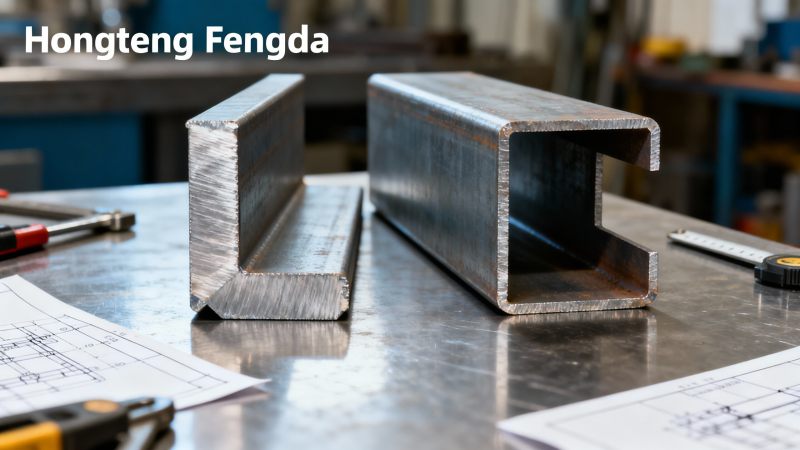
Procurement professionals face dual pressures: balancing cost-efficiency against long-term reliability. Key selection criteria include:
- Load path clarity: Use channel steel when unidirectional bending dominates (e.g., crane rails, mezzanine joists); choose angle steel for triangulated bracing or secondary framing.
- Installation speed: Angle steel allows faster field assembly with minimal drilling—ideal for time-sensitive EPC projects.
- Corrosion exposure: Channel sections trap moisture internally; specify galvanized or epoxy-coated variants for humid or coastal environments.
- Supply chain resilience: Opt for manufacturers with dual-standard capability (e.g., ASTM + GB)—reducing rework risk during customs clearance.
For civil infrastructure projects requiring reinforcing elements, consider pairing structural framing with high-strength Wire rod—available in HRB400/HRB500 grades and compliant with BS4449, ASTM A615, and GB1499.2 for seamless integration into foundations, columns, and slabs.
Why Choose Hongteng Fengda?
As a structural steel manufacturer and exporter from China, Hongteng Fengda bridges global demand with localized precision. Our ISO 9001-certified production line handles custom bends, pre-drilled holes, and surface treatments—from hot-dip galvanizing to anti-rust oil coating—without compromising dimensional accuracy (±0.75% tolerance).
We support procurement teams with real-time mill test reports, multi-language documentation, and flexible incoterms (FOB, CIF, DAP). With stable output across 120+ SKUs—and dedicated QC checkpoints at rolling, cutting, and packaging stages—we eliminate sourcing volatility for distributors in North America, EU, and ASEAN markets.
Whether you’re validating angle steel vs channel steel differences for a refinery retrofit or scaling OEM component supply for modular construction, Hongteng Fengda delivers certified quality, responsive lead times, and engineering-grade partnership—not just steel.
Related recommendations
 What Affects the Cost of Galvanized Steel in Fabrication Projects?Galvanized steel costs vary far beyond raw material price. Learn how coating, steel grade, fabrication, logistics, and hidden quote items affect project budgets before you buy.
 Steel Wire Strand Applications in Lifting and Support: Key Load and Safety ConsiderationsSteel wire strand selection for lifting and support starts with real load, fatigue, corrosion, and anchoring conditions. Learn how to improve safety, service life, and structural reliability.
 Architectural Steel Angle in Facades, Edges, and Clean LinesArchitectural steel angle improves facade edges, clean lines, and structural precision. Discover how it supports durability, faster installation, and smarter project control.
 Where Cold Formed Steel Angle Works Best in Modern BuildsCold formed steel angle works best in modular builds, secondary framing, and utility supports. Learn where it adds value, what to verify, and how to choose the right profile with confidence.
Please give us a message


Please enter what you want to find