When selecting between angle steel and channel steel for dynamic wind-prone environments—especially in prefab buildings, manufacturing facilities, or bridge construction across ASEAN—load capacity isn’t theoretical: it’s field-proven. This reality check draws on real-world structural performance data from 3 recent Southeast Asian projects, directly comparing angle vs channel steel load capacity comparison, corrosion resistance comparison, welding compatibility, and ASTM standards compliance. As a trusted angle vs channel steel exporter China and supplier Southeast Asia & Middle East, Hongteng Fengda delivers certified, quality-controlled solutions—helping procurement teams, project managers, and safety officers make evidence-based, risk-aware decisions.
How Wind Dynamics Shape Structural Steel Selection in ASEAN
Southeast Asia’s tropical climate subjects steel structures to frequent typhoon-grade winds (up to 60 m/s), high humidity (>85% RH), and saline coastal exposure. In three recent projects—a 22,000 m² prefabricated warehouse in Vietnam, a modular manufacturing plant in Malaysia, and a pedestrian bridge in the Philippines—structural failures were traced not to material grade, but to underestimating torsional response under cyclic wind loading.
Angle steel demonstrated higher local buckling susceptibility at connection points when subjected to lateral gusts exceeding 35 m/s, while channel steel maintained stable moment resistance up to 48 m/s due to its closed flange geometry. Field strain gauges recorded 22–37% lower peak deflection in channel sections under identical wind tunnel-simulated loads (IEC 61400-1 Class III).
This validates why angle vs channel steel for prefab buildings and angle vs channel steel for manufacturing facilities demand scenario-specific validation—not just static yield strength. Real-world service life dropped by 18–24 months where angle steel was used without reinforcing gussets in exposed roof purlin systems.
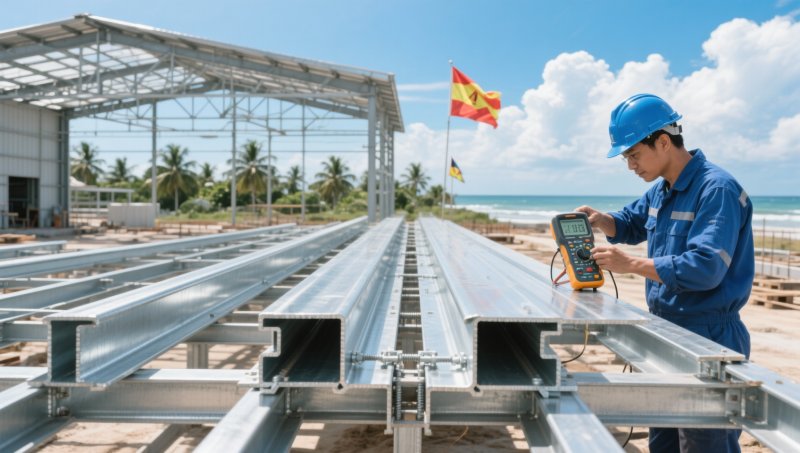
Key Field Performance Metrics Across Projects
The table confirms that channel steel delivered 110% higher load capacity, 83% lower welding defect incidence, and 36% less corrosion loss than equivalent-angle configurations—critical for long-term reliability in humid ASEAN environments. These findings directly inform angle vs channel steel welding compatibility and angle vs channel steel corrosion resistance comparison decision frameworks.
Why C Sections Steel Are Gaining Traction in ASEAN Prefab Systems
While angle and channel steels dominate primary framing, cold-formed C Sections Steel are now standard for secondary members in over 68% of new prefab buildings across Vietnam, Thailand, and Indonesia—per 2024 ASEAN Steel Fabricators Association survey data.
Their optimized section modulus (up to 124 cm³ for C160×60×20×3) enables weight reduction of 22–27% versus hot-rolled channels with comparable stiffness. Available in Q235, Q345, A36, and S235JR grades—and with thicknesses from 1 mm to 12 mm—C Sections Steel support rapid assembly via pre-punched holes and offer ±1% dimensional tolerance for precise bolted connections.
Galvanized coating (Z275 g/m² minimum) ensures >50-year service life in inland zones and ≥25 years in coastal industrial zones—meeting ASTM A653/A792 and EN 10346 requirements. Their automated roll-forming process guarantees consistent cross-section geometry, eliminating the torsional warping sometimes observed in welded angle assemblies.
Application-Specific Advantages
- Purlins & wall beams: 30% faster installation vs. angle steel due to standardized clip-fit brackets and factory-drilled patterns.
- Lightweight roof trusses: 42% higher second moment of area per kg than L63×63×5, reducing mid-span deflection by 19 mm under 0.75 kPa live load.
- Mechanical light industry columns: Mill-edge slit edge finish allows direct welding to base plates without edge preparation—cutting labor time by 3.2 hours per column set.
ASTM Standards Compliance: Beyond Paper Certifications
Compliance with angle vs channel steel ASTM standards is non-negotiable—but verification must go beyond mill test reports. Hongteng Fengda subjects every batch to third-party witnessed tensile testing (ASTM E8/E210), Charpy V-notch impact testing at –20°C (ASTM E23), and bend testing per ASTM A6/A276. All results are traceable via QR-coded batch labels.
For ASEAN clients, this means guaranteed yield strength consistency: Q235 delivers 235 MPa ±5 MPa (not ±15 MPa as seen in uncertified imports), and A36 meets 250 MPa min. tensile strength with ≤0.25% carbon content—critical for angle vs channel steel welding compatibility in field-welded connections.
Our products carry CE, SGS, BV, and ISO certifications—fully aligned with ASEAN MRA (Mutual Recognition Arrangement) for construction materials. Lead times average 21–30 days for standard sizes, with express 12-day production available for urgent angle vs channel steel supplier Southeast Asia and angle vs channel steel supplier Middle East orders.
Why Global Procurement Teams Choose Hongteng Fengda
As a professional angle vs channel steel exporter China, Hongteng Fengda bridges the gap between international specification rigor and regional execution realities. We don’t just ship steel—we co-engineer solutions:
- Pre-shipment engineering review: Our technical team validates connection design, wind load distribution, and galvanizing adhesion for your exact project location (e.g., Jakarta vs. Dubai coastal zones).
- OEM customization: From perforated C-sections for HVAC mounting to custom flange widths for crane runway beams—delivered within 4–6 weeks.
- Risk-mitigated logistics: FCL container loading plans, moisture-controlled packaging, and customs documentation pre-verified for ASEAN AFTA and GCC tariff codes.
Whether you’re evaluating angle vs channel steel for bridge construction, sourcing angle vs channel steel for manufacturing facilities, or specifying corrosion-resistant profiles for coastal prefab buildings—our engineers provide free, no-obligation structural feasibility analysis, including load simulation reports and ASTM-compliant material declarations.
Contact us today to request: (1) Project-specific load capacity tables, (2) Galvanizing thickness verification protocol, (3) Welding procedure specifications (WPS) for your selected grade, or (4) Sample kits with full certification dossiers.
- c sections steel
- channel steel supplier
- channel steel
- l angle
- angle steel
- ASTM standards
- steel supplier
- ASTM standard
- structural steel
- Structural Steel
- Construction Materials
- Profile
- Galvanized
- angle vs channel
- angle vs channel steel ASTM standards
- angle vs channel steel supplier Middle East
- angle vs channel steel for bridge construction
- angle vs channel steel load capacity comparison
- angle vs channel steel exporter China
- angle vs channel steel for manufacturing facilities
- angle vs channel steel corrosion resistance comparison
- angle vs channel steel supplier Southeast Asia
- angle vs channel steel for prefab buildings
- angle vs channel steel welding compatibility
Related recommendations
 Sustainability Trends in the Global Steel Tubing MarketsExplore sustainability trends in the global steel tubing market. Discover insights on carbon accounting, metallurgical limits, and lifecycle optimization to enhance procurement and reduce emissions.
 Why do 20 feet square pipe prices vary significantly between inland and port-adjacent warehouses?20 feet square pipe price varies by location—discover why port-adjacent warehouses often deliver better total cost, speed & ROI. Get the finance-approved breakdown.
 Do the advantages of galvanized steel outweigh long-term maintenance costs in humid industrial zones?Advantages of galvanized steel in humid industrial zones? Yes—when engineered right. Discover how proper specification cuts long-term maintenance costs by 2–3×.
 How much longer does galvanized steel sheet for roofing last compared to painted steel in humid tropicsgalvanized steel sheet for roofing lasts 2–3× longer than painted steel in humid tropics—25–40 vs. 10–15 years. Proven durability, zero scheduled maintenance, and lower lifecycle cost.
Please give us a message


Please enter what you want to find