The Reality of Carbon Accounting in Steel Tubing Procurement
The global steel tubing market is currently navigating a complex transition where sustainability claims frequently outpace verifiable metallurgical and supply chain realities. Enterprise procurement strategies are shifting from simply requesting generic green certificates to demanding granular Environmental Product Declarations (EPDs) that detail Scope 3 emissions. However, a significant discrepancy often exists between the theoretical carbon footprint of a steel tube and its actual embodied carbon once fabrication, transportation, and end-of-life recycling are accounted for. The true trend in the market is not merely the adoption of recycled materials, but the rigorous optimization of the entire production lifecycle to balance structural integrity with environmental compliance. Understanding the boundaries of cradle-to-gate versus cradle-to-grave assessments is critical, as different certification bodies handle the allocation of emissions in integrated steel plants versus electric arc mini-mills in vastly different ways.
Metallurgical Constraints of High Recycled Content
A primary driver of sustainability in steel tubing is the increased utilization of scrap metal in Electric Arc Furnace (EAF) production. While this drastically reduces the carbon footprint compared to traditional Basic Oxygen Furnace (BOF) routes relying on virgin iron ore, it introduces metallurgical variables that directly impact tube performance. Scrap-derived steel inherently contains higher levels of residual elements such as copper, nickel, chromium, and tin. When these residuals accumulate beyond specific thresholds, they can negatively affect the hot ductility of the steel, leading to surface cracking during the hot rolling or extrusion processes required to form seamless or welded tubes. Copper, in particular, enriches at the grain boundaries during high-temperature processing, causing hot shortness. To mitigate this, manufacturers must employ advanced ladle metallurgy, precise electromagnetic stirring, and sometimes add elements like nickel to counteract the copper effect.
Procurement specifications that ignore these residual limits may result in tubes that meet basic yield strength requirements but fail prematurely under cyclic loading or exhibit poor weldability in the field due to increased hydrogen cracking susceptibility. This often forces contractors to implement mandatory pre-heating protocols, which inadvertently adds to the overall carbon footprint of the construction project. The weldability of these high-strength, scrap-derived tubes is heavily influenced by their Carbon Equivalent Value (CEV). As manufacturers push for higher strength through micro-alloying, the CEV often increases, narrowing the window for safe welding without pre-heating. A high CEV increases the risk of cold cracking in the heat-affected zone (HAZ). Specifying a tube with a low CEV might require a more expensive, tightly controlled melting practice, but it eliminates the need for field pre-heating, which consumes fossil fuels and slows down construction progress. Therefore, the true carbon cost must factor in the welding procedures required on-site, not just the chemistry of the tube as it leaves the mill.
Lightweighting, Cold Forming, and Structural Synergy
To compensate for the potential variability in scrap-based steel and to meet stringent weight-reduction targets, the market is seeing a strong shift toward High-Strength Low-Alloy (HSLA) tubing. By utilizing micro-alloying elements like vanadium and niobium, manufacturers can achieve higher yield strengths without increasing the wall thickness. This lightweighting effect reduces the overall material consumption per project. However, the cold-forming process used to create rectangular or square hollow sections introduces its own complexities. The Bauschinger effect causes a reduction in yield strength at the corners of the tube compared to the flat faces, meaning the structural capacity is not uniform across the cross-section.
Furthermore, thinner-walled high-strength tubes introduce new challenges at the connection points, where local stress concentrations are significantly higher. The structural synergy between the tubular members and the connecting nodes becomes critical. In heavy-duty applications such as engineering machinery, mining trucks, or large-scale construction frameworks, the tubes must be paired with high-quality base materials to ensure joint integrity. For instance, integrating these tubes with a compliant Carbon Steel Sheet Plate like Q345A, which features controlled manganese (1.20-1.50%) and strictly limited sulfur and phosphorus (≤0.020%), ensures that the gusset plates and connection brackets can withstand the amplified localized stresses without brittle fracture. The chemical balance in such plates, including specific aluminum and vanadium content for grain refinement and low-temperature impact toughness, is just as vital to the overall structural sustainability as the tube itself, preventing premature joint failures that would necessitate carbon-intensive replacements.
Surface Treatments and the Hidden Costs of Preparation
Beyond the base metal, the sustainability trends in surface treatments for steel tubing are undergoing a fundamental re-evaluation. Traditional solvent-based liquid coatings are being phased out due to high Volatile Organic Compound (VOC) emissions. The industry is pivoting toward hot-dip galvanizing and advanced powder coating technologies. Hot-dip galvanizing offers exceptional longevity, which inherently reduces the lifecycle carbon footprint by minimizing the need for maintenance and recoating over decades of service. Yet, the galvanizing process itself is energy-intensive, and the surface preparation required—typically abrasive blasting—generates significant spent media that must be managed or disposed of.
Prior to galvanizing, the steel tubes must undergo acid pickling to remove mill scale and rust. The sustainability of this step is often overlooked. The disposal of spent pickling acid and the generation of iron sludge present significant environmental challenges. Modern facilities are addressing this by implementing acid regeneration plants that recover the hydrochloric or sulfuric acid and convert the iron byproduct into high-grade iron oxide, which can be sold to the cement or pigment industries. When evaluating the sustainability of a galvanized steel tube, it is essential to verify whether the supplier utilizes such closed-loop acid regeneration systems, as this drastically reduces the hazardous waste profile of the surface preparation phase.
The market trend is now focused on optimizing the galvanizing bath chemistry, such as adding nickel or bismuth, to lower the bath temperature and reduce zinc consumption while maintaining coating adhesion and thickness. For applications where aesthetics and specific environmental resistance are required, powder coating provides a zero-VOC alternative. The critical decision point lies in matching the coating technology to the specific degradation environment. A thick galvanized coating might be over-specified and carbon-inefficient for an indoor architectural application, whereas a thin powder coat would be entirely inadequate for a marine environment, leading to premature failure.
Logistical Optimization and Transport Emissions
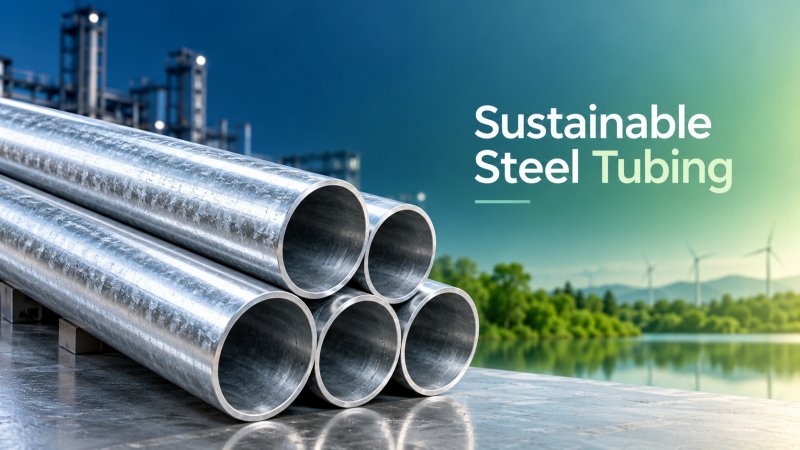
The geographical distribution of steel tubing manufacturing also plays a pivotal role in the sustainability equation. The carbon footprint of transporting heavy, bulky tubular products can sometimes negate the environmental benefits gained during the manufacturing phase. This reality is driving a trend toward regionalized sourcing and nearshoring for large-volume projects. Furthermore, the physical nesting and packaging of steel tubes during transit are being optimized to maximize container and truck load factors. Hollow sections are particularly susceptible to inefficient space utilization if not bundled correctly.
Transporting large-diameter pipes requires specialized structural bracing to prevent ovalization during transit, which adds dead weight and increases fuel consumption. Conversely, small-diameter tubes can be nested, but this requires precise dimensional tolerances to ensure a tight fit. Advanced logistics planning now considers the exact bundling configurations of the tubes to ensure maximum payload efficiency, thereby reducing the emissions per ton-kilometer. This logistical optimization requires close collaboration between the tube manufacturer, the freight forwarder, and the project site managers to align delivery schedules with installation sequences, preventing double-handling, on-site degradation, and the need for corrective rework.
End-of-Life Strategy and Scrap Contamination
True sustainability in the steel tubing market also necessitates a clear strategy for end-of-life material recovery. Steel is inherently recyclable, but the presence of certain coatings, composite linings, or embedded concrete can complicate the recycling process and downgrade the quality of the recovered scrap. The market is trending toward design for deconstruction, where mechanical connections are preferred over welded joints in temporary or modular structures. This allows the steel tubes to be dismantled and reused directly in new projects, bypassing the remelting phase entirely. Reuse is always more carbon-efficient than recycling.
When direct reuse is not feasible, the tubes must be easily separable from other building materials to ensure they re-enter the scrap stream as high-grade, low-residual material. The contamination of scrap by coating materials, such as thick zinc layers or legacy lead-based paints, requires sophisticated off-gas and dust management systems in the EAF to capture volatiles like dioxins and heavy metals. Managing these EAF dusts as hazardous waste adds to the environmental burden, making the selection of cleaner, more easily separable coating systems a vital part of the initial specification.
The evolution of sustainability in the global steel tubing market is moving past superficial marketing claims into the realm of rigorous engineering and supply chain management. It requires a holistic assessment of scrap quality, metallurgical consistency, coating lifecycle performance, and logistical efficiency. The most effective strategies do not simply seek the lowest initial carbon number on an EPD; they optimize the total environmental impact across the structure's entire lifespan. By understanding the intricate relationships between material chemistry, manufacturing processes, and application-specific demands, projects can achieve genuine sustainability without compromising on structural reliability or economic viability.
Please give us a message


Please enter what you want to find