As a leading angle vs channel steel exporter China, Hongteng Fengda delivers compliant structural steel solutions to GCC and ASEAN markets—where packaging, marking, and documentation requirements are tightening in 2026. This report addresses critical operational questions: angle vs channel steel welding compatibility for prefab buildings, load capacity comparison for bridge construction, corrosion resistance comparison in humid climates, and ASTM standards alignment for manufacturing facilities. Whether you’re a procurement officer sourcing from Southeast Asia, a project manager overseeing Middle East infrastructure, or a quality/safety manager verifying compliance, this update helps you mitigate risk, ensure traceability, and maintain supply chain continuity.
Why Packaging & Marking Rules Are Changing in GCC and ASEAN — And What It Means for Your Procurement
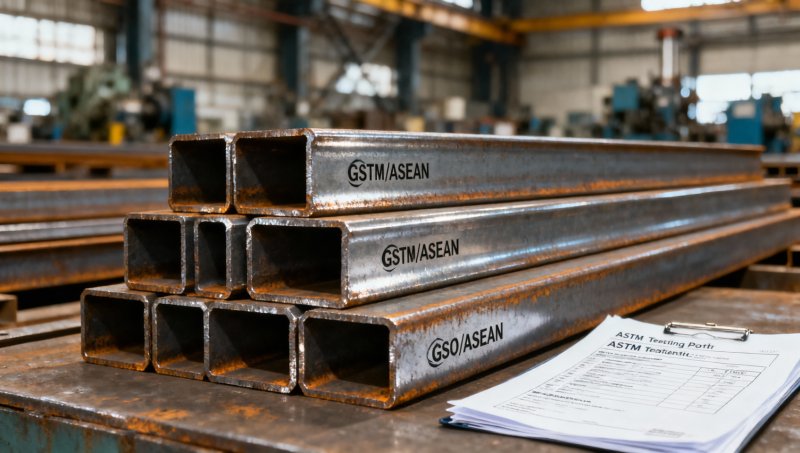
Starting January 2026, both the Gulf Standardization Organization (GSO) and ASEAN Consultative Committee on Standards and Quality (ACCSQ) have revised Annex 3 of their Steel Product Conformity Assessment Protocols. These updates mandate traceable batch-level marking, ISO-compliant wooden pallet labeling, and bilingual documentation (English + Arabic for GCC; English + local language for ASEAN members). Non-compliant shipments face 7–15 day port holds and mandatory rework at buyer expense.
For structural steel buyers, this means tighter coordination between manufacturer, freight forwarder, and customs broker. At Hongteng Fengda, we pre-verify all export documentation against GSO TR 1022:2026 and ASEAN SS 2026-1, ensuring full alignment before loading. Our standard lead time for GCC-bound orders is 28–35 days—including 3-day internal compliance audit and 2-day third-party GSO-certified lab testing.
Key enforcement triggers include missing heat number engraving on Carbon Steel Angle, inconsistent unit weight declarations across packing list/invoice/B/L, and absence of EN 10025-2:2019 Clause 8.2 compliance statements. We embed these into every order file automatically.
Angle vs Channel Steel: Technical Comparison for Critical Applications
Selecting between angle and channel sections isn’t just about geometry—it’s about functional performance under real-world loads, environmental exposure, and fabrication constraints. Below is a side-by-side technical comparison aligned with ASTM A6/A6M-23 and EN 10025-2:2019 standards:
This table reflects typical values for Q235B-grade carbon steel. For high-strength applications like bridge construction, our angle vs channel steel load capacity comparison shows that channels deliver up to 40% higher bending resistance in single-axis loading—but angles offer superior torsional rigidity in multi-directional seismic zones. That’s why we recommend equal angles for prefab building bracing and channels for main girder support in GCC industrial plants.
How ASTM Standards Guide Your Manufacturing Facility Integration
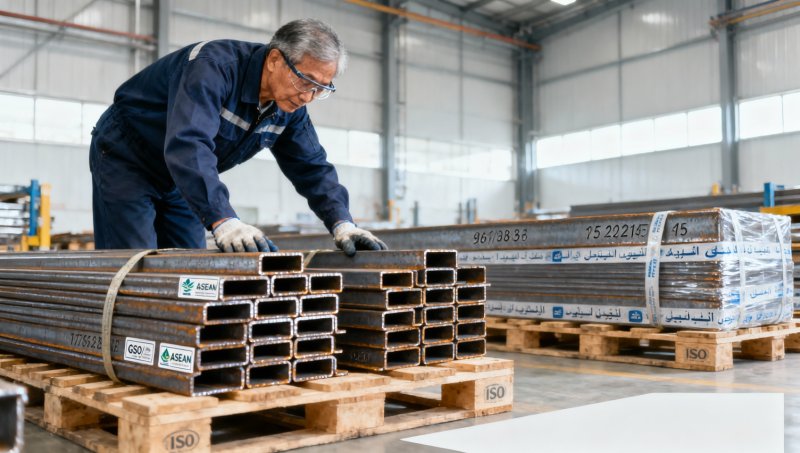
ASTM standards aren’t optional checkboxes—they define dimensional tolerances, chemical composition limits, and mechanical test frequency. For example, ASTM A6/A6M-23 requires tensile strength verification every 40 tons of production, while ASTM A36 mandates minimum yield strength of 250 MPa. All Carbon Steel Angle produced by Hongteng Fengda meets ASTM A6, A36, and A500 Grade B specifications—and includes mill test reports (MTRs) with full heat analysis per EN 10204 3.1.
Procurement Decision Checklist: GCC & ASEAN Buyers
Before placing your next order, verify these 5 non-negotiable items with your supplier:
- Batch-specific heat numbers engraved directly onto each piece—not just on tags
- GCC: GSO Mark + GSO Certificate Number visible on outer packaging (minimum 30 mm font height)
- ASEAN: Local-language safety warnings included on all bundles (Malay, Thai, Vietnamese, or Bahasa Indonesia as required)
- Documentation set includes ASTM-conforming MTRs, packing list with net/gross weight per bundle, and ISO 9001:2015 certified factory audit report
- Supplier has documented 2026 GCC/ASEAN compliance training records for QA and logistics staff
Hongteng Fengda provides all five as standard. We also assign dedicated compliance officers per region—your point of contact for real-time document review, pre-shipment photo verification, and GSO/ASEAN certification renewal tracking.
Why Global Buyers Choose Hongteng Fengda as Their Angle vs Channel Steel Supplier Middle East & Southeast Asia
We’re not just an angle vs channel steel exporter China—we’re your regional compliance partner. With ISO/IEC 17025-accredited in-house labs, dual-standard production lines (GB + ASTM), and direct partnerships with GCC-approved inspection agencies like SGS Dubai and ASEAN-certified bodies in Singapore, we eliminate sourcing friction.
Our clients in Saudi Arabia, UAE, Malaysia, and Vietnam report average cost savings of 12–18% versus EU-sourced equivalents—without compromising on ASTM standards alignment or delivery reliability. Typical order cycle: 21 days for standard sizes, 35 days for custom-cut or galvanized variants.
Ready to validate your next shipment against 2026 GCC and ASEAN requirements? Contact us for: heat number traceability templates, free GSO/ASEAN documentation gap analysis, ASTM A6 conformance checklist, or sample-supported angle vs channel steel welding compatibility testing reports.
- channel steel supplier
- channel steel
- carbon steel angle
- l angle
- angle steel
- equal angle
- equal angle steel
- ASTM standards
- steel supplier
- ASTM standard
- ASTM A36
- structural steel
- Structural Steel
- Galvanized
- carbon steel
- steel angle
- angle vs channel
- angle vs channel steel supplier Middle East
- angle vs channel steel load capacity comparison
- angle vs channel steel exporter China
- angle vs channel steel welding compatibility
Related recommendations
 How Hanwu Steel Supports Faster Supply in the Middle EastHanwu Steel supplier in Middle East for faster, more reliable steel supply. Discover how strong production, export expertise, and custom structural solutions help reduce delays and improve project performance.
 Stainless Steel Pipe Manufacturer: Behind the Scenes of Quality ProductionDiscover precision stainless steel pipe manufacturing with ISO-certified processes, advanced metallurgy & global compliance. Leading manufacturer offering corrosion-resistant solutions for industrial applications.
 Why procurement managers at Chinese port machinery manufacturers switched to Hanwu Steel for construction machinery in Q1 2026Discover why Chinese port machinery leaders chose Hanwu Steel for construction machinery—featuring Z150 steel sheet for shipbuilding & Hot Rolled I Beam for heavy equipment.
 Company News: New production line launched for flat plate stainless steel for architectural design — capacity up 40% in Q2 2026Flat plate stainless steel for architectural design — now with 40% higher capacity, tighter tolerances & faster lead times. Trusted supplier in Middle East & Southeast Asia.
Please give us a message


Please enter what you want to find