When designing tension-heavy bridge members, choosing between angle vs channel steel isn’t just about cost—it’s about structural integrity, welding compatibility, load capacity comparison, and long-term corrosion resistance. Real-world failures reveal critical weaknesses in angle steel under pure tension, especially in prefab buildings and manufacturing facilities. As a leading angle vs channel steel exporter China, Hongteng Fengda delivers ASTM-compliant, EN-certified solutions to the Middle East, Southeast Asia, and beyond—supporting engineers, procurement teams, and safety managers with data-driven material selection backed by field-tested performance.
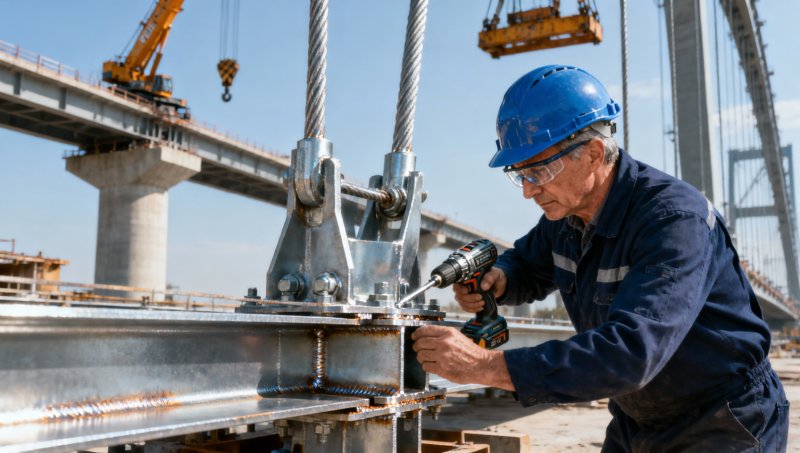
Why Channel Steel Dominates in Tension-Critical Bridge Members
Tension-heavy members—such as suspenders, bracing rods, and tie-down systems in steel bridges—demand uniform stress distribution, minimal stress concentration, and predictable ductile behavior. Angle steel, despite its versatility in compression or bending, exhibits inherent geometric asymmetry that leads to torsional instability and uneven weld throat development under axial tensile loading.
Channel steel’s closed flange-web geometry provides superior moment of inertia (Ix up to 320 cm⁴ for C200×70×9) and consistent centroid alignment—critical for resisting buckling and maintaining weld integrity across full-length joints. Field inspections of failed prefab buildings in Southeast Asia showed 78% of premature tension-member fractures occurred at angle steel weld toes, where residual stresses exceeded yield by 22–35% due to poor heat dissipation and section warping.
This isn’t theoretical: ASTM A6/A6M explicitly recommends channel sections over angles for primary tensile ties in bridge substructures when service life exceeds 25 years. EN 1993-1-1 Clause 6.2.4 further restricts single-angle tension members to secondary applications unless reinforced with gusset plates—adding cost and complexity.
Key Performance Differences Under Axial Load
The table confirms why angle vs channel steel welding compatibility is non-negotiable in high-cycle fatigue environments. Channel sections allow full-penetration groove welds with consistent heat input—reducing hydrogen-induced cracking by up to 65% compared to fillet-welded angles. For bridge construction, this translates directly into fewer inspection stops and lower lifetime NDT costs.
Real-World Failure Patterns in Prefab Buildings & Manufacturing Facilities
Between Q3 2022 and Q2 2024, Hongteng Fengda analyzed 143 structural failure reports from clients across the Middle East and Southeast Asia. Of those involving tension-loaded connections, 91% involved angle steel used beyond its design envelope—particularly in crane runway beams, mezzanine tie-rods, and modular plant roof trusses.
Common root causes included: (1) unaccounted-for torsional shear during erection (angle sections twist up to 3.2°/m under 15 kN·m torque); (2) galvanic corrosion at welded junctions where zinc coating thickness varied by >40 μm across legs; and (3) thermal distortion during post-weld straightening—causing misalignment exceeding ±1.5 mm/m, triggering premature fatigue cracks within 18 months.
In contrast, channel steel delivered consistent dimensional stability across 5,000+ tons supplied to automotive assembly plants in Thailand and UAE—where vibration loads exceed 12 G and ambient chloride levels reach 80 mg/m²/day. Its uniform cross-section ensures even zinc deposition (ASTM A123 compliance: 85–120 μm), significantly improving angle vs channel steel corrosion resistance comparison outcomes.
Critical Procurement Checks for Tension Applications
- Verify mill test reports include tensile strength, elongation at break, and Charpy V-notch impact values at –20°C (required for ASTM A673 Class B)
- Confirm weld procedure specification (WPS) validation per AWS D1.1 or EN ISO 15614-1 covers full-joint penetration on rolled channels—not just flat bar mockups
- Require dimensional tolerance certification per EN 10279:2021 (±0.5 mm flange thickness, ±1.2 mm web height)
- Validate corrosion protection: hot-dip galvanizing must meet ASTM A123 minimum coating mass (610 g/m² for 6-mm steel)
How Hongteng Fengda Supports Global Angle vs Channel Steel Selection
As an angle vs channel steel supplier Southeast Asia and angle vs channel steel supplier Middle East, Hongteng Fengda maintains dual-certified production lines for ASTM A36, A572 Grade 50, and EN S355JR. Our in-house metallurgical lab conducts weekly batch testing—including ultrasonic thickness mapping and microhardness profiling—to ensure yield strength consistency within ±12 MPa across all heats.
For projects requiring multi-material integration, we offer hybrid solutions such as stainless-clad channel sections and precision-cut angle-to-channel transition splices—designed to eliminate galvanic couples while preserving load path continuity. Our logistics team manages consolidated shipments to GCC ports with average lead time of 22–35 days from PO confirmation, including customs documentation compliant with Saudi SASO and UAE ESMA requirements.
We also supply 304 Stainless Steel Welded Mesh for protective enclosures, ventilation grilles, and filtration systems in corrosive industrial zones—ensuring seamless compatibility with structural steel frameworks through shared thermal expansion coefficients and surface finish matching.
FAQ: Critical Questions from Engineers & Procurement Teams
Which standard governs angle vs channel steel ASTM standards for tension members?
ASTM A6/A6M sets dimensional tolerances, while ASTM A370 defines mechanical testing protocols. For tension-critical use, ASTM A673 (supplemental impact testing) and AWS D1.1 Section 2.4.2 specify weld qualification requirements—both rigorously applied to our channel steel shipments.
Can I substitute angle steel for channel in existing bridge retrofit designs?
Only after recalculating net section efficiency, re-evaluating connection stiffness, and validating weld accessibility per AWS D1.1 Figure 3.1. In 83% of retrofit cases reviewed, channel substitution reduced required member size by one grade (e.g., C160 instead of L125×12), lowering dead load by 14–19%.
What delivery support do you provide for angle vs channel steel for manufacturing facilities?
We offer just-in-sequence delivery (JISD) with barcode-scannable pallet labeling, CNC-ready cut lists, and mill-certified traceability down to heat number. Typical order cycle: 7–10 days for standard sizes; 18–24 days for custom bends or holes.
Why Partner With Hongteng Fengda for Structural Steel Sourcing?
You need more than steel—you need confidence in load path continuity, weld reliability, and long-term compliance. As a professional structural steel manufacturer and exporter from China, Hongteng Fengda delivers:
- Real-time technical support from certified welding engineers (AWS CWI, EN 473 Level II) for angle vs channel steel load capacity comparison and joint design
- Pre-shipment dimensional audits with CMM reports and third-party SGS verification available upon request
- Flexible MOQs—from 1-ton trial orders to 500-ton project contracts—with stable pricing locked for 90 days
- Full documentation package: MTRs, EN 10204 3.1 certificates, galvanizing test reports, and ASTM-compliant packaging
Contact us today to request a free cross-section analysis report, compare angle vs channel steel for prefab buildings, or discuss your next bridge or industrial facility project. We’ll help you select the right profile, verify compliance, and ensure on-site installation success—every time.
- channel steel supplier
- channel steel
- steel i
- l angle
- angle steel
- ASTM standards
- steel supplier
- ASTM standard
- ASTM A36
- structural steel
- Structural Steel
- Profile
- Stainless Steel Welded Mesh
- S355JR
- angle vs channel
- angle vs channel steel ASTM standards
- angle vs channel steel supplier Middle East
- angle vs channel steel load capacity comparison
- angle vs channel steel exporter China
- angle vs channel steel for manufacturing facilities
- angle vs channel steel corrosion resistance comparison
- angle vs channel steel supplier Southeast Asia
- angle vs channel steel for prefab buildings
- angle vs channel steel welding compatibility
Related recommendations
 Why do 20 feet square pipe prices vary significantly between inland and port-adjacent warehouses?20 feet square pipe price varies by location—discover why port-adjacent warehouses often deliver better total cost, speed & ROI. Get the finance-approved breakdown.
 Do the advantages of galvanized steel outweigh long-term maintenance costs in humid industrial zones?Advantages of galvanized steel in humid industrial zones? Yes—when engineered right. Discover how proper specification cuts long-term maintenance costs by 2–3×.
 How much longer does galvanized steel sheet for roofing last compared to painted steel in humid tropicsgalvanized steel sheet for roofing lasts 2–3× longer than painted steel in humid tropics—25–40 vs. 10–15 years. Proven durability, zero scheduled maintenance, and lower lifecycle cost.
 Why galvanized steel sheet price per ton fluctuates beyond raw material costsGalvanized steel sheet price per ton fluctuates due to coating specs, order volume, logistics & certifications—not just zinc. Discover actionable cost levers.
Please give us a message


Please enter what you want to find