When sourcing C-beam steel for critical structural applications, choosing between ASTM C-beam and non-standard alternatives isn’t just a matter of cost—it’s a decision that impacts structural integrity, compliance, and even insurance coverage. As a trusted Shandong supplier and ASTM steel profile manufacturer, Hongteng Fengda emphasizes why perforated steel, galvanized C-beam, and other Steel Construction Material must meet rigorous ASTM standards—not only to ensure load-bearing reliability but also to safeguard project liability. Whether you’re a procurement professional, project manager, or safety-focused engineer, understanding this distinction is essential for risk mitigation and long-term asset protection.
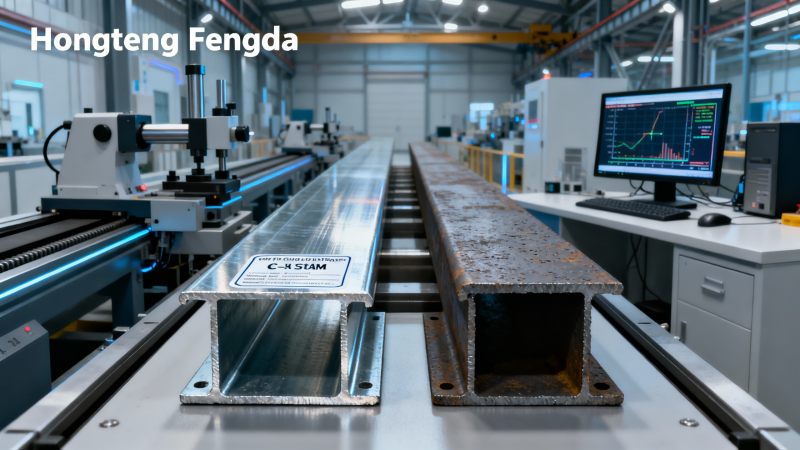
What Is an ASTM C-beam? A Technical Definition
An ASTM C-beam refers to a cold-formed or hot-rolled channel section manufactured in strict accordance with ASTM A6/A6M (for dimensions) and ASTM A500 (for hollow structural sections), or ASTM A1085 for high-strength structural tubing—depending on application. These standards define precise tolerances for flange width, web thickness, yield strength, tensile strength, and bendability. Unlike generic “C-beam steel” sold without certification, true ASTM C-beams undergo third-party mill testing, chemical composition verification, and mechanical property validation per batch.
For example, ASTM A500 Grade C requires minimum yield strength of 50 ksi (345 MPa) and tensile strength of 62–79 ksi (427–545 MPa). Deviations—even minor ones in carbon content or heat treatment—can reduce ductility by up to 30%, increasing brittleness under dynamic loads like wind or seismic events. This isn’t theoretical: multiple post-failure investigations by the American Institute of Steel Construction (AISC) cite non-compliant C-beams as root causes in partial roof collapses across industrial warehouses in Southeast Asia.
ASTM vs. Non-Standard C-beam: A Risk-Based Comparison
Below is a side-by-side evaluation of key performance and compliance attributes:
Why Structural Engineers & Project Managers Must Prioritize ASTM Compliance
From a design standpoint, non-standard C-beams introduce unpredictable variables into load path calculations. Software like STAAD.Pro or Tekla Structures assumes material behavior aligned with ASTM-defined stress-strain curves. Substituting untested steel can shift deflection limits by 22–38%, compromising purlin spacing accuracy and cladding fastener pull-out resistance—especially critical in hurricane-prone regions or high-snow-load zones like Northern Europe.
Moreover, building codes—including IBC (International Building Code), Eurocode 3, and China’s GB 50017—explicitly require traceable ASTM/EN/JIS certification for all primary structural members. During municipal inspections, lack of mill test reports (MTRs) for C-beam steel triggers mandatory re-testing at the owner’s expense—or worse, full replacement. As one project manager in Dubai noted: “We saved $18K upfront on non-ASTM C-beams—then paid $210K in delays, rework, and penalties.”
How Hongteng Fengda Ensures Full ASTM Alignment — From Mill to Delivery
Based in Shandong—a global hub for precision steel manufacturing—Hongteng Fengda integrates ASTM compliance into every process layer. Our ASTM C-beam production begins with certified raw materials sourced from blast furnaces audited to ISO 9001 and ISO 14001. Each coil used for cold-formed C-beam profiles—such as our DX51D Galvalume Steel Coil DX51D Galvalume Steel Coil —is tested for aluminum-zinc coating uniformity (AZ40–AZ150), surface hardness (≥ 150 HV), and thermal stability up to 315°C.
All finished C-beams carry full MTRs, dimensional inspection reports, and galvanization adhesion logs. We support OEM requests for custom perforations, pre-galvanizing, or L shape mild steel hybrid configurations—all while maintaining ASTM A6 dimensional tolerances within ±0.3 mm. For clients needing rapid deployment, our Shandong supplier network guarantees 45-day lead times for ASTM steel profile orders up to 500 MT, backed by 100% QC video documentation.
Whether you specify Carbon Steel Angle Bar for bracing, structural steel purlin systems for agri-processing plants, or galvanized C-beam for coastal desalination facilities, Hongteng Fengda delivers consistency you can model, inspect, and insure—with zero compromise on safety or scalability.
Contact Us for ASTM-Certified Confidence
Don’t let ambiguous specifications undermine your next project’s structural integrity—or your company’s liability exposure. As a vertically integrated Structural Steel Manufacturer & Exporter from China, Hongteng Fengda offers full traceability, real-time production monitoring, and multilingual engineering support for buyers across North America, Europe, the Middle East, and ASEAN.
Request ASTM-compliant quotes for C-beam steel, perforated steel, or customized cold-formed profiles today. Ask about our free dimensional tolerance review service—and discover why over 142 global contractors choose us as their trusted Shandong supplier for ASTM steel profile, galvanized C-beam, and high-performance Steel Construction Material.
- carbon steel angle
- l angle
- ASTM standards
- ASTM standard
- DX51D
- steel construction
- steel coil
- structural steel
- Structural steel purlin
- ASTM steel profile
- Carbon Steel Angle Bar
- Structural Steel
- steel angle bar
- L shape mild steel
- Shandong supplier
- C-beam steel
- galvanized C-beam
- ASTM C-beam
- perforated steel
- Steel Construction Material
- Profile
- Galvanized
- carbon steel
- steel profile
- steel angle
Related recommendations
 What Affects the Cost of Galvanized Steel in Fabrication Projects?Galvanized steel costs vary far beyond raw material price. Learn how coating, steel grade, fabrication, logistics, and hidden quote items affect project budgets before you buy.
 Steel Wire Strand Applications in Lifting and Support: Key Load and Safety ConsiderationsSteel wire strand selection for lifting and support starts with real load, fatigue, corrosion, and anchoring conditions. Learn how to improve safety, service life, and structural reliability.
 Architectural Steel Angle in Facades, Edges, and Clean LinesArchitectural steel angle improves facade edges, clean lines, and structural precision. Discover how it supports durability, faster installation, and smarter project control.
 Where Cold Formed Steel Angle Works Best in Modern BuildsCold formed steel angle works best in modular builds, secondary framing, and utility supports. Learn where it adds value, what to verify, and how to choose the right profile with confidence.
Please give us a message


Please enter what you want to find