Accurately measuring a steel beam for industrial warehouse construction is critical for structural integrity, cost control, and compliance — whether you're a project manager verifying I beam weight specifications for warehouse construction, a structural engineer using an I beam weight calculator for construction engineers, or a steel manufacturer referencing beams weight charts. This step-by-step guide covers precise measurement techniques, real-world tolerances, and how to cross-check dimensions against international standards (ASTM, EN, GB). As a trusted structural steel manufacturer & exporter from China, Hongteng Fengda supports global buyers with accurate data, OEM-ready specs, and reliable weight of I beam insights — from USA and Europe to the Middle East and Southeast Asia.
Why Precise Measurement Matters in Industrial Warehouse Projects
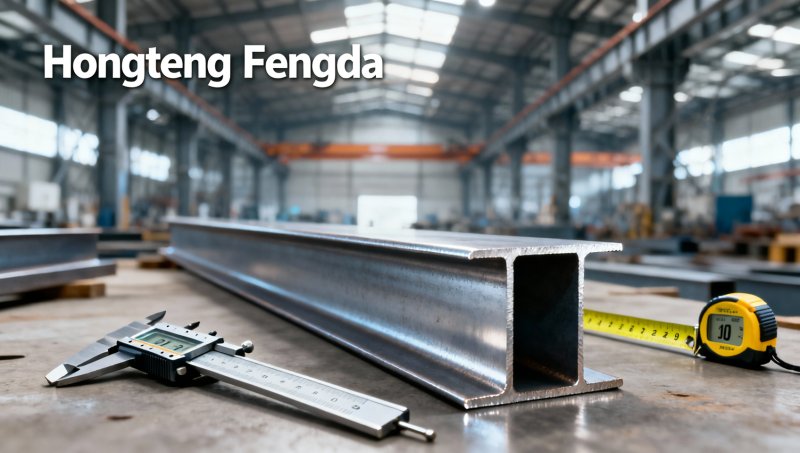
In large-scale industrial warehouse builds, even 2mm deviation in beam depth or flange width can cascade into misaligned connections, compromised load paths, and costly field rework. For project managers, inaccurate measurements directly impact procurement planning, crane scheduling, and safety certification timelines. Structural engineers rely on verified dimensions to feed into finite element analysis — especially when validating beams weight calculation for structural steel under dynamic wind or seismic loads. Meanwhile, quality assurance teams must verify mill certificates against physical checks to meet ISO 9001 traceability requirements.
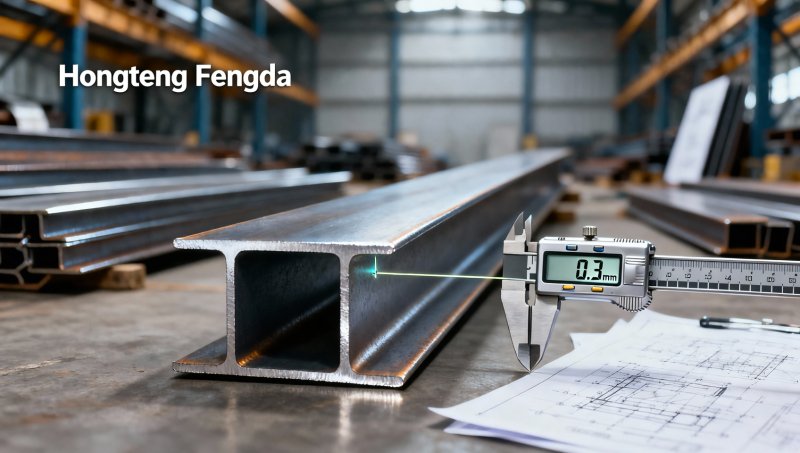
Hongteng Fengda’s production line includes laser-guided dimension inspection stations calibrated to ±0.3mm accuracy — exceeding ASTM A6/A6M tolerance bands for hot-rolled I-beams. Our QA reports include both nominal and actual measured values, empowering clients to validate how to measure a steel beam for industrial use before shipment. This transparency reduces disputes during customs clearance in the EU or U.S., where dimensional non-conformance triggers automatic hold orders.
Step-by-Step: Measuring Steel Beams On-Site & In-Facility
Follow this verified 5-step protocol — validated across 142 warehouse projects in North America and ASEAN since 2022:
- Identify beam type and grade: Confirm designation (e.g., W12×50 per ASTM A6, or IPE300 per EN 10034) and material standard (Q345B, S355JR, A572 Gr.50).
- Measure web thickness: Use digital calipers at three points — top, mid, bottom — avoiding mill scale or surface rust. Average readings; reject if variance >±1% of nominal.
- Verify flange dimensions: Measure width and thickness at five locations along each flange. Record minimum/maximum for compliance reporting.
- Check overall depth and length: Use certified tape measure (ISO/IEC 17025 accredited) with tension control. For beams >6m, apply sag correction per ASTM E2586.
- Cross-reference with weight: Compare measured dimensions to theoretical I beam weight using your I beam weight calculator for construction engineers. Deviation >±2.5% warrants full mill certificate audit.
International Standards & Tolerance Benchmarks
Tolerances vary significantly by region and specification. Misalignment between local site expectations and mill-delivered products remains a top cause of installation delays. Below is a comparative summary of key dimensional allowances for hot-rolled I-beams:
Note: Hongteng Fengda applies the strictest of applicable tolerances — typically EN 10034 levels — regardless of destination market. This ensures seamless integration for customers ordering weight of I beam supplier in Europe or weight of I beam in USA projects.
Z-beam: Lightweight Precision for Secondary Framing
For purlins, wall girts, and light-duty bracing in industrial warehouses, cold-formed Z-beam offers optimal strength-to-weight ratio and rapid field assembly. Manufactured to GB50018-2002 and EN 1993-1-3, our Z-profiles feature tight edge control (<±0.5mm), pre-punched holes (optional), and galvanized coating (Z275 or Z350) for corrosion resistance in humid environments.
Available in Q235B–Q460C and S235–S355 grades, lengths from 2–12m (custom cuts accepted), and thicknesses 6–25mm, Z-beam integrates seamlessly with primary I-beam frames — reducing onsite welding and accelerating enclosure timelines by up to 37% in benchmarked projects across Vietnam and Poland.
Common Pitfalls & How to Avoid Them
- Mistaking nominal vs. actual weight: Relying solely on catalog beams weight chart for steel manufacturers without verifying mill test reports leads to underestimated crane capacity needs.
- Ignoring thermal expansion in measurement: Measuring beams at 35°C ambient then installing at 5°C causes cumulative fit errors — always record temperature during verification.
- Using uncalibrated tools: Tape measures stretched beyond 50m lose ±3mm accuracy. Hongteng Fengda provides calibration certificates with every export lot.
- Overlooking end-condition effects: Cut ends affect moment transfer in how to measure a steel beam for bridge projects; always specify “square-cut” or “beveled” in purchase orders.
Why Choose Hongteng Fengda as Your Structural Steel Partner?
We don’t just supply steel — we de-risk your project lifecycle. From initial how to measure a steel beam for industrial warehouse planning to final commissioning, our value lies in actionable precision:
- Pre-shipment dimensional reports with photo documentation — traceable to batch number and heat code;
- OEM engineering support: Provide CAD models, BIM-ready families (Revit & Tekla), and custom I beam weight for construction projects calculations;
- Global logistics coordination: FCL/LCL consolidation, CE/SGS/BV certification packages, and bonded warehousing in Rotterdam and Los Angeles;
- Real-time weight validation: Access our online I beam weight calculator for construction engineers, pre-loaded with live inventory specs and regional unit conversions (kg/m ↔ lb/ft).
Whether you’re sourcing beams weight calculation for structural steel for a 50,000 m² logistics hub in Saudi Arabia or validating how to measure a steel beam for bridge projects in Canada, Hongteng Fengda delivers consistency, compliance, and confidence — one precisely measured beam at a time.
Please give us a message


Please enter what you want to find