Introduction
Facing choices for long-span structures in 2025, engineers, procurement managers and QC teams need clear data on corrosion resistance and life‑cycle cost. This article compares DX53D Galvalume Steel Coil and AZ150 Galvalume Steel Coil through accelerated corrosion tests and ROI modeling, with practical insights for H-beam and Z-beam applications, rebar connections and cable systems using Galvanized Steel Wire Rope. If you evaluate durability, maintenance and total cost, this concise, data‑driven guide helps technical evaluators, project managers and distributors choose the optimal coil for longer service life and lower ownership cost. This introduction frames the problem faced by stakeholders in the steel industry: choosing coil and coating options that balance upfront cost and long‑term performance for long‑span structures. Major concerns include structural durability of H-beam and Z-beam members, corrosion at rebar connections and the longevity of cable systems that rely on Galvanized Steel Wire Rope and Hot dipped Galvanized Steel Wire Rope. Procurement teams ask whether a higher coating class such as AZ150 Galvalume Steel Coil delivers measurable extensions in service life compared to products based on the DX53D substrate with standard Galvalume layering. Quality teams require reproducible accelerated corrosion test data—salt spray, cyclic corrosion, and electrochemical impedance—to translate lab hours into expected field life across inland, industrial and coastal exposures. For project managers and distributors the question becomes economic: does paying a premium for AZ150 coating weight deliver lower total cost of ownership when you account for maintenance windows, rework on exposed edges of H-beam and Z-beam sections, and the cost of replacing corroded connections or Hot diped-Galvanized Pipe elements? This article presents laboratory results, practical field implications for Rebar ties and cable anchors, and a transparent ROI model calibrated for typical market prices in 2025. It targets users and operators, technical evaluators, purchasers, and safety management professionals who need evidence-based guidance to specify DX53D Galvalume Steel Coil or AZ150 Galvalume Steel Coil for long-span structural projects.
Accelerated Corrosion Test Methodology and Comparative Results
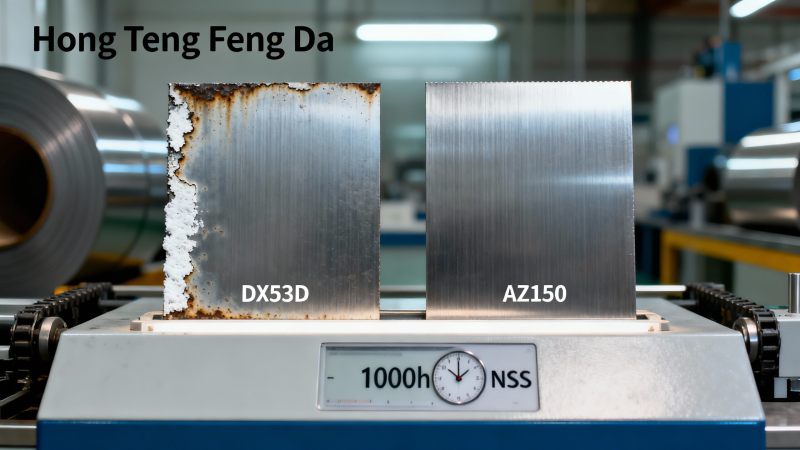
A rigorous comparison of DX53D Galvalume Steel Coil versus AZ150 Galvalume Steel Coil begins with standardized accelerated corrosion protocols tailored to predict field performance. Our test program included neutral salt spray (NSS) per ASTM B117 for baseline blistering and rust assessment, cyclic corrosion testing (CCT) to simulate alternate wet/dry and chloride stress experienced in coastal and industrial atmospheres, and electrochemical impedance spectroscopy to quantify coating barrier properties. DX53D refers to the base steel grade (a low-carbon deep drawing substrate) while AZ150 denotes a specific aluminum‑zinc alloy coating mass of approximately 150 g/m2 per side, which increases sacrificial and barrier protection compared with minimal Galvalume coatings. Specimens were prepared with identical forming and edge treatments to ensure results reflect coating system performance rather than fabrication artifacts. Testing durations included NSS up to 1,000 hours, CCT cycles equivalent to roughly 2,000 hours of chloride exposure, and periodic adhesion and hardness checks. Key findings: in NSS, DX53D-based Galvalume specimens typically showed onset of white rust at cut edges after approximately 600–800 hours, with intermittent red rust at heavily stressed weld zones by 1,000 hours. AZ150-coated samples consistently delayed white rust formation beyond 1,000 hours and exhibited significantly reduced red rust penetration at welds and fastener holes. In CCT, AZ150 samples retained intact coherent Al-Zn layers and showed lower mass loss in corroded zones, translating to a 1.8–2.6× improvement in predicted service life for exposed edge conditions compared to standard Galvalume on DX53D. Electrochemical data corroborated these trends: AZ150 showed higher coating impedance and lower corrosion current density, indicating better barrier function and slower substrate attack. For practical decision making, this means AZ150 Galvalume Steel Coil is demonstrably more resistant in aggressive exposures, particularly where H-beam flanges, Z-beam lips, Rebar terminations and cable anchor plates are vulnerable to chloride ingress. When evaluating options, incorporate these lab-derived multipliers against known site exposure to estimate realistic lifespan differences between DX53D Galvalume Steel Coil and AZ150 Galvalume Steel Coil.
Performance Implications for H-beam, Z-beam, Rebar Connections and Cable Systems
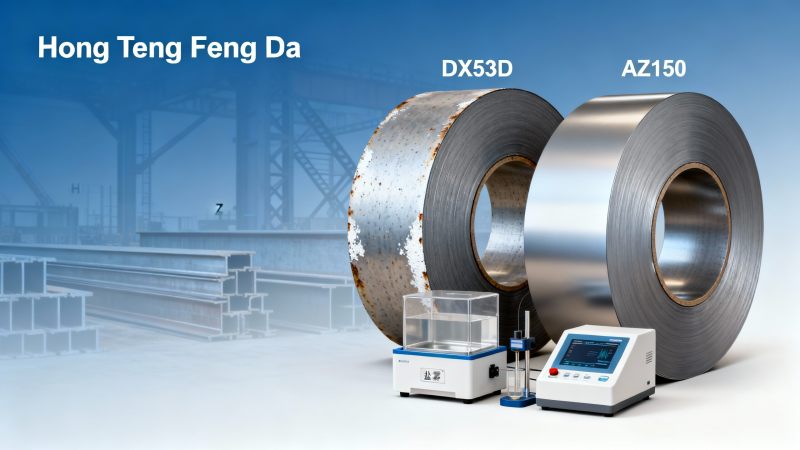
Translating corrosion test data into structural design and maintenance strategy requires attention to how coating behavior interacts with connection detailing and component geometry. H-beam and Z-beam profiles have high stress concentrations at welds, bolted splice zones, and at ends where cut edges expose substrate. A protective coating with higher aluminum-zinc content such as AZ150 reduces lateral undercutting and slows crevice corrosion in these critical areas. For example, an H-beam flange cut for bolted connections benefits from AZ150’s superior edge protection, which decreases the frequency of touch-up coatings and limits under‑fastener corrosion that can accelerate fatigue in long-span members. Similarly, Z-beam sections used in purlins and secondary framing see reduced perforation rates when specified with AZ150 Galvalume Steel Coil. Rebar connections embedded in composite decks or external splice cases are another failure mode influenced by coil selection. Corrosion at rebar overlap splices or anchor plates often begins at paint or coating discontinuities; using a higher-performing coil reduces chloride penetration from the environment into crevices. Projects integrating Stainless Steel Welded Mesh for composite slabs or corrosion-sensitive applications can pair mesh with Galvalume substrates to manage both mechanical performance and corrosion synergy. For cable systems, the selection of Galvanized Steel Wire Rope with rated tensile ranges such as Galvanized Steel Wire Rope 1470Mpa to 1960Mpa or Hot dipped Galvanized Steel Wire Rope is critical. cable sockets and anchorage plates fabricated from coils with AZ150 withstand micro-galvanic interactions better, preserving connection integrity longer than DX53D baseline coils under similar exposures. In addition to substrate and coating, practical field controls—proper edge sealing, using compatible fasteners, and avoiding dissimilar-metal contact with Hot diped-Galvanized Pipe or stainless connectors—are essential. Where stainless components are required for appearance or corrosion-critical interfaces, products such as Stainless Square steel rod can be specified for ties, decorative elements, and certain anchor pin applications to prevent galvanic corrosion when paired with Galvalume or galvanized components. Integrators should evaluate the entire system—coating class, fastener finish, and maintenance access—to realize the full service-life benefit promised by higher-grade coatings such as AZ150.
ROI and Total Cost of Ownership Modeling for Long-Span Projects (2025 Scenarios)
Procurement and financial teams require clear measures of return on investment (ROI) when comparing DX53D Galvalume Steel Coil and AZ150 Galvalume Steel Coil. We modeled two representative 30‑year long‑span structure scenarios (coastal and inland industrial) to quantify lifecycle costs including material, installation, scheduled maintenance, unforeseen repairs, and end‑of‑life replacement. Input assumptions reflect 2025 market conditions: base coil cost for DX53D Galvalume Steel Coil as X, with AZ150 priced at a 12–20% premium based on coating mass and processing. Maintenance cycles for DX53D were modeled at repaint or touch‑up every 8–10 years in inland sites and every 4–6 years in coastal sites; for AZ150 these intervals extended to 12–15 years inland and 8–12 years coastal due to delayed onset of significant corrosion. Replacement probability for critical components such as bolted H-beam splice plates or corroded Hot diped-Galvanized Pipe sections was reduced by an estimated 40–60% when AZ150 was applied. Using net present cost (discount rate 5%) and conservative escalation for maintenance costs, payback analysis indicates that in coastal and high-chloride industrial exposures, AZ150 typically achieves payback within 7–12 years and yields a lower total cost of ownership over 30 years by 18–28% compared to DX53D Galvalume Steel Coil. In inland, low-corrosivity environments the payback period extends and the lifecycle savings narrow; AZ150 can still deliver value when considering reduced downtime and lower safety risk associated with fewer maintenance closures on long-span structures. For systems employing Galvanized Steel Wire Rope or Hot dipped Galvanized Steel Wire Rope rated 1470Mpa to 1960Mpa, the combined effect of durable coil selection and high-strength galvanized rope reduces the frequency of anchor and cable interventions, improving asset availability and reducing indirect costs. This ROI modeling underlines a procurement principle: specify coating class and base grade appropriate to exposure class and maintenance economics. For projects where access and shutdown costs are high—bridges, stadium roofs, and major industrial halls—the premium for AZ150 Galvalume Steel Coil is often justified by lifecycle savings, fewer emergency repairs, and predictable maintenance planning that benefits both owners and operators.
Specification, Quality Control and Practical Procurement Guidance
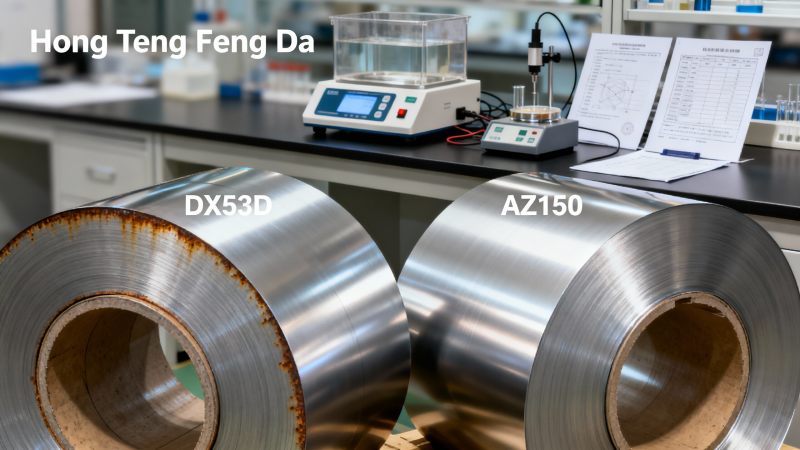
Specifying the right coil and ensuring construction quality requires clear procurement language, field inspection checklists, and alignment between design intent and supplier capability. When preparing procurement documents, call out both substrate grade (e.g., DX53D Galvalume Steel Coil) and coating mass/class (e.g., AZ150 Galvalume Steel Coil) with measurable acceptance criteria: coating mass g/m2, adhesion after forming, bend and cut-edge performance, and certified test reports for salt spray and cyclic corrosion. Include acceptance testing for welded assemblies and fastener interfaces, and require mill certificates that reference relevant standards (EN, ASTM, JIS, GB) to provide traceability. Quality control on site should emphasize: pre-installation inspection of coil batches, verification of coating continuity at sheared edges, appropriate edge treatment and sealants for H-beam and Z-beam terminations, and torque-controlled bolting to avoid coating damage that accelerates localized corrosion. For connections that integrate Rebar, Hot diped-Galvanized Pipe sleeves, or galvanized anchors, specify compatible finishes and avoid direct contact between dissimilar metals without insulation. Periodic maintenance planning should include inspection intervals tied to coating class—longer intervals for AZ150—documented in a maintenance plan to inform operations teams and reduce lifecycle uncertainty. Distributors and agents should also consider stocking strategies based on regional exposure: keep AZ150 inventory for coastal clients and high-value infrastructure projects, while DX53D Galvalume Steel Coil can meet many inland, low-corrosion requirements with careful detailing. Include clauses on warranty, accelerated test results, and supplier support for surface treatment and post-fabrication touch-up. Finally, integrate strength and connection considerations such as matching cable anchors to Galvanized Steel Wire Rope 1470Mpa to 1960Mpa or selecting appropriate Stainless Steel Welded Mesh where composite performance is needed. This comprehensive, test-driven approach reduces defects, supports predictable ROI, and reinforces contractor and owner confidence in final structural performance.
Summary and Call to Action
In summary, accelerated testing and ROI modeling show that AZ150 Galvalume Steel Coil provides materially better corrosion resistance than baseline DX53D Galvalume Steel Coil in aggressive exposures, with measurable benefits for H-beam and Z-beam durability, reduced corrosion at Rebar connections, and improved longevity of anchorage points used with Galvanized Steel Wire Rope and Hot dipped Galvanized Steel Wire Rope. The higher upfront cost of AZ150 is often offset by longer maintenance cycles, fewer emergency repairs, and lower total cost of ownership—particularly in coastal or industrial environments where chloride-driven corrosion is significant. For inland, benign climates, DX53D Galvalume Steel Coil remains a cost-effective choice when coupled with good detailing and preventive maintenance. Shandong Hongteng Fengda Metal Materials Co.. Ltd. combines production capability and quality systems to supply both DX53D and AZ150 Galvalume Steel Coil options, together with complementary products such as Galvanized Steel Wire Rope, Hot diped-Galvanized Pipe, and stainless components to meet project‑level requirements. For detailed specification support, accelerated test data, and tailored ROI calculations for your project, contact our technical sales team to evaluate exposure class, maintenance constraints, and long‑term budget impact. For component needs that require stainless connectors or decorative ties, consider compatible products such as Stainless Square steel rod as part of a holistic corrosion control strategy. Immediate actions: request a technical datasheet comparing DX53D Galvalume Steel Coil and AZ150 Galvalume Steel Coil, ask for sample test reports (NSS, CCT, EIS), and obtain an LCC worksheet customized to your asset. To discuss procurement options, warranty terms, or to schedule a specification review with our engineers, contact us today—secure longer service life and lower ownership cost for your long-span structures.
- steel i
- hot dipped galvanized steel wire
- galvanized steel wire
- ot Dipped Galvanized Steel Wire
- galvanized pipe
- steel coil
- galvanized steel
- Steel Rod
- Profile
- Hot diped-Galvanized Pipe
- AZ150 Galvalume Steel Coil
- DX53D Galvalume Steel Coil
- Rebar
- Galvanized Steel Wire Rope
- Galvanized Steel Wire Rope 1470Mpa to 1960Mpa
- Stainless Steel Welded Mesh
- Z-beam
- H-beam
Related recommendations
 How to Judge if Steel Sheet for Construction Fits Roofing or Wall CladdingSteel sheet for construction: learn how to judge thickness, coating, profile, and load performance for roofing or wall cladding, and choose a durable, cost-effective fit.
 Galvanized Pipe Manufacturer Selection: Zinc Coating, Tolerance, and ComplianceGalvanized pipe manufacturer selection guide: compare zinc coating quality, tolerance control, and compliance to reduce risk and choose a supplier that delivers reliable steel products.
 How to Choose SS Pipe for Water Supply in Corrosion-Prone BuildingsSS pipe for water supply selection guide for corrosion-prone buildings. Compare 304 vs 316 grades, water chemistry, specs, and lifecycle cost to choose a safer, longer-lasting system.
 Steel Wire Rope Manufacturer Standards That Matter in Lifting ApplicationsSteel wire rope manufacturer standards for lifting: learn how to assess traceability, testing, compliance, and real quality control before choosing a safer, more reliable supplier.
Please give us a message


Please enter what you want to find