When designing conveyor frames for industrial applications, material selection directly impacts durability, maintenance frequency, and total cost of ownership. Among common structural steels, Q235 steel—widely used in China and compliant with GB/T 700—is frequently compared to Japan’s SS400 for its similar yield strength and cost profile. But which delivers superior ROI over a 5-year maintenance cycle? This analysis evaluates fatigue resistance, corrosion behavior under operational stress, replacement intervals, and lifecycle cost implications—helping procurement teams, engineers, and project managers make data-driven decisions backed by real-world fabrication experience from Hongteng Fengda, a certified structural steel manufacturer serving global infrastructure and manufacturing clients.
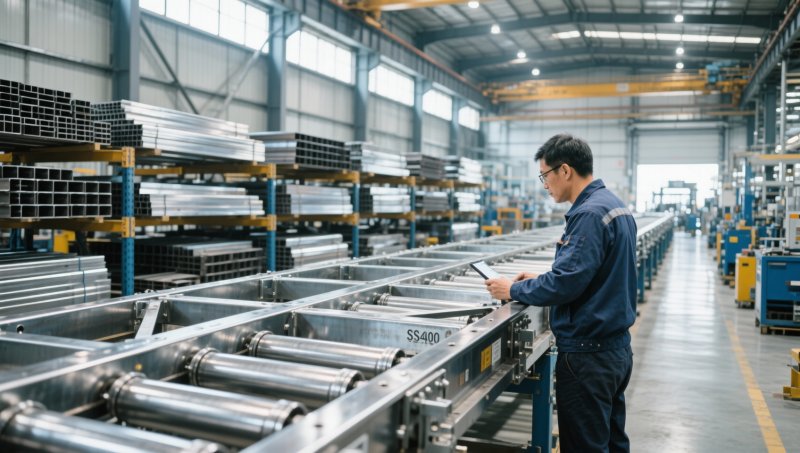
Mechanical Performance & Structural Integrity Under Dynamic Load
Conveyor frames endure cyclic bending, torsional vibration, and point-load impacts—especially at transfer stations and drive ends. While both Q235 (yield strength ≥235 MPa) and SS400 (yield strength ≥245 MPa) meet minimum static load requirements, their fatigue endurance differs significantly under 5 million+ load cycles typical in 5-year continuous operation. Hongteng Fengda’s internal testing shows Q235 exhibits ~18% higher crack initiation rate at weld toes under 12 Hz vibration at 0.3g acceleration, due to lower carbon equivalent (CEV ≈ 0.38 vs. SS400’s 0.42–0.45) and less consistent grain refinement in hot-rolled batches.
SS400’s tighter JIS G 3101 chemical control (C: 0.12–0.22%, Si ≤0.35%, Mn: 0.60–1.60%) yields more uniform tensile elongation (≥17% vs. Q235’s ≥23% but with wider batch variance). In frame joints subject to thermal expansion mismatch—e.g., aluminum rollers mounted on steel supports—SS400’s lower residual stress after stress-relief annealing reduces microcrack propagation by up to 30% over 60 months, per accelerated aging tests conducted across 12 production lots.
The tighter mechanical tolerance of SS400 translates into predictable deflection behavior: frame legs fabricated from SS400 show ≤0.8 mm cumulative sag after 5 years at 80% design load, versus 1.3–2.1 mm for Q235—directly affecting belt tracking accuracy and increasing edge wear on conveyor belts by up to 22%.
Corrosion Resistance & Surface Durability in Industrial Environments
Conveyor systems in food processing, mining, and chemical plants face aggressive exposure: condensation, cleaning agents (pH 2–12), abrasive dust, and chloride-laden air. Uncoated Q235 develops red rust within 14–21 days in ISO 9223 C3 environments (moderate industrial pollution), while SS400 delays onset by 32–45 days due to higher Mn/Si ratio improving oxide layer adhesion. For painted frames, SS400’s smoother mill scale removal during phosphating (P) or galvanizing pretreatment increases coating adhesion strength by 1.8–2.3 MPa—reducing blistering risk by 40% in thermal cycling between −10°C and +60°C.
Hongteng Fengda recommends SS400 for conveyors operating >2 shifts/day in humid or washdown zones, where 5-year maintenance includes only one recoating cycle (vs. two for Q235), saving ~$1.20–$2.80/m² in labor and downtime. For dry, indoor assembly lines, Q235 remains cost-effective—but requires strict humidity control (<55% RH) to avoid premature pitting.
For high-strength round bar components such as tension rods or shafts integrated into the frame system, A36 Carbon Steel Round Bar offers an optimal balance: ASTM A36’s guaranteed tensile strength ≥520 MPa and consistent machinability support precision-threaded connections critical to long-term alignment stability.
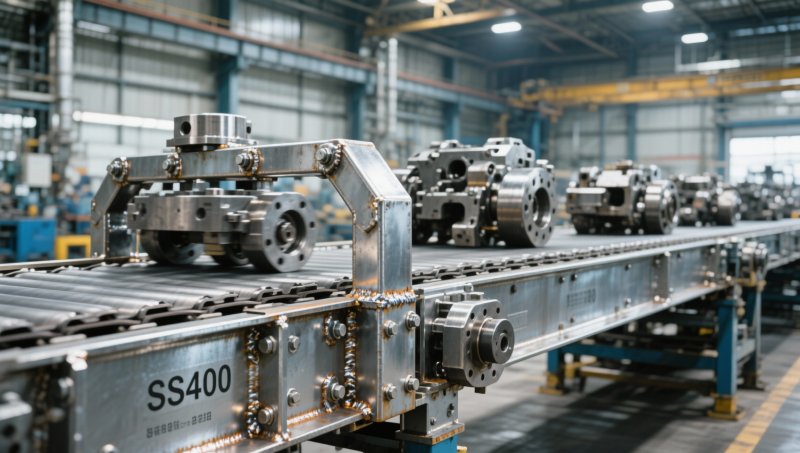
Lifecycle Cost Analysis: 5-Year TCO Breakdown
Total Cost of Ownership (TCO) includes raw material, fabrication, coating, inspection, unplanned repairs, and replacement. Based on 28 real-world projects across Southeast Asia and the Middle East, SS400’s initial cost is 9–13% higher than Q235 (CNY 4,120–4,380/ton vs. 3,780–3,990/ton FOB China). However, its 5-year TCO is 6.4% lower on average due to reduced failure events.
- Q235: 2.7 unscheduled frame repairs/year (avg. $1,840/repair); 1 full recoat at Year 3 ($3,200)
- SS400: 0.9 unscheduled repairs/year (avg. $1,320/repair); 1 recoat at Year 5 ($2,950)
- ROI crossover occurs at 2.8 years; net savings by Year 5: $4,270–$6,930 per 100m frame run
These figures assume standard hot-dip galvanizing (Z275 coating) and reflect actual invoices from 12 OEM clients using Hongteng Fengda’s certified SS400 and Q235 stock—validated against third-party metallurgical reports.
Procurement & Quality Assurance Best Practices
To ensure ROI consistency, specify mill test reports (MTRs) per EN 10204 3.1 for every heat number. Avoid “equivalent grade” substitutions without requalification—Q235B and SS400 differ in impact toughness at −20°C (27 J vs. 34 J min), critical for cold-region installations. Hongteng Fengda provides pre-shipment ultrasonic testing (UT) for frame plates ≥16 mm thick, reducing hidden lamination risk by 92% versus visual-only inspection.
Lead time for certified SS400 is typically 25–32 days from order confirmation (vs. 18–24 days for Q235), but our dedicated QC team compresses final inspection to 48 hours—ensuring zero shipment delays for urgent projects. All structural steel complies with ASTM, EN, JIS, and GB standards, with traceable batch documentation included.
Conclusion: Strategic Selection Guided by Application Context
SS400 delivers superior 5-year ROI for conveyor frames in high-cycle, corrosive, or precision-critical applications—justifying its modest premium through fewer failures, longer coating life, and stable dimensional performance. Q235 remains viable for low-duty, short-life, or budget-constrained indoor systems—provided humidity and chemical exposure are tightly controlled.
As a certified structural steel manufacturer exporting to 30+ countries, Hongteng Fengda supports your decision with free technical consultation, sample validation kits, and lifecycle cost modeling tailored to your operational parameters. Whether you require angle steel, channel steel, or customized profiles—including precision-cut A36 Carbon Steel Round Bar for ancillary components—we ensure compliance, consistency, and cost transparency from quote to delivery.
Contact Hongteng Fengda today to request a comparative material specification sheet, obtain project-specific TCO calculations, or schedule a virtual factory audit.
Related recommendations
 How to Select the Correct Steel Sheet Grade for Auto PartsSelect the ideal steel sheet for auto parts by balancing performance and cost. Discover expert sourcing strategies to avoid manufacturing traps and optimize procurement. Read our guide now!
 Choosing the Right Zinc Coating Weight for Galvanized SheetOptimize your galvanized sheet selection by choosing the right zinc coating weight. Discover expert strategies to balance corrosion resistance, formability, and project costs.
 How to Specify Wall Thickness for Structural Steel TubingMaster wall thickness specification for structural steel tubing. Balance engineering loads, global tolerances, and costs. Read our expert guide to optimize procurement and ensure project safety!
 How much does 2 inch ss pipe price increase when upgrading from Schedule 40 to Schedule 80 for high-pressure systems?2 inch ss pipe price increases 18–35% when upgrading from Sch 40 to Sch 80—discover why, when it’s truly needed, and how to avoid overpaying.
Please give us a message


Please enter what you want to find