How to Specify Wall Thickness for Structural Steel Tubing
Specifying the wall thickness for structural steel tubing goes beyond merely matching a structural engineer's theoretical load calculations. For procurement and supply chain professionals, it is a critical balancing act between structural integrity, manufacturing tolerances, environmental durability, and overall project cost. Misjudging this specification can lead to over-engineering, which drives up material and logistics expenses, or under-specifying, which introduces severe compliance and safety risks during project execution.
The process of defining the correct wall thickness requires translating abstract engineering requirements into precise, commercially viable purchasing specifications. This involves navigating international standards, understanding manufacturing limitations, and accounting for long-term environmental degradation.
### Translating Engineering Requirements into Procurement Specifications
Structural engineers determine the minimum required wall thickness based on axial loads, bending moments, buckling resistance, and deflection limits. However, the theoretical minimum thickness calculated in a design software rarely aligns perfectly with the standard sizes produced by steel mills.
When issuing inquiries or purchase orders, the specification must bridge the gap between design intent and market availability. If an engineer specifies a minimum required thickness of 4.2 mm for a specific load-bearing column, a purchaser cannot simply order a "4.2 mm" tube, as this is not a standard commercial size. The specification must be rounded up to the next available standard thickness, such as 5.0 mm or 6.0 mm, depending on the standard system being used (metric or imperial).
Furthermore, purchasers must clearly distinguish between the "design thickness" and the "nominal thickness" in procurement documents. The nominal thickness is the designated size used for ordering and identification, while the actual measured thickness must account for the manufacturing tolerances permitted by the relevant standard. Failing to clarify this distinction often leads to disputes during material inspection and acceptance at the construction site.
### Navigating Wall Thickness Tolerances Across International Standards
The most common pitfall in procuring steel tubing lies in misunderstanding wall thickness tolerances. Different international standards define acceptable deviations differently, and these variations have a direct impact on material weight, cost, and structural performance.
Under the ASTM A500 standard, which governs cold-formed welded and seamless carbon steel structural tubing, a standard tolerance of -10% is typically permitted on the nominal wall thickness. This means that if a purchaser orders a tube with a nominal wall thickness of 5.0 mm, the manufacturer is legally permitted to supply a tube with a minimum measured thickness of 4.5 mm. If the structural design strictly requires a minimum of 5.0 mm to prevent buckling under specific dynamic loads, ordering a 5.0 mm nominal tube under ASTM A500 will result in a non-compliant structure. In such cases, the procurement specification must explicitly state that the *minimum* required thickness is 5.0 mm, which would require ordering a 6.0 mm nominal tube to accommodate the -10% negative tolerance.
In contrast, European standards like EN 10210 (hot-finished) and EN 10219 (cold-formed) have different tolerance classes. EN 10219 generally allows a tolerance of ±10% or a fixed absolute value (e.g., ±0.4 mm), whichever is greater, depending on the dimension.
Purchasers must explicitly state the governing standard and the specific tolerance class in the purchase order. If the project requires tighter control over wall thickness to minimize weight variations or ensure precise connections, purchasers should request "tighter tolerances on request" from the manufacturer, acknowledging that this may incur a premium or affect lead times.
 ### The Impact of Manufacturing Processes on Thickness Consistency
The method used to form the steel tubing significantly influences wall thickness consistency, which is a vital consideration when specifying materials for critical structural nodes.
Cold-formed steel tubing, typically produced by rolling steel coil into a circular or rectangular shape and welding the seam, often experiences thickness variations. The steel undergoes plastic deformation, which can lead to thinning at the corners of rectangular or square tubes. When specifying cold-formed tubes, engineers and purchasers must ensure that the specified thickness accounts for this corner thinning, or require the manufacturer to guarantee that the minimum thickness at the corners still meets the structural design requirements.
Hot-finished structural tubing, produced by forming the steel at high temperatures, generally offers a more uniform wall thickness throughout the cross-section, including the corners. While hot-finished tubes might carry a higher initial cost, specifying them for complex connections or highly stressed nodes can reduce the risk of localized failures and minimize the need for excessive corrosion allowances, ultimately providing better lifecycle value.
### Factoring in Corrosion Allowance and Surface Treatments
Wall thickness specification is not solely a mechanical calculation; it is also a durability strategy. In environments exposed to moisture, chemicals, or marine conditions, the steel will corrode over time, effectively reducing the load-bearing wall thickness.
Traditionally, engineers address this by adding a "corrosion allowance"—an extra fraction of a millimeter to the base wall thickness to compensate for expected material loss over the structure's design life. However, simply increasing the raw steel thickness is not always the most cost-effective or efficient solution, as it increases the dead load of the structure and raises material costs.
A more optimized approach is to specify advanced surface treatments that protect the base metal, allowing the structural wall thickness to remain strictly aligned with mechanical load requirements. For structural applications exposed to harsh weather, such as electric power towers, communication towers, highway protection, or building steel structure components, utilizing Galvanized Round Steel provides a robust hot-dip galvanized anti-corrosion profile surface. This treatment creates a metallurgical bond that offers long anti-corrosion life, adapting to a wide range of aggressive environments. By relying on the galvanized layer for environmental protection, purchasers can specify a base wall thickness that is optimized purely for structural力学性能, avoiding the hidden costs of over-thickened raw steel.
### Optimizing Sourcing Through Standardized Dimensions
From a supply chain perspective, the choice of wall thickness directly influences procurement risk, lead times, and costs. Steel mills and structural steel manufacturers operate most efficiently when producing standard, high-volume sizes.
When specifying wall thickness, purchasers should actively collaborate with design teams to align requirements with standard manufacturing schedules. For example, specifying a 4.75 mm thickness when a 5.0 mm or 4.0 mm is structurally acceptable can force the manufacturer to adjust rolling mills, change tooling, or produce a custom batch. This customization disrupts production schedules, increases the likelihood of defects, and significantly extends lead times.
Reliable structural steel manufacturers maintain optimized inventory and production lines for standard thicknesses such as 3.0 mm, 4.0 mm, 5.0 mm, 6.0 mm, and 8.0 mm. By selecting these standard dimensions, purchasers benefit from stable production capacity, consistent quality, and dependable lead times. It also simplifies the sourcing process, allowing buyers to leverage competitive bidding among multiple suppliers, as standard sizes are universally available across the market.
### Verification and Acceptance Protocols
Specifying the correct wall thickness is only the first step; verifying it upon delivery is equally critical. Discrepancies between the purchase order and the delivered goods can cause severe project delays if not caught early.
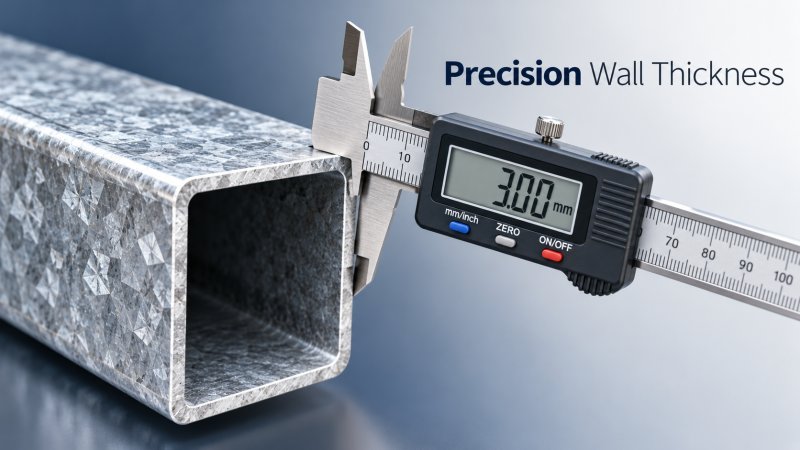
Procurement contracts should clearly define the measurement methodology. Wall thickness should not be measured arbitrarily. For cold-formed tubes, measurements should typically be taken at a specified distance from the corners and away from the weld seam, as these areas are prone to localized thinning or weld reinforcement. Ultrasonic thickness gauges are the industry standard for non-destructive verification, but the calibration of the equipment and the surface preparation of the steel (e.g., removing mill scale or galvanized coating at the test point) must be standardized in the acceptance protocol.
Furthermore, purchasers must establish clear protocols for handling out-of-tolerance materials. If a batch of steel tubing fails the thickness verification, the contract should specify whether the material will be rejected entirely, accepted at a discounted rate based on the actual weight, or sorted for use in less critical, non-load-bearing applications.
Specifying wall thickness for structural steel tubing is a multidimensional decision. It requires a deep understanding of how international standards define tolerances, how manufacturing processes affect material consistency, and how environmental factors dictate long-term durability. By aligning engineering requirements with commercial realities, optimizing for standard dimensions, and implementing rigorous verification protocols, purchasers can secure materials that ensure structural safety while maintaining strict control over project budgets and schedules.
Previous page: Already the first one
Next page: Already the last one
Please give us a message


Please enter what you want to find