Selecting the optimal zinc coating weight for your galvanized sheet is critical for balancing long-term corrosion resistance, structural durability, and overall project costs. For technical evaluators, understanding the precise relationship between coating thickness and specific environmental exposure ensures that steel components consistently meet stringent international standards. A common challenge in material specification is the tendency to either over-specify the zinc layer, leading to unnecessary budget inflation, or under-specify it, resulting in premature corrosion and costly maintenance. The core decision relies on mapping the exact atmospheric corrosivity category to the required design life of the structure, rather than defaulting to the highest available coating weight.
When evaluating materials for a new project, engineering and procurement teams must look beyond basic thickness metrics. The degradation rate of zinc is highly dependent on the presence of sulfur dioxide, chlorides, and moisture. By aligning the zinc coating mass with the specific environmental conditions and the expected service life, you can make informed, cost-effective material decisions. This guide breaks down the technical factors, environmental classifications, and formability constraints to help you determine the exact zinc coating weight required for your application.
Decoding Zinc Coating Weight Designations
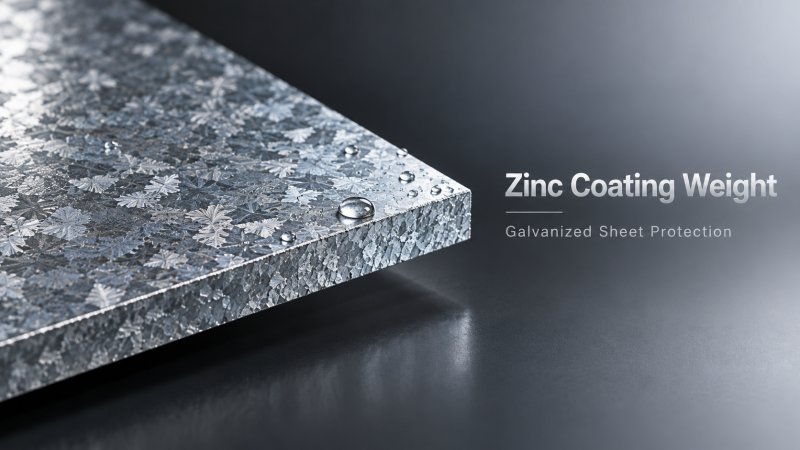
The zinc coating weight is typically expressed in grams per square meter (g/m²), representing the total weight of the zinc layer on both sides of the sheet. Standard designations, such as Z100, Z180, Z275, and Z600, indicate the combined mass of the coating on both surfaces. For instance, a Z275 coating means there is 275 grams of zinc distributed across one square meter of the sheet, equating to roughly 137.5 g/m² per side.
It is crucial to distinguish between coating weight and coating thickness. While they are directly correlated, the conversion depends on the density of the zinc-iron alloy layers formed during the galvanizing process. A pure zinc coating has a different thickness-to-weight ratio compared to a galvannealed coating, where the zinc is alloyed with the steel substrate. Technical evaluators must specify the coating type alongside the weight to ensure the manufacturing process aligns with the end-use requirements, whether it involves deep drawing, roll forming, or structural welding.
Matching Coating Mass to Environmental Exposure
The most critical step in selecting the right galvanized sheet is assessing the environmental corrosivity where the material will be installed. The ISO 9223 standard classifies atmospheric corrosivity into categories ranging from C1 (very low) to C5 (very high), with CX for extreme marine or industrial environments.
For indoor environments with heated, clean atmospheres, such as standard warehouses or interior architectural panels, a lighter coating like Z100 or Z120 is often sufficient. These environments lack the aggressive pollutants and moisture cycles that accelerate zinc consumption. In contrast, rural or lightly polluted urban areas with occasional condensation might require Z180 to Z200 to prevent the formation of white rust during storage and early service life.
When moving to industrial zones with moderate sulfur dioxide emissions or coastal areas with low salinity, the corrosivity jumps to C3 or C4. Here, a Z275 coating becomes the baseline requirement. The zinc acts as a sacrificial anode, and the higher mass provides a larger reservoir to protect the underlying steel substrate from red rust. For heavy industrial environments or severe marine splash zones, specifying Z350, Z450, or even Z600 is necessary to guarantee a design life exceeding 20 to 25 years without maintenance.
Navigating the Formability and Coating Trade-offs
A frequent oversight in material selection is ignoring the mechanical constraints imposed by heavier zinc coatings. As the zinc layer thickness increases, its behavior during forming operations changes significantly. Thicker coatings, particularly pure zinc coatings above Z275, are more prone to flaking, micro-cracking, or peeling when subjected to severe bending, deep drawing, or tight-radius roll forming.
If your project involves complex fabrication where the galvanized sheet will be heavily deformed, specifying an excessively thick coating can lead to surface defects that compromise both aesthetics and localized corrosion resistance. In such cases, it may be more effective to use a moderate zinc coating combined with a steel substrate that offers superior mechanical properties. For instance, when the final product requires extensive secondary processing or structural integration, sourcing high-quality base materials like a Wire Rod with excellent formability and weldability ensures that the underlying steel can withstand the fabrication stresses without failing, allowing you to optimize the zinc layer purely for corrosion protection rather than trying to compensate for substrate limitations.
Alternatively, for applications demanding both high formability and heavy corrosion protection, galvannealed sheets are often preferred. The iron-zinc alloy layer in these sheets provides excellent powdering resistance and weldability, making it ideal for automotive and appliance manufacturing, though it offers slightly lower bare-steel corrosion resistance compared to an equivalent weight of pure zinc coating.
Preventing White Rust During Storage and Transit
Even with the correct zinc coating weight specified for the final application, the material can suffer premature degradation before it ever reaches the construction site. White rust, or zinc oxide, forms when newly galvanized surfaces are exposed to condensation or trapped moisture, particularly when sheets are stacked tightly without adequate airflow. This is a critical concern during ocean freight or prolonged on-site storage in humid climates.
To mitigate this risk, technical evaluators must specify appropriate post-galvanizing treatments. Standard chromate passivation provides a basic level of protection against white rust during transit. However, environmental regulations have restricted hexavalent chromium, leading to the widespread adoption of trivalent chromium or chromium-free passivation treatments. For severe storage conditions, specifying an additional oiled layer or a specialized organic skin pass can significantly extend the time before white rust appears. It is also crucial to establish strict site-handling protocols, ensuring that bundles are stored off the ground, covered with breathable tarps, and never left exposed to direct condensation cycles.
Lifecycle Cost and Maintenance Planning
Procurement decisions are frequently driven by initial material costs, which naturally leads to the temptation of downgrading the zinc coating weight to reduce the purchase price. However, technical evaluators must present a lifecycle cost analysis to stakeholders. The cost difference between a Z180 and a Z275 sheet is relatively small compared to the total installed cost of a roofing or cladding system.
Furthermore, the maintenance strategy for the structure must align with the selected coating weight. Inaccessible areas of a structure, such as the interior of closed box sections or the underside of complex roof geometries, cannot be easily inspected or repainted. For these critical zones, specifying a higher zinc coating weight acts as an insurance policy against localized corrosion that could compromise structural stability. Evaluators should map out the maintenance access plan alongside the environmental map, upgrading the zinc specification in areas where future touch-ups are physically impossible or economically unviable.
Verification and Quality Control Protocols
Once the appropriate zinc coating weight is specified, verifying compliance during production and delivery is essential. The standard test method for determining coating weight is the triple spot test using an antimony chloride solution, which dissolves the zinc and allows for weight calculation based on the area tested. However, this is a destructive test.
When conducting the triple spot test, it is standard practice to take samples from the edges of the coil or sheet, as the coating thickness can sometimes vary across the width due to the air knife dynamics during the galvanizing process. Evaluators should be aware of the allowable tolerances defined by international standards. These standards typically permit a slight negative tolerance on the coating weight for spot tests, provided the average coating weight across the order meets the specified designation. Understanding these statistical tolerances prevents unnecessary disputes with suppliers over marginal test results and ensures that quality control remains focused on systemic compliance rather than isolated anomalies.
Addressing Edge Corrosion and Cut Edges
No matter how thick the zinc coating is on the flat surface of the galvanized sheet, the cut edges remain a vulnerable point. When the sheet is sheared or laser-cut, the bare steel edge is exposed to the environment. The zinc will sacrificially protect a small distance inward from the edge, but this protection zone is limited, typically extending only a few millimeters depending on the coating thickness and environmental aggressiveness.
The rate at which the zinc protects the cut edge is governed by the conductivity of the environment. In dry, indoor conditions, the protective zone might extend up to 25 millimeters from the cut. However, in a continuous wet or highly saline environment, this distance shrinks dramatically to less than 5 millimeters. Evaluators must account for this physical limitation when detailing joint designs and specifying fastener types, ensuring that the overall assembly does not become the weak link in the corrosion protection system. In highly corrosive environments, relying solely on the zinc coating weight to protect cut edges is insufficient, and secondary edge protection strategies like sealants or specialized trim profiles must be implemented.
Finalizing the Specification
The final material specification for a galvanized sheet should clearly state the coating type, the coating weight designation, the substrate steel grade, the surface treatment, and the intended forming requirements. Clear communication with the galvanizing supplier is paramount. Providing detailed drawings that highlight critical forming zones, expected environmental exposures, and specific edge conditions allows the manufacturer to optimize the air knife settings and passivation processes.
By systematically evaluating the environmental corrosivity, the mechanical demands of the fabrication process, and the lifecycle cost implications, technical evaluators can confidently select a zinc coating weight that delivers optimal performance. This collaborative and rigorous approach ensures that the final product not only meets the theoretical coating weight requirements but also performs reliably under the physical and chemical stresses of real-world application, securing the long-term viability of the entire structural project.
Please give us a message


Please enter what you want to find