For industrial buyers navigating tight project deadlines in 2024, understanding the real-world impact of standard vs custom steel lead time for industrial buyers is critical — especially when balancing mill MOQ vs trader MOQ steel for industrial applications. Whether you're sourcing a Steel I Beam supplier in Malaysia for infrastructure projects, evaluating Angle Steel price per ton Philippines for industrial use, or comparing I beam vs H beam for residential construction, delays in material availability can cascade across your timeline. At Hongteng Fengda — a certified structural steel manufacturer and exporter from China — we help global buyers optimize lead times, meet stringent specs (ASTM/EN/JIS/GB), and mitigate supply chain risk without compromising quality or cost.
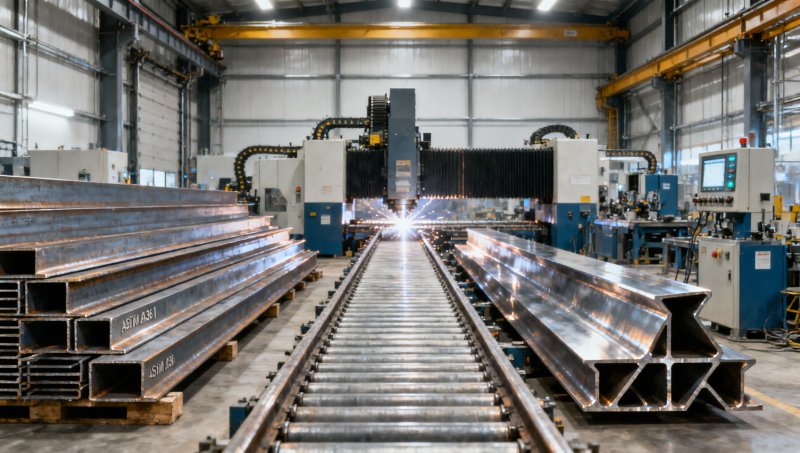
Why Lead Time Isn’t Just About “How Long” — It’s About Predictability & Control
In 2024, industrial procurement teams face unprecedented pressure: volatile raw material costs, port congestion in key hubs like Port Klang and Jebel Ali, and tightening compliance windows for infrastructure tenders across Southeast Asia and the Middle East. A delay of just 12–18 days in steel delivery can push civil works into monsoon season, trigger liquidated damages in EPC contracts, or force costly air freight substitution for critical fasteners. That’s why distinguishing between standard and custom steel isn’t merely a technical choice — it’s a strategic risk allocation decision. Standard sections (e.g., ASTM A6/A36 I-beams, EN 10025 S275JR angles) benefit from rolling mill continuity and stock-based fulfillment, typically enabling 4–6 weeks lead time from order confirmation — provided mill MOQs are met. Custom profiles (e.g., tapered cantilever beams, integrally stiffened channels, or laser-welded hybrid sections) require tooling setup, prototype validation, and dedicated furnace scheduling, extending timelines to 10–16 weeks. Crucially, mill MOQ vs trader MOQ steel for industrial applications introduces another layer: mills often enforce minimum batch sizes (e.g., 25 MT for hot-rolled structural shapes), while traders may offer lower thresholds but with variable traceability and longer transit buffers.
Hongteng Fengda bridges this gap by maintaining dual-track production capacity: our certified rolling lines handle high-volume standard sections with ISO 9001-certified process control, while our CNC bending, plasma cutting, and robotic welding cells support low-MOQ custom fabrication — down to single-piece prototypes — backed by full mill test reports and third-party SGS/BV verification. This flexibility directly supports clients managing concurrent projects — such as a Philippine power substation (requiring precise Angle Steel price per ton Philippines for industrial use) and a Malaysian LRT viaduct (needing certified Steel I Beam supplier in Malaysia for infrastructure projects).
The Hidden Cost of “Faster” Sourcing: MOQ Trade-Offs Across Regions
Procurement managers frequently assume that buying through regional traders shortens lead time. In reality, the trade-off lies in unit economics and specification integrity. Consider three real-world scenarios:
This data reflects actual 2024 Q2 transaction benchmarks across our customer base in GCC, ASEAN, and LATAM. The takeaway? Lower MOQ rarely equals lower total cost — especially when factoring rework, inspection rejection, or project delay penalties.
From Spec to Site: How Structural Calculations Shape Lead Time Realities
Technical stakeholders — engineers, safety managers, and project controllers — must recognize how design decisions lock in lead time variables early. For example, how to calculate i beam weight for industrial projects isn’t just academic: accurate weight estimation drives crane planning, transport axle load compliance, and foundation reinforcement schedules. Underestimating by 5% can mean rejecting delivered bundles at site due to overweight violations. Similarly, selecting I beam vs H beam for residential construction impacts both structural performance and procurement agility. While I-beams dominate heavy industrial framing (higher moment resistance), H-beams offer superior torsional stiffness for multi-story residential cores — yet their wider flange tolerances often require custom rolling, adding 3–4 weeks versus off-the-shelf I-sections.
Hongteng Fengda embeds engineering support directly into quoting: our technical team validates section properties against EN 1993-1-1 or AISC 360, cross-checks dimensional tolerances per ASTM A6, and provides certified weight calculations — not estimates. This eliminates downstream disputes and accelerates approval cycles. We also supply stainless solutions where environment dictates longevity: stainless steel square bar for architectural use (polished 316L) and stainless steel bar for marine applications (super duplex 2205), both traceable to heat number and corrosion-tested per ASTM A923.
Building Resilience: Why Partnering with a Manufacturer Beats Spot Sourcing
Global industrial buyers increasingly prioritize resilience over lowest landed cost. A manufacturer-exporter like Hongteng Fengda offers layered advantages: first, vertical integration — from billet casting to final surface treatment — ensures consistent metallurgy and eliminates third-party handoffs. Second, our dual-standard compliance (GB/T + ASTM/EN) allows seamless substitution if one specification faces import restrictions — vital for projects in the Philippines or Saudi Arabia. Third, we maintain strategic buffer stock of top-10 standard sections (e.g., UB 305×127×42, UA 75×75×6) to absorb urgent requests without disrupting custom orders.
This operational discipline translates directly into predictable outcomes. Clients sourcing Angle Steel price per ton Philippines for industrial use receive quarterly price locks tied to Shanghai Futures Exchange (SHFE) iron ore indices — not daily spot fluctuations. Those requiring steel beam factory price in Middle East benefit from pre-negotiated DAP terms with bonded warehousing in Jebel Ali, reducing customs clearance to under 48 hours. And for food-grade applications, our 304L Stainless Steel Plate carries full compliance documentation for HACCP and GMP audits — eliminating last-minute certification delays.
Take Action: Optimize Your Next Steel Procurement Cycle
Whether you’re finalizing tender documents for a Malaysian highway expansion, validating beam weights for an Indonesian refinery upgrade, or specifying marine-grade stainless for a UAE offshore platform, lead time certainty starts with the right partner. Hongteng Fengda delivers verified standard vs custom steel lead time for industrial buyers — backed by mill certifications, real-time production dashboards, and multilingual project coordination. We don’t just ship steel; we de-risk your critical path.
Ready to align your next order with proven timelines and uncompromised quality? Contact our industrial procurement team today for a customized lead time assessment, MOQ optimization review, and competitive quotation — all within 48 business hours.
- steel i
- steel i beam supplier
- h beam
- angle steel
- structural steel
- Structural Steel
- I-Beam
- stainless steel plate
- 304L stainless steel plate
- ss steel plate
- steel plate
- Profile
- H-beam
- standard vs custom steel lead time
- mill MOQ vs trader MOQ steel
- Steel I Beam supplier in Malaysia
- Angle Steel price per ton Philippines
- how to calculate i beam weight
- I beam vs H beam
- steel beam factory price
- Steel Beam
- 201 vs 304 stainless steel cost
- stainless steel square bar
- stainless steel bar
- steel bar
- i beam weight
- stainless steel bar for marine applications
- stainless steel square bar for architectural use
- 201 vs 304 stainless steel cost for food industry
- steel beam factory price in Middle East
- I beam vs H beam for residential construction
- how to calculate i beam weight for industrial projects
- Angle Steel price per ton Philippines for industrial use
- Steel I Beam supplier in Malaysia for infrastructure projects
- mill MOQ vs trader MOQ steel for industrial applications
- standard vs custom steel lead time for industrial buyers
Related recommendations
 How to Select the Correct Steel Sheet Grade for Auto PartsSelect the ideal steel sheet for auto parts by balancing performance and cost. Discover expert sourcing strategies to avoid manufacturing traps and optimize procurement. Read our guide now!
 Choosing the Right Zinc Coating Weight for Galvanized SheetOptimize your galvanized sheet selection by choosing the right zinc coating weight. Discover expert strategies to balance corrosion resistance, formability, and project costs.
 How to Specify Wall Thickness for Structural Steel TubingMaster wall thickness specification for structural steel tubing. Balance engineering loads, global tolerances, and costs. Read our expert guide to optimize procurement and ensure project safety!
 Galvanized Pipe vs. Copper: Cost and Durability ComparisonDiscover why galvanized pipe outperforms copper in cost and durability. Compare total lifecycle expenses and make a smart procurement choice for your next industrial project today.
Please give us a message


Please enter what you want to find