When procuring carbon steel pipe in bulk, choosing between a carbon steel pipe stockist and a manufacturer significantly impacts ROI—especially for global construction and industrial projects. Stockists offer speed and small-lot flexibility; manufacturers like Hongteng Fengda deliver cost efficiency, customization, stricter QA, and compliance with ASTM, EN, JIS, and GB standards. For buyers prioritizing long-term value, consistent quality, and project-critical reliability, direct sourcing from an integrated structural steel manufacturer often yields superior returns. Let’s break down the strategic trade-offs.
Cost Structure Transparency: Where Hidden Margins Reside
Bulk procurement of carbon steel pipe isn’t just about unit price—it’s about total landed cost, including logistics, documentation, rework risk, and time-value erosion. A carbon steel pipe stockist typically operates on a margin-based model: they purchase from multiple mills (often at varying tiers of quality), hold inventory across grades and sizes, and add layers of handling, warehousing, and administrative overhead. While this supports rapid dispatch for spot orders, it also introduces opacity—especially when traceability, mill test reports (MTRs), or dimensional tolerances are mission-critical. In contrast, a vertically integrated structural steel manufacturer like Hongteng Fengda controls raw material sourcing, rolling, heat treatment, non-destructive testing (NDT), and final certification under one roof. This integration eliminates third-party markup and allows precise cost modeling per order—down to alloy surcharge fluctuations, energy consumption per ton, and certified labor hours per batch. For example, a 500-ton order of ASTM A53 Grade B seamless pipe can be quoted with full breakdowns: raw billet cost (based on current Shanghai Steel Index), rolling yield loss (≤1.2% vs. industry avg. 2.8%), NDT pass rate (99.94% over Q3 2024), and customs-compliant EN 10204 3.1 certification included—not as an add-on. Such transparency directly translates into ROI predictability: no surprise charges at port clearance, no delays due to mismatched MTRs, and no need for secondary inspection before site installation.
Customization Capability: Beyond Standard Catalog Sizes
Standardized schedules (e.g., SCH 40, SCH 80) and nominal pipe diameters (NPS) suit many applications—but large-scale infrastructure, power generation, and modular fabrication demand precision beyond off-the-shelf offerings. A carbon steel pipe stockist rarely offers true customization: their inventory is optimized for turnover, not engineering nuance. Requests for non-standard wall thicknesses (e.g., 12.7mm instead of 12.5mm), extended length tolerances (±0.5% vs. ±1.5%), or proprietary surface finishes (e.g., shot-blasted + zinc-phosphate pre-treatment for subsequent epoxy coating) are either declined or subject to prohibitive minimum order quantities (MOQs) and extended lead times. Hongteng Fengda, however, routinely fulfills such specifications without compromise. Our four-roller universal mill line enables tight control over flange symmetry, web straightness, and corner radii—even for complex hybrid sections. This capability extends seamlessly to complementary structural components: for instance, pairing custom carbon steel pipe spools with Structural Steel I Beam fabricated to S235J2 grade, 320mm flange width, and ±0.8% dimensional tolerance—all under a single QA protocol. Real-world impact? A Middle Eastern desalination plant reduced piping alignment rework by 63% after switching from stockist-sourced pipes to fully coordinated, mill-certified bundles supplied by our engineering team. That’s not just procurement—it’s system-level optimization.
Quality Assurance & Compliance Rigor: From Mill Certificate to Site Handover
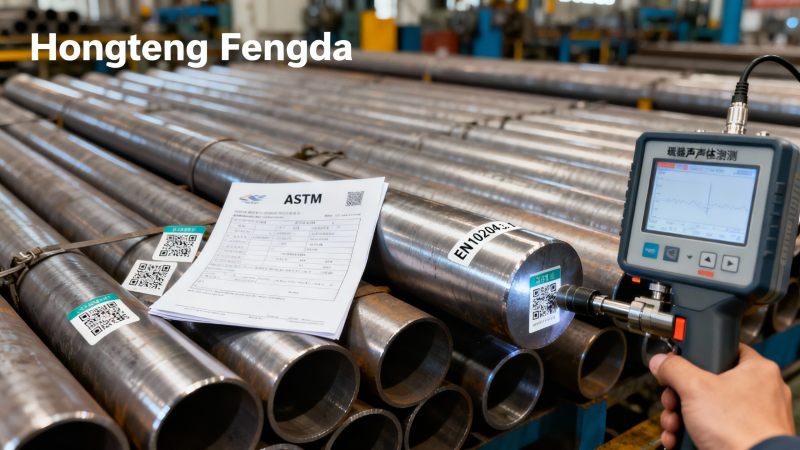
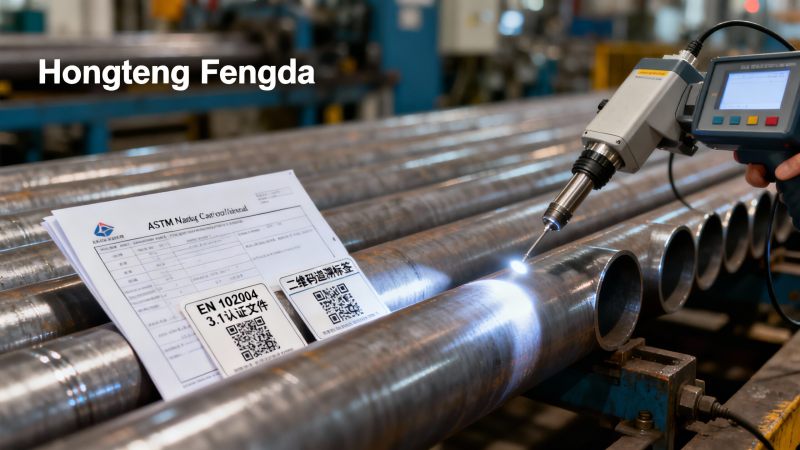
Compliance isn’t paperwork—it’s process discipline enforced at every touchpoint. A carbon steel pipe stockist may provide EN 10204 2.1 or 3.1 certificates, but those documents reflect the original mill’s output, not the stockist’s handling, storage conditions, or post-arrival verification. Corrosion during transit, mechanical damage from improper bundling, or mislabeling across batches are common pain points—and liability often falls on the end user. Hongteng Fengda embeds QA into production architecture: every heat undergoes ultrasonic testing (UT) per ASTM A578, hydrostatic pressure testing at 1.5× design pressure, and visual inspection under ISO 13920 geometric tolerances. Crucially, our internal QA lab is accredited to ISO/IEC 17025, enabling in-house validation of tensile strength, impact toughness (Charpy V-notch at −20°C), and chemical composition (OES analysis). All certifications carry our mill ID, heat number, and unique QR-coded traceability—scannable on-site to retrieve full manufacturing history. This level of assurance is indispensable for regulated sectors: North American refinery upgrades require API RP 578 compliance for material verification, while EU construction mandates CE marking under EN 1090-2 with DoP (Declaration of Performance). Choosing a manufacturer means aligning procurement with regulatory readiness—not retrofitting compliance after delivery.
Supply Chain Resilience: Predictability Over Expediency
In today’s volatile commodity environment, “fast” doesn’t equal “reliable.” A carbon steel pipe stockist may promise 5-day delivery—but only if inventory matches your exact spec, and only until geopolitical disruptions, port congestion, or sudden export restrictions intervene. Their supply chain is inherently fragmented: dependent on third-party mills, freight forwarders, and customs brokers—none under unified contractual governance. Hongteng Fengda operates with dual-sourcing resilience: dual iron ore suppliers (Australia + Brazil), redundant billet casting lines, and dedicated container slots on key Asia–Europe and Asia–US shipping lanes. Our production planning uses real-time ERP integration with global steel indices and freight rate APIs, allowing dynamic lead-time adjustments communicated proactively—not reactively. For a 1,200-ton order destined for a Southeast Asian wind farm, we guaranteed delivery within 20 days—including bonded warehouse release, CIQ inspection, and FOB Qingdao documentation—by synchronizing rolling schedules with vessel departure windows. That predictability avoids idle labor costs, prevents penalty clauses in EPC contracts, and ensures just-in-sequence delivery to prefabrication yards. ROI isn’t just saved dollars—it’s avoided downtime, contractual penalties, and reputational risk.
Strategic Partnership vs. Transactional Sourcing: The Long-Term Value Curve
Procurement decisions echo across project lifecycles. A transactional relationship with a carbon steel pipe stockist delivers short-term convenience but rarely evolves into engineering collaboration. Conversely, partnering with an integrated structural steel manufacturer unlocks lifecycle advantages: co-engineering support during design review (e.g., optimizing pipe-to-beam connections for seismic loads), joint development of corrosion-resistant coatings for aggressive environments, or shared investment in tooling for high-volume OEM components. Hongteng Fengda maintains technical teams fluent in ASTM, EN, and GB standards—capable of reviewing P&IDs, stress analysis reports, and welding procedure specifications (WPS) to preempt field-fit issues. We’ve collaborated with European engineering firms to redesign pipe support brackets using finite element analysis (FEA), reducing material weight by 18% without compromising ASME B31.4 integrity requirements. Such partnerships compress time-to-commissioning, lower total ownership cost, and position buyers as innovation enablers—not just commodity takers. For enterprise buyers managing multi-year capital programs, this strategic alignment compounds ROI across portfolios—not just per order.
Ultimately, ROI in bulk carbon steel procurement balances immediate cost, long-term risk, and operational certainty. While a carbon steel pipe stockist serves well for urgent, low-risk replacements, global industrial and construction projects demand deeper integration, stricter accountability, and engineered consistency. Hongteng Fengda combines modern manufacturing capacity, international compliance mastery, and responsive partnership to transform structural steel sourcing from a cost center into a competitive advantage. Whether you’re specifying carbon steel pipe for offshore platforms or coordinating Structural Steel I Beam for high-rise frameworks, our team delivers certified quality, predictable timelines, and scalable solutions—backed by 15+ years of verified performance across six continents. Request your tailored bulk procurement proposal today—complete with mill test reports, dimensional validation data, and logistics scheduling.
Related recommendations
 How much does 2 inch ss pipe price increase when upgrading from Schedule 40 to Schedule 80 for high-pressure systems?2 inch ss pipe price increases 18–35% when upgrading from Sch 40 to Sch 80—discover why, when it’s truly needed, and how to avoid overpaying.
 Which 304 stainless steel coil suppliers meet ISO 9001 and EN 10088-2 for food-grade fabrication?Discover verified 304 stainless steel coil suppliers meeting ISO 9001 & EN 10088-2 for food-grade fabrication—traceable, audited, and ready for regulatory validation.
 How does 2 inch ss pipe price compare between 304 and 316 grades for marine environments?2 inch ss pipe price varies significantly between 304 and 316 — but in marine environments, choosing 304 risks costly failures. Discover why 316 is the true value choice.
 Is 20 feet square pipe price affected more by raw material volatility or regional logistics costs?20 feet square pipe price is driven primarily by raw material volatility—not logistics. Discover why billet costs dominate pricing & how to forecast smarter with Hongteng Fengda.
Please give us a message


Please enter what you want to find