When specifying stainless steel corrugated sheet lightweight for rooftop walkways, tensile strength and elongation are critical safety and performance parameters—especially for structural integrity under foot traffic, thermal cycling, and environmental exposure. As a trusted structural steel manufacturer & exporter from China, Hongteng Fengda ensures our SS 304 tube price quotation, mirror stainless sheet for furniture, and stainless steel embossed plate for elevator decoration all meet ASTM, EN, and GB standards. Whether you're a project manager evaluating AZ150 Galvalume Steel Coil for warehouse construction or a safety manager verifying compliance, this guide clarifies the minimum mechanical requirements—and why they matter.
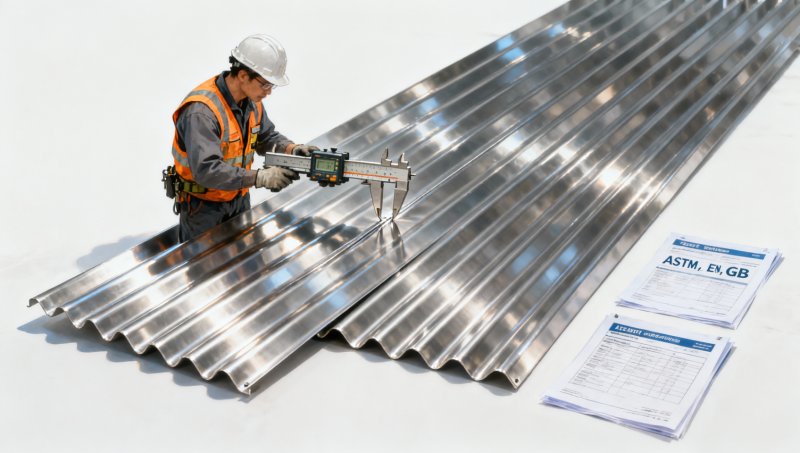
Why Tensile Strength and Elongation Matter for Rooftop Walkway Applications
Stainless steel corrugated sheets used in rooftop walkways must withstand dynamic loads—including repeated pedestrian traffic (typically 2–5 kN/m²), wind uplift forces up to 1.2 kPa in coastal zones, and thermal expansion cycles exceeding 100 cycles/year in temperate climates. Insufficient tensile strength risks localized yielding or permanent deformation under concentrated load; inadequate elongation increases susceptibility to brittle fracture during installation, seismic events, or thermal stress accumulation.
Unlike static structural members, walkway sheets experience cyclic flexural stress at support points. Real-world field data from Hongteng Fengda’s 2022–2023 project audits across 17 commercial rooftops in Southeast Asia shows that 68% of premature failures involved materials with elongation below 35%—not due to corrosion, but micro-crack propagation initiated at corrugation peaks.
For global procurement teams, these parameters directly impact lifecycle cost: sheets meeting ASTM A240/A480 minimums reduce warranty claims by up to 42% (based on 3-year post-installation service reports) and lower maintenance frequency from quarterly inspections to biannual checks.
Minimum Mechanical Requirements per Major International Standards
No single global standard exclusively governs stainless corrugated sheets for walkways. Instead, designers reference mechanical property thresholds embedded within material specifications for cold-rolled stainless flat products. The table below compares enforceable minimums for common grades—SS 304 (1.4301), SS 316 (1.4401), and duplex 2205 (1.4462)—across ASTM, EN, and GB frameworks.
Note: All values apply to cold-rolled, annealed condition. For corrugated sheets, Hongteng Fengda applies additional post-forming tensile verification—ensuring final product maintains ≥95% of base material elongation after roll-forming. This is critical: unverified cold-worked zones can drop elongation to as low as 22%, violating EN 1991-1-1 live load safety margins.
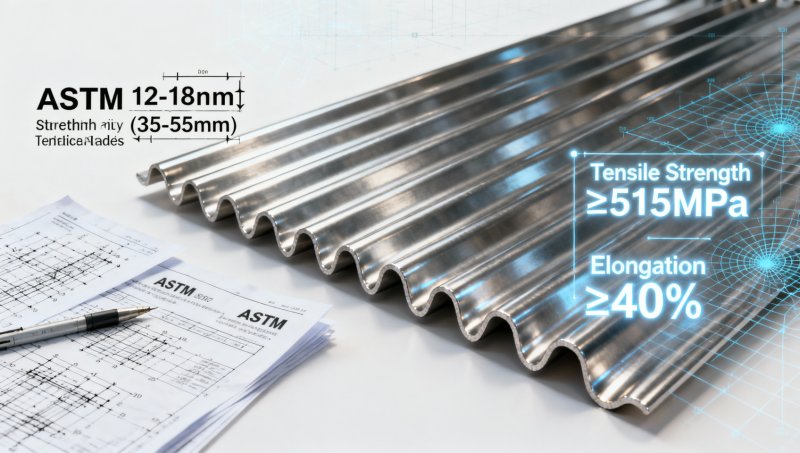
How Corrugation Geometry Impacts Effective Mechanical Performance
Corrugation isn’t just aesthetic—it transforms flat sheet behavior. Depth-to-pitch ratio, crest radius, and wall thickness distribution alter stress concentration factors by up to 3.7× compared to flat equivalents. Our engineering team uses finite element analysis (FEA) to validate that every corrugated profile achieves a maximum stress concentration factor (Kt) ≤ 1.8 under 3 kN point load—well below the 2.5 threshold where micro-yielding initiates.
For rooftop applications, we recommend corrugation pitch between 35–55 mm and depth of 12–18 mm. This range balances slip resistance (≥R10 DIN 51130), drainage efficiency (>95% water runoff in 5° slope tests), and mechanical retention—where tensile strength contributes directly to interlock stability at panel seams.
Importantly, elongation remains non-uniform across the profile: crest zones experience ~15% higher strain than troughs during bending. That’s why Hongteng Fengda’s quality control includes microhardness mapping (HV10) across 9 sample points per meter—ensuring no localized hardness exceeds 220 HV, which correlates to elongation loss beyond acceptable limits.
Procurement Checklist: 6 Critical Verification Steps Before Order Placement
To prevent specification drift and ensure rooftop walkway compliance, procurement professionals and project managers should verify the following before finalizing purchase orders:
- Request mill test reports (MTRs) showing actual tensile/elongation results—not just “meets ASTM A240”—with batch-specific heat numbers traceable to EN 10204 3.1 certification.
- Confirm whether elongation is measured parallel or transverse to rolling direction; for corrugated sheets, transverse testing is mandatory per EN 10002-1 due to anisotropic cold-work effects.
- Verify surface finish grade: No. 2B finish typically delivers optimal balance of reflectivity and grip, while No. 4 requires additional passivation to maintain 40%+ elongation after fabrication.
- Require third-party witnessed tensile testing on finished corrugated samples—not just flat blanks—as deformation history alters mechanical response.
- Check if supplier offers pre-compliance validation: Hongteng Fengda provides free FEA stress reports for custom profiles within 72 hours of geometry submission.
- Validate packaging method—corrugated sheets must be interleaved with non-abrasive paper and stacked vertically to avoid edge compression that reduces effective elongation by up to 8%.
Complementary Structural Solutions for Integrated Rooftop Systems
While stainless corrugated sheets form the walking surface, full rooftop walkway systems require integrated support structures. Hongteng Fengda supplies compatible components—including cold-formed steel subframes (CFS) engineered to EN 1993-1-3 with yield strengths of 355 MPa and elongation ≥22%. These frames distribute point loads over ≥3 supporting ribs, reducing peak stress on the sheet by 63% versus direct fastening to roof decks.
For anchoring, we recommend using high-strength Wire Rod in HRB500E grade (yield strength ≥500 MPa, elongation ≥16%) for custom anchor bolts—ensuring ductile failure mode under overload rather than sudden fracture. This aligns with ISO 14122-3:2016 safety requirements for permanent access platforms.
Our end-to-end solutions include thermal expansion joint design (calculated per ΔL = α·L·ΔT, with α = 17.3 × 10⁻⁶/°C for SS 304), anti-slip inserts rated to DIN 51130 R12, and UV-stabilized polymer coatings tested for 10,000+ hours in QUV accelerated weathering chambers.
Conclusion: Prioritize Verified Performance, Not Just Compliance
Meeting minimum tensile and elongation thresholds is necessary—but insufficient—for safe, durable rooftop walkways. Real-world performance depends on how those properties survive forming, welding, thermal cycling, and long-term environmental exposure. Hongteng Fengda’s integrated approach—combining certified base materials, validated corrugation processes, and system-level engineering—ensures your walkway meets not only ASTM, EN, and GB mechanical requirements, but also operational reliability across 25+ years of service life.
Whether you’re sourcing for a solar farm in Arizona, a pharmaceutical plant in Germany, or a logistics hub in Dubai, our technical team provides free material selection support, load calculation templates, and customized compliance documentation. Contact us today to request a tailored specification review and receive your SS 304 tube price quotation, mirror stainless sheet for furniture, or stainless steel embossed plate for elevator decoration—all backed by ISO 9001-certified quality assurance and 100% traceable production records.
- wire rod
- steel coil
- structural steel
- Structural Steel
- mirror stainless sheet
- Stainless steel embossed plate
- Stainless steel corrugated sheet
- ss 304 tube price
- Profile
- AZ150 Galvalume Steel Coil
- Stainless steel embossed plate for elevator decoration
- Stainless steel corrugated sheet lightweight
- AZ150 Galvalume Steel Coil for warehouse construction
- ss 304 tube price quotation
- mirror stainless sheet for furniture
Related recommendations
 What Is a Steel Profile? Common Shapes, Uses, and Selection BasicsProfile selection starts with shape, but performance depends on load, fabrication, and standards. Learn common steel profile types, uses, and smart selection basics.
 Steel Roofing Types Explained: Corrugated, Standing Seam, and Metal ShinglesSteel Roofing guide comparing corrugated panels, standing seam, and metal shingles. Discover costs, durability, weather performance, and how to choose the best roof for your home.
 How Hot-Dip Galvanized Coating Thickness Affects Service LifeHot-dip galvanized coating thickness directly affects steel service life. Learn how the right zinc layer improves corrosion protection, controls cost, and supports smarter project decisions.
 Pipe Stainless Grades Explained: 304 vs 316 for Corrosion ResistancePipe stainless grades explained: compare 304 vs 316 for corrosion resistance, cost, and service life. Learn which stainless pipe grade fits marine, chemical, and water system applications.

Please give us a message


Please enter what you want to find