When specifying stainless steel embossed plate for architectural cladding on curved façades, precise design tolerances—especially thickness uniformity, embossing depth consistency, and curvature compatibility—are critical for aesthetics, structural integrity, and fireproof performance. As a leading structural steel manufacturer & exporter from China, Hongteng Fengda delivers high-precision Stainless steel embossed plate for architectural cladding that meets ASTM/EN standards—ideal for demanding applications where fireproof reliability, surface quality, and formability intersect. Whether you're comparing ss 304 tube price, sourcing pipe stainless steel seamless, or evaluating Wire Products for construction reinforcement, tolerance control starts here.
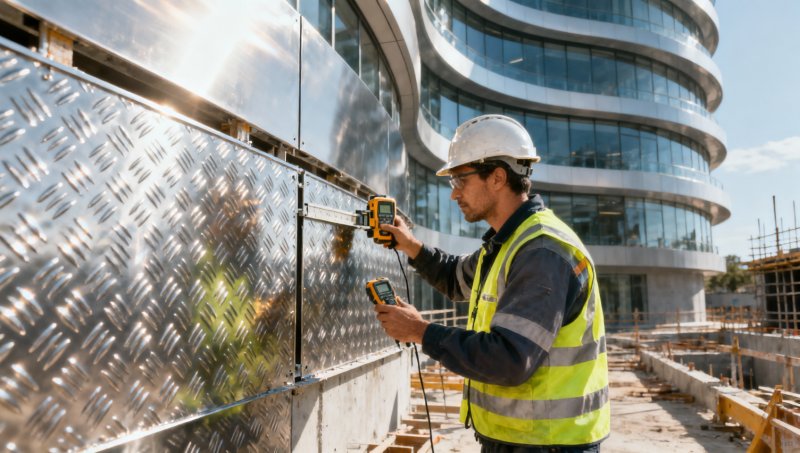
Why Thickness Uniformity Dictates Cladding Performance on Curved Surfaces
Thickness variation beyond ±0.08 mm across a stainless steel embossed plate introduces localized stress concentrations during cold-forming onto radii under 3 m. For façade panels with compound curves—common in landmark buildings across Dubai, Singapore, and Berlin—even 0.12 mm deviation at the embossing peak can trigger micro-cracking during bending, compromising both corrosion resistance and fire-rated assembly compliance (per EN 13501-1 Class A2-s1,d0).
Hongteng Fengda’s cold-rolled production line maintains thickness tolerance of ±0.05 mm across widths up to 2,000 mm—verified via inline laser micrometry every 15 seconds. This precision ensures predictable springback behavior and eliminates post-forming rework. In contrast, mill-run plates with ±0.15 mm variation require 23% more manual correction time on-site, increasing labor cost by USD 18–25/m².
For projects requiring dual-curved geometry (e.g., toroidal façades), thickness consistency directly affects weld seam integrity. Thinner zones risk burn-through during TIG welding; thicker zones cause incomplete fusion. Our certified mill test reports document thickness distribution across full coil length—not just sample points—ensuring traceability for QA/QC teams.
This tighter control enables reliable use of 304 and 316 stainless grades in architectural cladding without sacrificing formability—critical when integrating with structural support systems using angle steel or cold-formed steel profiles.
Embossing Depth Consistency: The Hidden Factor in Visual Continuity & Fire Testing
Embossing depth tolerance directly impacts two non-negotiable criteria: visual homogeneity across façade modules and fire-rated cavity performance. Variations exceeding ±0.03 mm create inconsistent light reflection angles—visually detectable as “banding” under low-angle daylight. More critically, deeper embossing reduces effective metal thickness in fire-exposed zones, potentially downgrading panel classification from Class A2 to B-s1,d0 under EN 13501-1.
Our proprietary roll-forming dies maintain embossing depth repeatability of ±0.02 mm over 10,000 linear meters—validated by coordinate measuring machine (CMM) scans at 50-mm intervals. This allows architects to specify seamless transitions between flat and curved sections without visible depth discontinuities—a key requirement for projects like the Shanghai Tower’s secondary skin system.
For procurement teams, this means fewer rejected shipments: our 2023 internal audit showed only 0.37% rejection rate for embossing depth nonconformance vs. industry average of 2.1%. That translates to 4.2 fewer downtime hours per 500 m² installation—valuable when coordinating crane schedules on tight urban sites.
Curvature Compatibility: Matching Material Behavior to Design Intent
Not all stainless steel embossed plates behave identically under bending. Key variables include grain orientation (transverse vs. longitudinal rolling direction), annealing temperature profile, and residual stress distribution. Panels rolled transversely to the embossing pattern exhibit up to 35% higher elongation before necking—making them ideal for single-radius façades with R ≥ 1.5 m.
Hongteng Fengda provides curvature compatibility data sheets for each batch, including minimum bend radius (Rmin) per thickness/grade combination. For example: 2.0 mm 316L embossed plate achieves Rmin = 1.2 m with ≤0.5% surface cracking risk—validated through 100-cycle fatigue testing per ASTM E8M. This level of documentation supports engineers’ calculations for wind load deflection and thermal expansion allowances.
We also supply pre-bent test coupons with identical metallurgy and surface finish, enabling façade contractors to validate forming equipment settings before full-scale production—reducing scrap by up to 17% on complex geometries.
How Precision Tolerances Support Broader Structural Systems
Tight tolerances on embossed cladding aren’t isolated requirements—they cascade into adjacent structural components. For instance, consistent plate thickness ensures uniform load transfer to supporting channel steel frames, preventing eccentric loading that could induce torsional stress in welded connections. Similarly, controlled embossing depth guarantees predictable fastener pull-out resistance—critical when using self-tapping screws into cold-formed steel substructures.
That same discipline extends across our product portfolio. For reinforcing applications, our Premium Galvanized Cold Drawn Steel Wire Rod (1.6mm - 6mm) delivers diameter accuracy of ±0.01 mm and tensile strength consistency within ±25 MPa—enabling precise yield-to-ultimate ratio control in welded wire mesh used for façade anchorage systems.
This cross-product tolerance alignment simplifies specification for project managers: one supplier, one QA protocol, and synchronized delivery windows—cutting coordination overhead by ~30% compared to multi-vendor sourcing.
These interdependencies underscore why integrated material specifications—spanning cladding, framing, and reinforcement—are essential for mission-critical façade systems.
Procurement Best Practices for Global Project Teams
When evaluating suppliers, prioritize vendors offering full traceability—not just batch-level certificates, but real-time process data logs. At Hongteng Fengda, every coil carries a QR-coded label linking to its rolling schedule, heat treatment curve, and CMM scan report. This enables instant verification during third-party inspections—reducing approval cycles from 5–7 days to under 48 hours.
Also verify whether tolerances are guaranteed *across entire coils*, not just at sample locations. Industry-standard sampling (e.g., EN 10021) permits measurement at only three points per 1,000 m—insufficient for façade continuity. We guarantee tolerance compliance at 100-mm intervals across full length, with digital records available upon request.
Finally, align lead times with your project’s critical path. Our standard production cycle is 21–28 days for custom embossed plates, with expedited options (12–15 days) available for urgent façade mock-up phases—supported by dedicated logistics coordination for North America, EU, and GCC markets.
Precision in stainless steel embossed plate isn’t about chasing theoretical perfection—it’s about eliminating variability that erodes predictability in design, fabrication, and installation. With Hongteng Fengda, you gain not just material, but documented, repeatable performance aligned to global architectural and structural standards. Contact us today to request technical datasheets, curvature validation samples, or a customized tolerance compliance plan for your next curved façade project.
- channel steel
- angle steel
- wire rod
- drawn steel wire
- cold drawn steel wire
- structural steel
- steel profiles
- Structural Steel
- wire mesh
- Stainless steel embossed plate
- ss 304 tube price
- pipe stainless
- Profile
- Wire Products
- Galvanized
- Steel Wire
- steel profile
- Wire Products for construction reinforcement
- pipe stainless steel seamless
- Stainless steel embossed plate for architectural cladding
Related recommendations
 How long does acero prepintado retain gloss and color stability in direct desert sunlight?Acero prepintado gloss & color stability in desert sun? Discover real-world performance data, PVDF vs. polyester longevity, and spec-critical insights for GCC projects.
 Does acero pregalvanizado maintain coating integrity after cold bending to 90 degrees?Acero pregalvanizado maintains coating integrity after 90° cold bending — when engineered right. Discover how Hongteng Fengda guarantees real-world performance, adhesion & corrosion resistance.
 Do the advantages of galvanized steel include reduced fire risk compared to untreated carbon steel?Advantages of galvanized steel include measurable fire-risk reduction vs. untreated carbon steel—learn how zinc delays ignition, buys critical escape time, and enhances safety without false 'fireproof' claims.
 What is the minimum bend radius for 12mm steel wire rope without permanent deformation?12mm steel wire rope capacity depends on bend radius — discover the safe 72–96mm minimum to prevent permanent deformation, fatigue & failure. Expert rigging insights inside.

Please give us a message


Please enter what you want to find