When acero prepintado—pre-painted steel sheet commonly used in architectural cladding, roofing, and industrial enclosures—is exposed to direct desert sunlight, two performance metrics dominate engineering and procurement decisions: gloss retention and color stability. Unlike temperate or coastal environments, the desert combines extreme UV intensity (up to 1.5× higher annual irradiance than Mediterranean zones), thermal cycling (surface temperatures regularly exceeding 70°C), low humidity (reducing wash-off of surface contaminants but accelerating photo-oxidation), and abrasive dust loading. Under these conditions, conventional polyester-coated acero prepintado may begin showing measurable degradation within 12–18 months—not as catastrophic failure, but as progressive, visually detectable loss of reflectivity and hue fidelity.
Gloss decay is rarely linear—and rarely starts where you expect
Gloss loss in desert-exposed acero prepintado typically follows a three-phase curve: an initial “stabilization” phase (0–6 months), during which surface volatiles evaporate and minor micro-scratches from sand abrasion appear; a rapid-decay phase (6–30 months), where UV-driven polymer chain scission dominates; and a plateau phase (beyond 3 years), where remaining gloss stabilizes at 40–60% of original value—depending heavily on coating type, film thickness, and substrate pretreatment.
This is not theoretical. Accelerated weathering per ASTM D4303 (for pigment fade) and ISO 2812-2 (for gloss retention) shows that standard 20–25 μm polyester coatings lose ~35–45% of initial 60° gloss within 2,000 hours of QUV-B exposure—equivalent to roughly 18–24 months of real-time Gulf Cooperation Council (GCC) desert exposure. In contrast, high-performance PVDF-based systems (e.g., 70% PVDF + acrylic blends, minimum 25 μm dry film thickness) retain >75% gloss after 4,000 hours—projecting 5+ years before gloss falls below 60% of baseline under identical conditions.
Critical nuance: gloss loss isn’t uniform across panel geometry. Flat, horizontal surfaces degrade fastest—not because of UV angle, but due to thermal soak and dust accumulation. Vertical façades often retain gloss longer, but suffer more from wind-driven sand impact, leading to localized micro-scratching that diffuses light without reducing measured gloss values significantly. That’s why visual inspection alone can mislead: a panel may still read 70% gloss on a gloss meter yet appear visibly chalky or dull under midday sun.
Color shift is more predictable—but less forgiving
While gloss loss reflects physical coating breakdown, color stability hinges on pigment chemistry and UV absorber package integrity. Organic pigments—especially reds, oranges, and some yellows—are most vulnerable. In desert testing, RAL 3020 (traffic red) and RAL 1015 (light ivory) show ΔE*ab shifts >3.0 (just perceptible to trained observers) within 12 months on standard polyester. By 36 months, ΔE often exceeds 8.0—well beyond acceptable thresholds for architectural specification (typically ΔE < 2.0 for critical façades).
Inorganic pigments—iron oxides, titanium dioxide, and complex inorganic colored pigments (CICPs)—perform markedly better. RAL 7016 (anthracite grey) and RAL 7021 (black brown), when formulated with optimized UV stabilizers and applied over chromated or zinc-iron passivated substrates, maintain ΔE < 2.5 even after 5 years of direct exposure in Riyadh or Abu Dhabi. But this assumes consistent application quality: uneven film thickness, poor curing, or substrate contamination during coil coating will accelerate fade regardless of pigment choice.
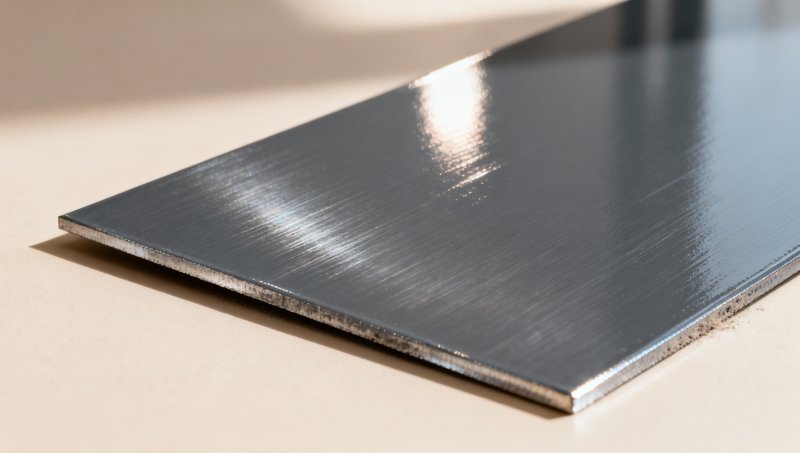
What “acero prepintado” really means on the ground
The term itself offers no performance guarantee. “Acero prepintado” is a functional descriptor—not a specification. It covers everything from low-cost, single-layer polyester-coated sheets (common in temporary site fencing or warehouse roofs) to premium, dual-layer PVDF systems with corrosion-inhibiting primers and anti-graffiti topcoats. The difference isn’t just price: it’s service life, maintenance frequency, and aesthetic liability.
For projects where appearance directly impacts brand perception—think airport terminals, corporate HQs, or hospitality façades—specifying only “acero prepintado” invites risk. What matters is the full system: substrate grade (e.g., hot-dip galvanized vs. Galvalume®), pretreatment (chromate vs. chrome-free zirconium), primer type and thickness (epoxy vs. polyurethane), topcoat resin (polyester vs. SMP vs. PVDF), total coating thickness (measured per ISO 2808), and compliance with regional durability benchmarks like GSB (Global Standards Board) Class C4 or Qualicoat Class 3.
Even then, local installation practices matter. Panels cut onsite with unsealed edges, fastened with non-compatible screws, or installed without proper thermal expansion gaps will see accelerated edge corrosion—creating dark halos that undermine perceived color stability long before the field area fades.
When pre-painted steel isn’t the answer—even in the desert
There are scenarios where gloss and color stability become secondary to structural or functional demands. For example, ventilation screens, filtration housings, or chemical process enclosures in arid industrial zones require not just UV resistance, but sustained resistance to acid mist, alkaline cleaning agents, or abrasive particulates. In those cases, bare stainless steel—particularly 316 grade—often delivers superior long-term value despite higher initial cost. Its passive oxide layer regenerates continuously, eliminating concerns about coating adhesion loss, chalking, or color matching over time. 316 Stainless Steel Welded Mesh is routinely specified for such applications across oil & gas facilities in Oman and solar thermal plants in Morocco—not for its appearance, but for its immunity to the very mechanisms that degrade painted surfaces.
Practical selection guidance
If your project requires acero prepintado in direct desert sunlight:
- Avoid generic “pre-painted steel” specs. Require full coating system data: resin type, pigment classification (organic/inorganic), minimum dry film thickness per layer, and third-party test reports against ASTM D4303 (for color) and ASTM D523/D5894 (for gloss and corrosion).
- Prefer PVDF or high-SMP systems for façades. Polyester is acceptable for non-visible structural elements (e.g., soffits, concealed supports) where maintenance access is easy and aesthetics are secondary.
- Verify substrate compatibility. Galvalume® (55% Al-Zn) outperforms pure zinc-coated steel in high-heat, low-humidity UV exposure—but only if the primer is specifically formulated for aluminum-rich substrates.
- Factor in logistics and handling. Desert sites often lack climate-controlled storage. Pre-painted coils or panels left uncovered for weeks develop micro-condensation cycles overnight, promoting intercoat delamination before installation even begins.
Ultimately, gloss and color stability aren’t abstract metrics—they’re proxies for coating integrity. When either degrades significantly, the underlying corrosion protection is likely compromised. So the question isn’t just “how long will it look good?” but “how long will it protect?” And that timeline depends far less on geography than on how precisely the material was engineered, tested, and applied for the environment it faces.
Please give us a message


Please enter what you want to find