In sour service environments across the oil and gas industry, material integrity is non-negotiable — which is why stainless steel metal plates for oil and gas industry increasingly specify duplex 2205 over conventional 316L. As a trusted stainless steel plate manufacturer in Southeast Asia and flat plate stainless steel supplier in Middle East, Hongteng Fengda delivers high-performance duplex 2205 plates that resist chloride stress corrosion cracking, pitting, and sulfide stress cracking far better than 316L. Whether you're sourcing stainless flat plate for chemical processing, flat plate stainless steel for architectural design, or ss sheets price per ton comparisons, this article reveals why 2205 is the engineered choice — backed by ASTM/EN-compliant quality and global supply reliability.
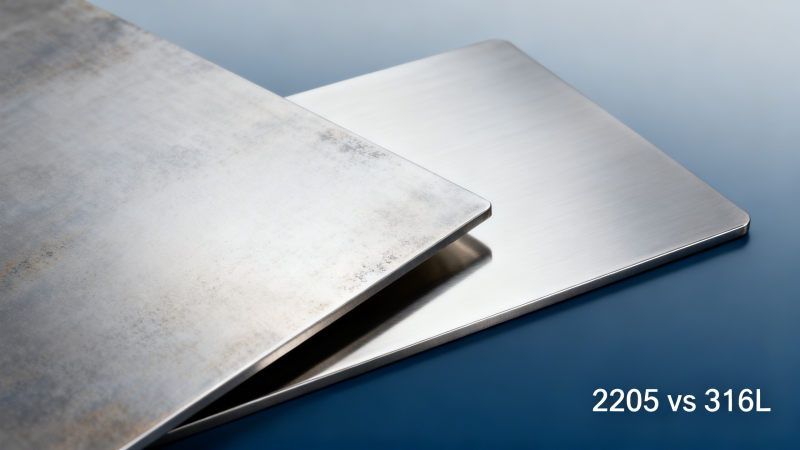
Why Sour Service Demands More Than Standard Austenitic Grades
Sour service refers to environments containing hydrogen sulfide (H₂S), often combined with chlorides, moisture, and elevated temperatures—common in upstream production, subsea pipelines, and acid gas treatment units. In such conditions, standard austenitic stainless steels like 316L face critical limitations: their Cr–Ni–Mo composition provides only moderate resistance to sulfide stress cracking (SSC) and localized corrosion. Field data shows that 316L fails under H₂S partial pressures exceeding 0.05 psi at pH < 4.5 and temperatures above 60°C—conditions routinely encountered in Gulf of Mexico, North Sea, and Middle Eastern fields.
Duplex 2205, by contrast, combines ~22% Cr, 5–6% Ni, 3.0–3.5% Mo, and 0.14–0.20% N, delivering a balanced microstructure of ~50% austenite + ~50% ferrite. This dual-phase structure enhances mechanical strength (yield strength ≥ 450 MPa—nearly double that of 316L) while significantly raising the threshold for SSC initiation. According to NACE MR0175/ISO 15156-3, 2205 qualifies for use in sour service up to 1.0 MPa H₂S partial pressure at 95°C—making it suitable for high-pressure, high-temperature (HPHT) applications where 316L is strictly prohibited.
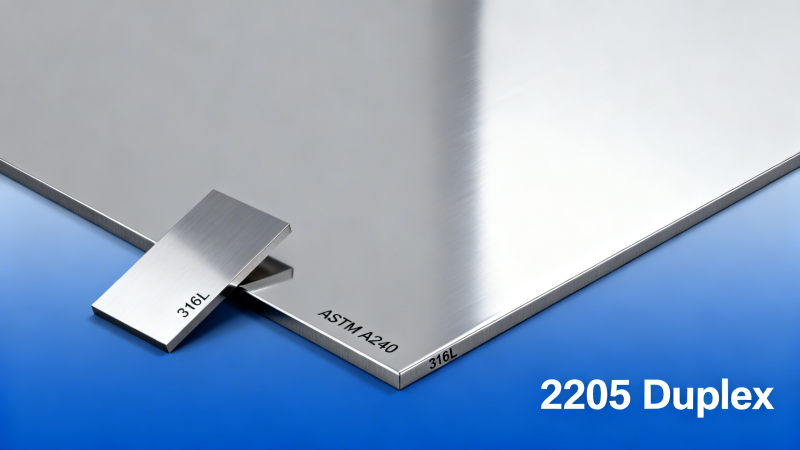
Hongteng Fengda produces ASTM A240/A480-compliant duplex 2205 plates with strict thermal history control during hot rolling and solution annealing (1020–1100°C followed by rapid water quenching). Every heat lot undergoes ferrite content verification via magnetic permeability testing (target range: 40–50% ferrite), ensuring consistent phase balance and corrosion resistance.
Corrosion Resistance Comparison: Quantifying the Performance Gap
The performance divergence between 2205 and 316L becomes evident under accelerated laboratory testing. In ASTM G48 Method A (ferric chloride pitting test), 2205 exhibits a critical pitting temperature (CPT) of ≥ 35°C—compared to just 22°C for 316L. For chloride stress corrosion cracking (CSCC), ASTM G36 testing shows 2205 withstands 40% CaCl₂ solution at 100°C for >1,000 hours without failure, whereas 316L cracks within 24–48 hours under identical conditions.
This table underscores a decisive engineering advantage: 2205 delivers not just incremental improvement—but an order-of-magnitude leap in environmental tolerance. For procurement teams evaluating lifecycle cost, the higher initial plate cost (typically 20–30% premium over 316L) is offset by extended inspection intervals, reduced downtime, and elimination of premature replacement—translating to 35–50% lower total cost of ownership over 20 years.
Beyond Plates: Integrated Material Solutions for Oil & Gas Projects
Hongteng Fengda supports full-system integrity—not just base plate supply. Our structural steel manufacturing capabilities include precision cutting, edge machining (beveling to ASME B16.25), and certified welding procedure qualification (WPQR) per AWS D1.1 and ISO 15614-1. We regularly supply 2205 plates in thicknesses from 6 mm to 100 mm, widths up to 3,000 mm, and lengths up to 12,000 mm—all traceable to mill test reports (MTRs) with full chemical and mechanical certification.
For auxiliary components exposed to similar aggressive media—such as filtration housings, strainer baskets, or process screens—we recommend complementary solutions like 316 Stainless Steel Welded Mesh. Its 316-grade wire offers superior resistance to acid, alkali, and chemical corrosion across mesh counts from 2 to 635, with open area ranging from 25% to 84.6%—ideal for high-efficiency separation in amine units or desalting systems.
Our regional logistics hubs in Dubai and Singapore enable lead times of 7–15 days for standard 2205 plates, with OEM-specific configurations delivered within 4–6 weeks. All shipments comply with EN 10204 3.1 certification requirements and include dimensional inspection reports, ultrasonic testing (UT) records (to EN 10160 S3 class), and positive material identification (PMI) verification.
Procurement Best Practices for Duplex Stainless Steel
Selecting the right duplex plate supplier involves more than price comparison. Buyers should verify four key criteria:
- Mill source transparency: Confirm direct supply from certified mills (e.g., Outokumpu, Acerinox, or domestic producers meeting ASTM A240 Annex A)
- Thermal processing documentation: Require full heat treatment records—including soak time, temperature profile, and quench medium
- Ferrite content validation: Insist on third-party verification (e.g., Fischer MP30 or MagneGage) with results reported per ASTM E562
- Weldability assurance: Verify availability of matching filler metals (e.g., ER2209) and prequalified WPS for common joint types (butt, fillet, T-joint)
Hongteng Fengda maintains ISO 9001:2015-certified quality management systems and conducts 100% ultrasonic testing on plates ≥ 20 mm thick. Our technical team provides free pre-order engineering review—including weld joint design support and corrosion modeling for specific field chemistry profiles.
Frequently Asked Questions
What thickness tolerances apply to ASTM A240 duplex 2205 plates?
Per ASTM A240 Table 2, thickness tolerance for plates ≤ 25 mm is ±0.3 mm; for 25–50 mm, it’s ±0.4 mm; and for >50 mm, ±0.5 mm. Hongteng Fengda holds tighter internal controls: ±0.2 mm for all plates ≤ 20 mm.
Can 2205 be used in seawater injection systems?
Yes—2205 is widely approved for seawater service up to 30°C, with CPT values confirming resistance to biofouling-induced crevice corrosion. For temperatures above 30°C or high-velocity flow (>3 m/s), super duplex grades (e.g., UNS S32750) are recommended.
How does Hongteng Fengda ensure consistency across large orders?
Each order is assigned a unique heat number. We batch-process plates from the same heat, perform inter-heat verification via spark emission spectroscopy, and retain physical samples for 5 years—ensuring full traceability and reproducibility across multi-continent deliveries.
Conclusion: Engineering Confidence Through Material Excellence
Duplex 2205 isn’t merely an alternative to 316L—it’s the performance benchmark for integrity-critical applications in sour service. Its superior resistance to pitting, SCC, and SSC directly translates into safer operations, longer asset life, and measurable CAPEX/OPEX optimization. As a structural steel manufacturer and exporter from China, Hongteng Fengda bridges global specification rigor with agile supply chain execution—delivering ASTM/EN-compliant 2205 plates with verified metallurgical consistency, rigorous NDT coverage, and responsive regional support.
Whether you’re specifying materials for a new FPSO module, upgrading a refinery desalter, or designing a modular skid system, partnering with a manufacturer that understands both metallurgical fundamentals and project delivery realities is essential. Contact Hongteng Fengda today to request a technical datasheet, review mill test reports for your next order, or consult our engineers on optimal grade selection for your specific H₂S/chloride exposure profile.
- steel supplier
- structural steel
- Structural Steel
- stainless steel plate
- stainless steel supplier
- ss plate
- ss steel plate
- stainless steel metal plates
- stainless flat plate
- flat plate stainless steel
- ss sheets price
- steel plate
- Profile
- Stainless Steel Welded Mesh
- flat plate stainless steel supplier in Middle East
- stainless flat plate for chemical processing
- stainless steel metal plates for oil and gas industry
- ss sheets price per ton
- flat plate stainless steel for architectural design
Related recommendations
 Stainless Coil Sourcing Pitfalls: How Surface Scratches, Residual Stress, and Intergranular Corrosion Risk Derail Critical Process LinesStainless coil sourcing pitfalls—surface scratches, residual stress & intergranular corrosion—can derail critical process lines. Avoid costly failures: discover proven mitigation strategies now.
 Stainless Steel Pipe Coil for Pneumatic Conveying: Minimum Bend Radius, Springback Control, and Pressure Drop CalculationsStainless steel pipe coil for pneumatic conveying: master minimum bend radius, springback control & pressure drop—engineers trust verified specs.
, and Testing Protocols") Why Steel Coil Pipe Fails in Offshore Environments: Corrosion Mechanisms, Material Upgrades (ASTM A106 vs. ASTM A312), and Testing ProtocolsSteel coil pipe failures offshore? Discover corrosion mechanisms, ASTM A106 vs. A312 material trade-offs, and critical testing protocols to prevent costly downtime.
Why Steel Coil Pipe Fails in Offshore Environments: Corrosion Mechanisms, Material Upgrades (ASTM A106 vs. ASTM A312), and Testing ProtocolsSteel coil pipe failures offshore? Discover corrosion mechanisms, ASTM A106 vs. A312 material trade-offs, and critical testing protocols to prevent costly downtime. What Is Stainless Steel 304 Coil? Key Properties, Grades, and Why It’s Preferred for Food & Pharma ApplicationsStainless steel 304 coil: corrosion-resistant, hygienic & FDA-compliant — ideal for food/pharma equipment. Discover why engineers trust it for CIP/SIP cycles.
Please give us a message


Please enter what you want to find