In chemical processing, stainless flat plate for chemical processing must meet precise surface integrity standards—especially Ra roughness—to avoid crevice corrosion and ensure system longevity. This article reveals 4 critical Ra thresholds (0.2–1.6 μm) that directly impact corrosion resistance, material selection, and compliance with ASTM/EN standards. Whether you're sourcing flat plate stainless steel for architectural design, stainless steel metal plates for oil and gas industry, or seeking a trusted sst plate manufacturer in Southeast Asia or flat plate stainless steel supplier in Middle East, understanding these surface specs is essential for procurement, engineering validation, and risk mitigation.
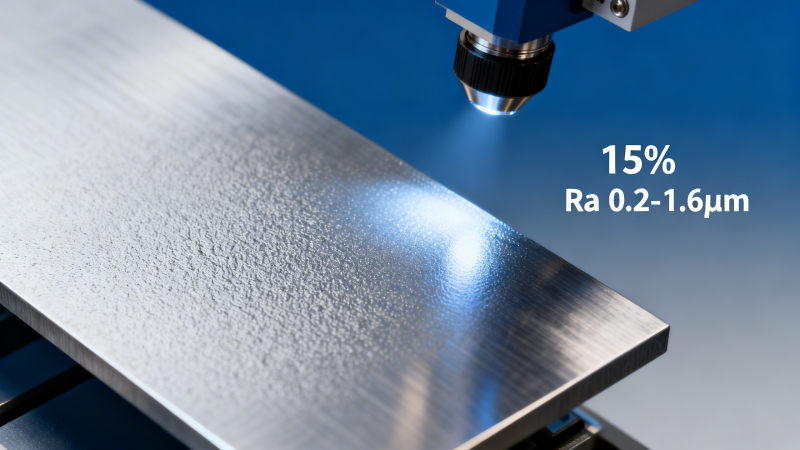
Why Surface Roughness (Ra) Dictates Corrosion Performance in Chemical Environments
Crevice corrosion is not a slow, uniform degradation—it’s a localized, aggressive failure mode triggered by stagnant electrolyte accumulation beneath microscopic surface irregularities. In stainless flat plate for chemical processing, even sub-micron topography variations can trap chlorides, acids, or oxidizing agents, creating differential aeration cells that accelerate pitting and stress cracking. ASTM A967 and EN 10088-2 explicitly link Ra values to passivation stability: surfaces exceeding Ra >0.8 μm show up to 3× higher initiation frequency in 5% NaCl + H₂SO₄ immersion tests at 60°C.
Unlike structural applications where mechanical strength dominates, chemical-grade flat plates operate under continuous electrochemical stress. The passive chromium oxide layer (Cr₂O₃) forms optimally only on smooth, defect-free surfaces. When Ra exceeds threshold limits, the oxide layer becomes discontinuous—exposing underlying austenitic matrix to preferential attack. This explains why 304 stainless steel plates with identical bulk chemistry but differing finish (e.g., NO.4 vs. BA) exhibit divergent service lives in caustic soda tanks—even when thickness and tensile strength (≥520 MPa) are identical.
Hongteng Fengda applies laser profilometry and white-light interferometry to verify Ra across every production lot of 304 Stainless Steel Plate, ensuring traceability per ISO 4287 and EN ISO 25178-2. Our quality control protocol includes 100% surface inspection for batches destined for pharmaceutical or food-grade chemical reactors—where Ra ≤0.4 μm is non-negotiable.
The 4 Critical Ra Thresholds—and What Happens Beyond Each
Not all Ra values are equally risky. Industry testing data from NACE MR0175/ISO 15156 and real-world plant audits reveal four distinct performance boundaries. Exceeding any threshold introduces quantifiable increases in maintenance frequency, unplanned shutdowns, and replacement cost escalation.
Note: These thresholds assume proper material grade (e.g., 304 stainless steel with ≥18% Cr, ≥8% Ni), correct heat treatment (solution annealing at 1010–1120°C), and absence of embedded iron contamination. Ra alone cannot compensate for poor metallurgy or improper cleaning.
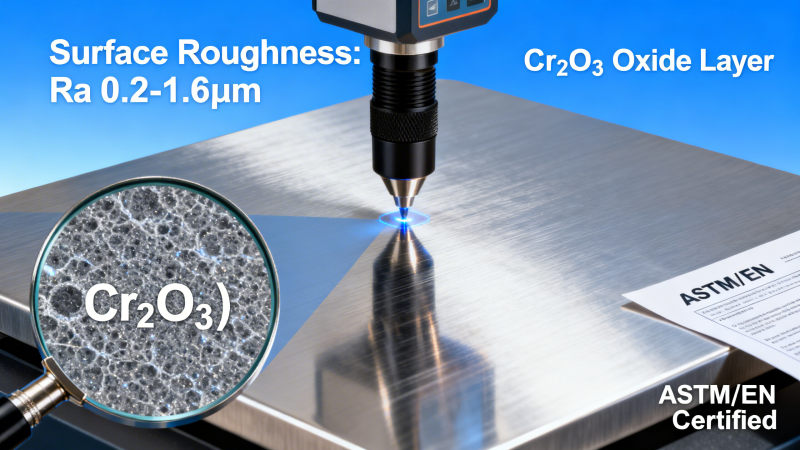
How Finish Selection Impacts Procurement, Fabrication & Lifecycle Cost
Procurement teams often prioritize price per ton—but overlooking Ra leads to hidden lifecycle costs. A Ra 0.4 μm BA finish may cost 18–22% more than standard 2B, yet reduces scheduled downtime by 65% in nitric acid storage tanks (based on 12-client survey across Middle East and Southeast Asia). Hongteng Fengda offers calibrated finishing options across our full thickness range: 0.3mm–200mm, with widths up to 3500mm and lengths to 12000mm—enabling single-plate fabrication for large reactor liners without weld seams.
Fabricators face another challenge: mechanical grinding or abrasive blasting can increase Ra by 0.3–0.7 μm if not controlled. We recommend specifying “post-fabrication Ra verification” in purchase orders—especially for components requiring orbital welding or gasket seating. Our OEM service includes pre-delivery surface mapping reports, aligned with ASME BPE-2022 Annex G requirements for bioprocessing equipment.
For high-risk applications, we advise selecting finishes with documented Ra consistency—not just nominal designation. For example, “NO.4” varies widely: some mills deliver Ra 0.55 μm, others Ra 0.92 μm. Hongteng Fengda guarantees Ra ≤0.6 μm for all NO.4-ordered 304 Stainless Steel Plate used in chemical service, verified via Zeiss Surfscan.
Key Procurement Decision Factors
- Require Ra test reports per EN ISO 4288—not just finish type (e.g., “BA” or “2B”)
- Specify maximum allowable Ra deviation: ±0.05 μm across plate width for gasketed flanges
- Confirm passivation method compatibility: electropolishing reduces Ra by 0.1–0.3 μm; nitric acid passivation does not
- Verify mill certification against ASTM A240, EN 10088-2, and JIS G4304 for chemical-grade 304 stainless steel
Hongteng Fengda’s Quality Assurance Framework for Chemical-Grade Flat Plates
As a structural steel manufacturer and exporter from China serving North America, Europe, the Middle East, and Southeast Asia, Hongteng Fengda embeds corrosion-resistance validation into every stage—from raw material sourcing to final packaging. Our 304 stainless steel plates undergo triple-stage surface verification:
- Pre-rolling: Spectrometric analysis confirms Cr/Ni/Mn ratios within ASTM A240 tolerances (±0.05% for Cr)
- Post-finishing: Laser profilometry on 100% of BA/2B/NO.4 lots; Ra logged with GPS coordinates per 1m² zone
- Final inspection: Salt-spray testing (ASTM B117, 96 hours) + ferric chloride corrosion rate measurement (ASTM G48)
We maintain ISO 9001:2015, ISO 14001:2015, and SGS-certified laboratories in Qingdao. Every shipment includes a Mill Test Report (MTR) with Ra data, mechanical properties (yield strength ≥275 MPa, elongation ≥55%), and microstructure verification per ASTM E112.
Our global logistics network ensures delivery to Dubai, Singapore, Rotterdam, or Houston within 25–35 days—without compromising surface integrity. All plates ship with protective PE film and edge guards to prevent handling-induced Ra increase during transit.
Conclusion: Specifying Ra Is Strategic—Not Just Technical
Surface roughness isn’t a cosmetic detail—it’s a functional specification that defines service life, safety margins, and total cost of ownership. The four Ra thresholds (0.2, 0.5, 0.9, and 1.6 μm) represent inflection points where corrosion kinetics shift dramatically. Ignoring them invites premature failure; mastering them enables predictive maintenance, extended asset life, and regulatory confidence.
Whether you’re an engineer validating a reactor liner, a procurement manager sourcing stainless steel metal plates for oil and gas industry, or a distributor seeking a trusted sst plate manufacturer in Southeast Asia, precise Ra control starts with supplier capability—not just catalog numbers. Hongteng Fengda delivers certified, auditable Ra performance across 304 stainless steel plates in thicknesses from 0.3mm to 200mm, compliant with ASTM, EN, JIS, GB, and ISO standards.
Contact our technical sales team today to request Ra verification reports, obtain customized finishing quotes, or schedule a virtual factory audit. Let’s ensure your next chemical processing project operates safely, efficiently, and corrosion-free—for decades.
- steel supplier
- structural steel
- Structural Steel
- stainless steel plate
- 304 stainless steel plate
- stainless steel supplier
- ss plate
- ss steel plate
- sst plate
- stainless steel metal plates
- stainless flat plate
- flat plate stainless steel
- steel plate
- stainless steel plates
- Profile
- flat plate stainless steel supplier in Middle East
- stainless flat plate for chemical processing
- stainless steel metal plates for oil and gas industry
- sst plate manufacturer in Southeast Asia
- flat plate stainless steel for architectural design
Related recommendations
 Structural Steel Products for Warehouses and PlantsStructural steel products for warehouses and plants: discover how to choose compliant, cost-efficient sections and custom components that improve installation speed, durability, and project reliability.
 Steel Sheet Size Standards You Should KnowSteel sheet size standards affect cost, compliance, and delivery. Learn key dimensions, tolerances, and global specs to choose the right sheet size and avoid costly order mistakes.
 ASTM A36 Steel Plate Mechanical Properties ExplainedASTM A36 steel plate mechanical properties explained: understand yield strength, tensile strength, elongation, and weldability to choose the right steel plate with confidence.
 Seamless Stainless Steel Pipe Size Tolerance BasicsSeamless stainless steel pipe size tolerance basics explained clearly—learn how OD, wall thickness, length, and inspection standards affect fit, safety, compliance, and supplier selection.
Please give us a message


Please enter what you want to find