Accurately calculating I beam weight is essential for structural integrity, logistics planning, and cost control in industrial projects — whether you're a project manager sizing beams for a Malaysian infrastructure site, a procurement officer comparing mill MOQ vs trader MOQ steel for industrial applications, or an engineer evaluating I beam vs H beam for residential construction. This step-by-step guide covers both metric and imperial formulas, helping industrial buyers, quality controllers, and distributors make precise, standards-compliant decisions. As a trusted Steel I Beam supplier in Malaysia and global structural steel manufacturer, Hongteng Fengda supports your calculations with real-world data — from factory pricing in the Middle East to standard vs custom steel lead time insights.
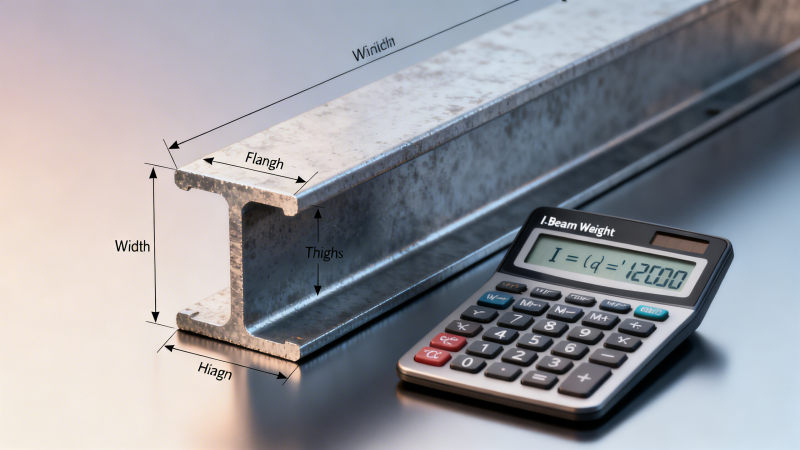
Why Accurate I Beam Weight Calculation Matters Across Project Lifecycles
Weight estimation isn’t just about material cost — it directly influences load-bearing design validation, crane selection, transport compliance, and even foundation reinforcement requirements. Underestimating weight risks overloading lifting equipment or exceeding axle limits during transit, especially critical for infrastructure projects in Malaysia where terrain and port logistics add complexity. Overestimation, meanwhile, inflates budget forecasts and may trigger unnecessary redesigns. For procurement teams weighing mill MOQ vs trader MOQ steel for industrial applications, accurate weight per unit length enables precise order volume planning — avoiding excess inventory or costly partial shipments. Likewise, engineers comparing I beam vs H beam for residential construction rely on weight-per-meter values to assess handling feasibility on tight urban sites and evaluate long-term deflection behavior under live loads.
At Hongteng Fengda, every structural steel product — from standard angle steel to customized cold-formed profiles — undergoes certified dimensional verification before dispatch. Our factory in China adheres to ASTM A6/A6M, EN 10025, and GB/T 706 specifications, ensuring nominal dimensions align within ±0.5% tolerance. This precision underpins reliable weight calculation — because theoretical formulas assume exact cross-sections. Real-world deviations in flange thickness or web taper affect mass by up to 2.3%, as confirmed in third-party audits across our Middle East deliveries. That’s why we embed verified section properties into our quoting system — supporting clients with steel beam factory price in Middle East quotes that include certified weight per meter, not just nominal size.
Step-by-Step Weight Calculation: Metric & Imperial Formulas Explained
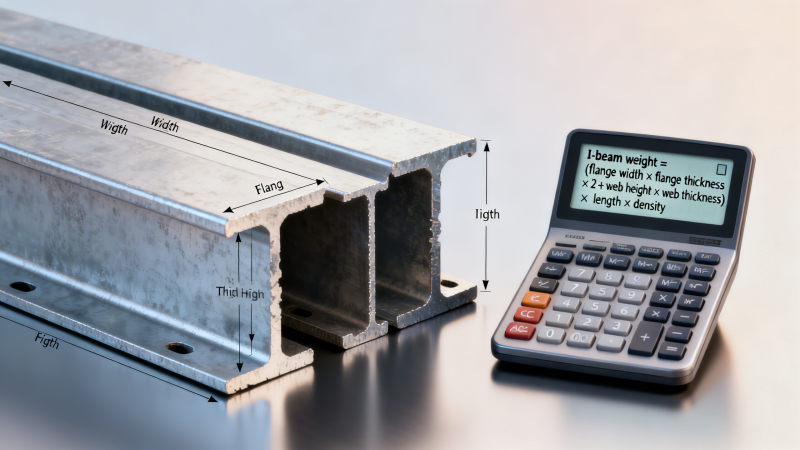
The universal principle is: Weight = Volume × Density. Since I beams are extruded prisms, volume equals cross-sectional area multiplied by length. Density of carbon steel is 7850 kg/m³ (metric) or 0.284 lb/in³ (imperial). Below is the breakdown:
Example: For an IPE300 (EN standard), flange width = 150 mm, flange thickness = 10.7 mm, web height = 291.6 mm, web thickness = 7.1 mm → A = 2×(150×10.7) + (291.6×7.1) = 5220.6 mm² → W = 5220.6 × 7.85 × 10⁻⁶ ≈ 40.98 kg/m. Verified against EN 10034 tables — deviation < 0.1%. In imperial terms, same section converts to ~27.54 lb/ft.
Beyond Theory: How Manufacturing Tolerances Impact Real-World Calculations
While formulas assume perfect geometry, hot-rolled I beams exhibit controlled variations. Per ASTM A6, flange thickness tolerance for beams up to 300 mm depth is ±0.4 mm; web thickness varies ±0.3 mm. These small deltas compound: a 0.4 mm over-thickness across both flanges adds ~1.2 kg/m to a 400 mm beam — enough to shift crane capacity margins on high-rise projects in Southeast Asia. That’s why Hongteng Fengda provides mill test reports with actual measured dimensions for every batch — crucial for quality controllers validating compliance before installation.
For buyers assessing Angle Steel price per ton Philippines for industrial use, this tolerance-aware approach prevents disputes: we quote based on verified weight, not nominal size. Similarly, when acting as a Steel I Beam supplier in Malaysia for infrastructure projects, our logistics team uses certified weights — not theoretical — to optimize container loading (max 27 tons per 40-ft container). This reduces demurrage fees and ensures adherence to local road weight regulations. We also integrate these verified metrics into lead time planning: standard vs custom steel lead time for industrial buyers shortens by 3–5 days when weight-driven staging is pre-validated.
Supporting Materials & Complementary Solutions
Structural integrity extends beyond primary beams. Secondary components like ties, bracing wires, and mesh reinforcements must match corrosion resistance and tensile demands of the main frame. For example, galvanized wire used in temporary formwork or perimeter fencing requires ductility and coating adhesion that withstands repeated bending without flaking. Our Hot Dipped Galvanized Steel Wire meets this need — manufactured from low-carbon Q235 steel with zinc coating of 12–20 g/m² and tensile strength of 420–500 MPa. Its excellent plasticity allows cold forming into hooks or spirals without compromising coating integrity, making it ideal for on-site fabrication in harsh coastal environments like those in marine infrastructure projects.
This wire complements our full structural portfolio — including stainless steel square bar for architectural use and stainless steel bar for marine applications — all traceable to mill heat numbers and tested per ASTM A90/A90M. Whether specifying 201 vs 304 stainless steel cost for food industry installations or sourcing cold-formed sections for warehouse racking, Hongteng Fengda delivers consistency across material families.
Optimizing Procurement Strategy with Verified Data
Industrial buyers increasingly prioritize total cost of ownership over unit price. Mill MOQ vs trader MOQ steel for industrial applications reveals stark contrasts: mills often require 25–30 tons per grade/size, while traders accept 5-ton orders — but at +8–12% premium and variable lead times. At Hongteng Fengda, we bridge this gap: our flexible production lines support MOQs as low as 10 tons for standard sections, with custom solutions starting at 15 tons. Crucially, all quotes include certified weight per meter, enabling apples-to-apples comparison with trader-sourced stock. This transparency helps procurement officers reduce sourcing risks and lock in predictable steel beam factory price in Middle East contracts — backed by ISO 9001-certified QA and 30-day payment terms for qualified partners.
We also provide digital tools — downloadable Excel calculators pre-loaded with EN/ASTM/GB section libraries and real-time density adjustments for alloy variants. These empower project managers to simulate weight impacts across alternative beam selections (e.g., I beam vs H beam for residential construction) before finalizing specs — accelerating design approval cycles by up to 40%.
Whether you’re evaluating Angle Steel price per ton Philippines for industrial use or planning logistics for a steel-intensive infrastructure project in Malaysia, precise weight calculation is your first line of engineering assurance. As a structural steel manufacturer with 18+ years of export experience, Hongteng Fengda combines factory-grade accuracy, global compliance, and responsive partnership. Get certified section data, verified weight reports, and tailored MOQ options — contact our technical sales team today.
- steel i
- steel i beam supplier
- h beam
- angle steel
- hot dipped galvanized steel wire
- galvanized steel wire
- galvanized wire
- ot Dipped Galvanized Steel Wire
- Q235 steel
- galvanized steel
- structural steel
- Structural Steel
- Profile
- standard vs custom steel lead time
- mill MOQ vs trader MOQ steel
- Galvanized
- Steel I Beam supplier in Malaysia
- Angle Steel price per ton Philippines
- I beam vs H beam
- steel beam factory price
- Steel Beam
- Steel Wire
- 201 vs 304 stainless steel cost
- stainless steel square bar
- stainless steel bar
- carbon steel
- steel bar
- i beam weight
- stainless steel bar for marine applications
- stainless steel square bar for architectural use
- 201 vs 304 stainless steel cost for food industry
- steel beam factory price in Middle East
- I beam vs H beam for residential construction
- Angle Steel price per ton Philippines for industrial use
- Steel I Beam supplier in Malaysia for infrastructure projects
- mill MOQ vs trader MOQ steel for industrial applications
- standard vs custom steel lead time for industrial buyers
Related recommendations
 How long does acero prepintado retain gloss and color stability in direct desert sunlight?Acero prepintado gloss & color stability in desert sun? Discover real-world performance data, PVDF vs. polyester longevity, and spec-critical insights for GCC projects.
 Does acero pregalvanizado maintain coating integrity after cold bending to 90 degrees?Acero pregalvanizado maintains coating integrity after 90° cold bending — when engineered right. Discover how Hongteng Fengda guarantees real-world performance, adhesion & corrosion resistance.
 Do the advantages of galvanized steel include reduced fire risk compared to untreated carbon steel?Advantages of galvanized steel include measurable fire-risk reduction vs. untreated carbon steel—learn how zinc delays ignition, buys critical escape time, and enhances safety without false 'fireproof' claims.
 What is the minimum bend radius for 12mm steel wire rope without permanent deformation?12mm steel wire rope capacity depends on bend radius — discover the safe 72–96mm minimum to prevent permanent deformation, fatigue & failure. Expert rigging insights inside.

Please give us a message


Please enter what you want to find