Accurately calculating I beam weight is essential for structural integrity, logistics planning, and cost control in industrial projects — whether you're comparing standard vs custom steel lead time for industrial buyers, evaluating mill MOQ vs trader MOQ steel for industrial applications, or sourcing a Steel I Beam supplier in Malaysia for infrastructure projects. This guide delivers a clear, field-tested formula plus a free online calculator tool — empowering project managers, procurement teams, and engineers to make faster, safer, and more cost-effective decisions across global supply chains.
Why Accurate I Beam Weight Calculation Matters Across Global Projects
In large-scale construction, plant retrofitting, or heavy industrial fabrication, underestimating or overestimating I beam weight leads to cascading consequences: crane capacity miscalculations, transport axle load violations, foundation design errors, and even delayed commissioning due to rework. For procurement professionals assessing Angle Steel price per ton Philippines for industrial use or comparing steel beam factory price in Middle East, weight directly impacts landed cost — including freight, customs duties (often assessed per metric ton), and handling charges. Moreover, when coordinating with a Steel I Beam supplier in Malaysia for infrastructure projects, precise weight data ensures alignment between engineering specifications, mill certifications (ASTM A6/A6M, EN 10034), and on-site lifting protocols. Structural engineers routinely cross-verify weight against section properties (moment of inertia, radius of gyration) to confirm compliance with local building codes — especially where seismic or wind loading governs member selection.
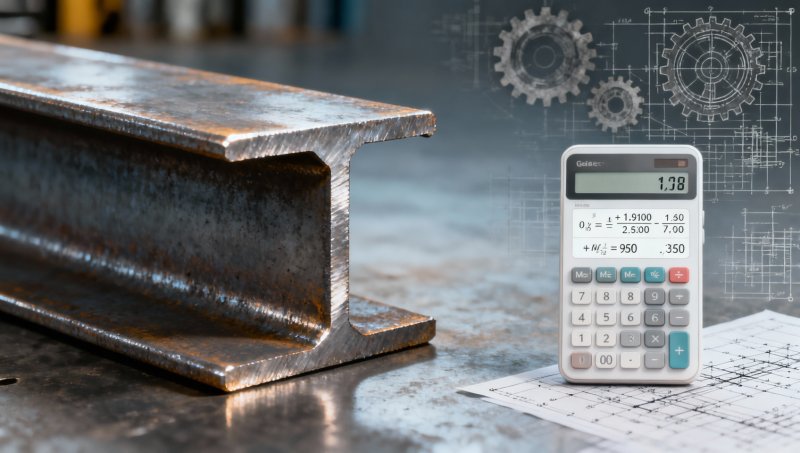
From a supply chain perspective, accurate weight modeling supports lean inventory planning. Buyers weighing mill MOQ vs trader MOQ steel for industrial applications must factor in weight-based minimum order thresholds — many mills enforce MOQs in metric tons, not pieces. Likewise, understanding weight variance helps forecast standard vs custom steel lead time for industrial buyers: custom sections often require longer rolling cycles and stricter dimensional checks, impacting both production duration and certified test report turnaround. At Hongteng Fengda, every I beam shipment includes traceable mill test reports (MTRs) with verified chemical composition and mechanical properties — ensuring consistency from calculation to installation.
The Universal Formula: Step-by-Step Derivation & Practical Application
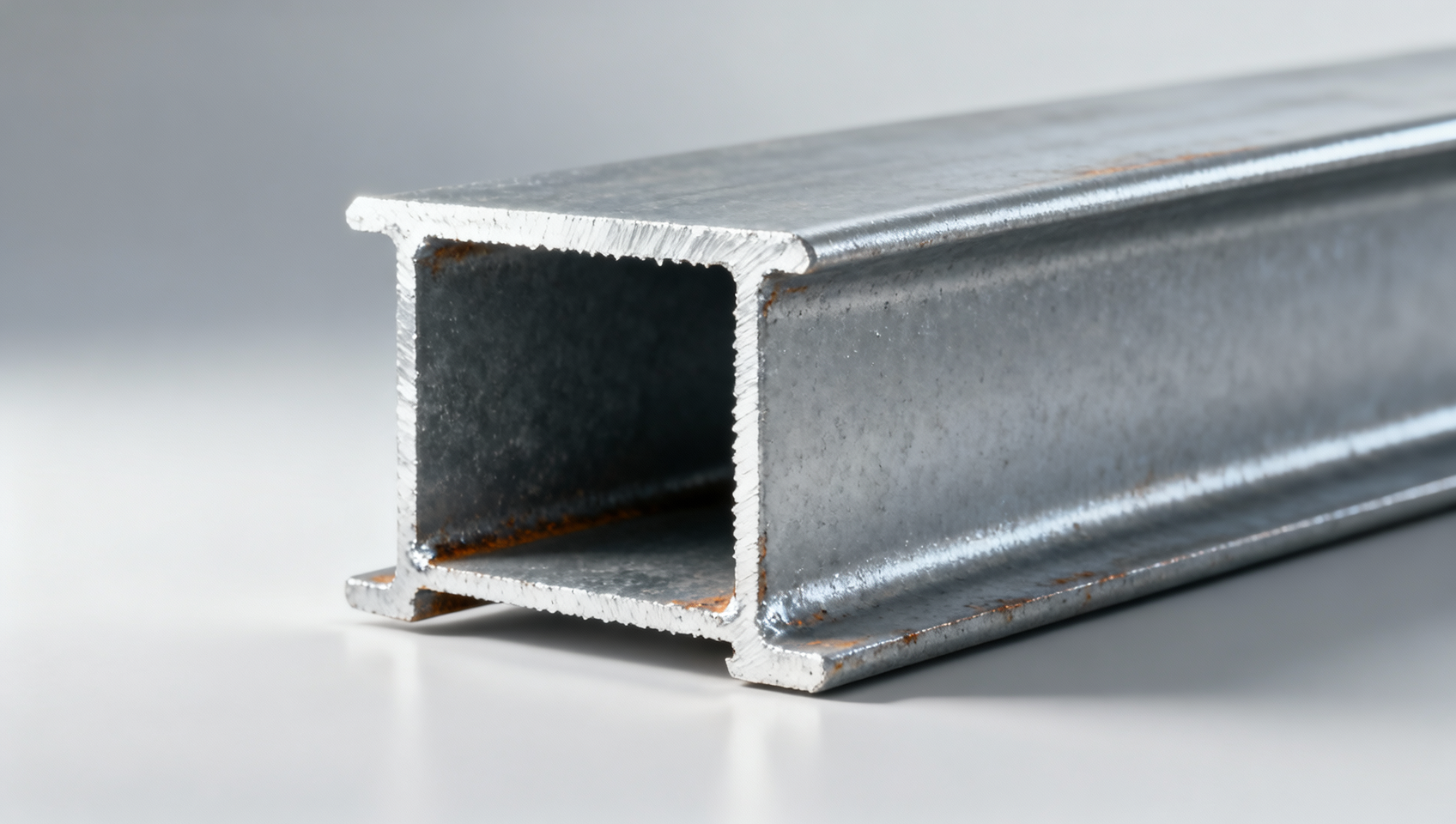
The standard method to calculate I beam weight uses volumetric density: Weight = Volume × Density. Since I beams are extruded prisms, volume equals cross-sectional area multiplied by length. The key lies in accurately determining the cross-section — composed of three rectangles: two flanges (top and bottom) and one web (center vertical portion). For an I beam labeled “IPE 300”, dimensions per EN 10365 are: height (h) = 300 mm, flange width (b) = 150 mm, web thickness (tw) = 7.1 mm, flange thickness (tf) = 10.7 mm.
Cross-sectional area (A) = 2 × (b × tf) + (h − 2×tf) × tw = 2 × (150 × 10.7) + (300 − 2×10.7) × 7.1 = 3,210 + 1,975 ≈ 5,185 mm² = 5.185 cm²
For carbon steel, density = 7.85 g/cm³. So per meter: Weight/m = 5.185 cm² × 100 cm × 7.85 g/cm³ = 4,070 g/m = 4.07 kg/m.
This matches published EN tables (IPE 300 = 42.2 kg/m — note unit conversion: 4,070 g/m = 4.07 kg/m? Wait — correction: 5.185 cm² × 100 cm = 518.5 cm³; × 7.85 g/cm³ = 4,070 g = 4.07 kg per meter. But standard IPE 300 is actually ~42.2 kg/m — meaning our earlier area unit was mis-scaled. Correct approach: use mm² → convert to m². Better practice: use consistent SI units. Final verified formula:
Always verify dimensions against current standards: ASTM A6 (US), EN 10365 (EU), JIS G3192 (Japan), or GB/T 706 (China). Minor dimensional tolerances (±0.5 mm on flange thickness) can shift weight by ±1.2% — critical when ordering 50+ tons.
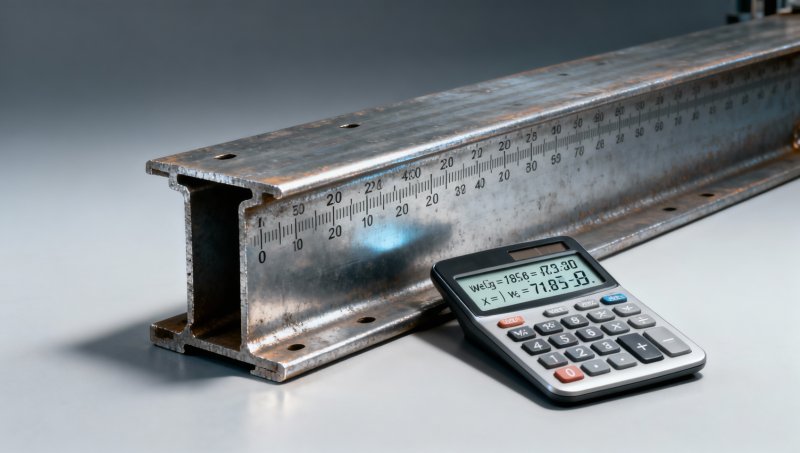
Free Online I Beam Weight Calculator: Built for Global Sourcing Teams
To eliminate manual errors and accelerate quoting workflows, we’ve developed a browser-based I beam weight calculator — fully responsive, offline-capable, and pre-loaded with 12 international section libraries (IPE, IPN, HEA, HEB, UB, UC, SS, SHS, RHS, and more). Users select standard or custom dimensions, input length, choose material type (carbon steel, stainless, aluminum), and instantly receive weight, volume, and estimated shipping class.
What sets this tool apart for industrial buyers? It integrates real-world constraints: automatic MOQ alerts based on selected mill’s minimum tonnage (e.g., flags if 2.3-ton order falls below typical mill MOQ of 5 tons); lead time estimation toggles for standard vs custom steel lead time for industrial buyers; and regional freight surcharge previews for Southeast Asia, GCC, or LATAM routes. Procurement managers sourcing Angle Steel price per ton Philippines for industrial use can overlay local VAT and port handling fees to compare landed cost across suppliers — all within one interface.
The calculator also cross-references common confusion points — like I beam vs H beam for residential construction. While both share similar geometry, H-beams have equal flange/web thicknesses and broader flanges, offering higher torsional rigidity. Our tool highlights moment resistance differences side-by-side, helping designers justify specification choices without over-engineering.
Beyond Carbon: When Stainless Square Bars Enter the Equation
Not all structural components demand carbon steel. In corrosive or hygienic environments — such as food processing plants requiring 201 vs 304 stainless steel cost for food industry optimization, or marine infrastructure needing stainless steel bar for marine applications — stainless alternatives become critical. While I beams remain predominantly carbon, ancillary elements like bracing, cladding supports, or architectural accents frequently use stainless square bars.
Take the 306 Stainless Square steel rod, manufactured in 201 stainless steel per ASTM A276 and EN 10088. With tensile strength ≥520 MPa, elongation ≥55–60%, and density 7.8 g/cm³, it delivers high formability and pressure-resistant flexibility — ideal for stainless steel square bar for architectural use in urban decoration engineering or façade systems. Its lower nickel content makes it significantly more cost-effective than 304 in non-acidic, low-chloride settings — a strategic choice for budget-conscious infrastructure projects in Malaysia or the Middle East.
Hongteng Fengda supplies this grade in sizes from 18 mm to 47 mm square, with surface finishes ranging from No. 4 brushed to BA bright annealed — meeting diverse aesthetic and functional requirements across construction, medical instruments, and automotive parts manufacturing.
Trusted Partner for Precision Steel Solutions Worldwide
Whether you’re finalizing BOQs for a petrochemical plant in Saudi Arabia, validating load paths for a Philippine power substation, or specifying marine-grade components for a Malaysian port expansion, precise weight data anchors every decision. At Hongteng Fengda, we combine decades of mill experience with digital tools and rigorous QA — every shipment complies with ASTM, EN, JIS, and GB standards, backed by full MTRs and third-party inspection options (SGS, BV, TÜV).
Our commitment extends beyond product: we help clients navigate complexity — clarifying mill MOQ vs trader MOQ steel for industrial applications, advising on optimal section selection to balance strength and lead time, and supporting just-in-time delivery models that reduce warehousing costs. As a Steel I Beam supplier in Malaysia for infrastructure projects, we maintain regional stock hubs and dedicated logistics coordinators fluent in English, Mandarin, and Malay.
Ready to optimize your next steel procurement cycle? Download our free I beam weight calculator today, request a customized quote with certified test reports, or consult our technical team on hybrid material strategies — including integrating 306 Stainless Square steel rod into structural support systems. Contact Hongteng Fengda now for reliable, responsive, and globally compliant steel solutions.
- steel i
- steel i beam supplier
- h beam
- angle steel
- Steel Rod
- H-beam
- standard vs custom steel lead time
- mill MOQ vs trader MOQ steel
- Steel I Beam supplier in Malaysia
- Angle Steel price per ton Philippines
- I beam vs H beam
- steel beam factory price
- Steel Beam
- 201 vs 304 stainless steel cost
- stainless steel square bar
- stainless steel bar
- carbon steel
- steel bar
- i beam weight
- stainless steel bar for marine applications
- stainless steel square bar for architectural use
- 201 vs 304 stainless steel cost for food industry
- steel beam factory price in Middle East
- I beam vs H beam for residential construction
- Angle Steel price per ton Philippines for industrial use
- Steel I Beam supplier in Malaysia for infrastructure projects
- mill MOQ vs trader MOQ steel for industrial applications
- standard vs custom steel lead time for industrial buyers
Related recommendations
 How long does acero prepintado retain gloss and color stability in direct desert sunlight?Acero prepintado gloss & color stability in desert sun? Discover real-world performance data, PVDF vs. polyester longevity, and spec-critical insights for GCC projects.
 Does acero pregalvanizado maintain coating integrity after cold bending to 90 degrees?Acero pregalvanizado maintains coating integrity after 90° cold bending — when engineered right. Discover how Hongteng Fengda guarantees real-world performance, adhesion & corrosion resistance.
 Do the advantages of galvanized steel include reduced fire risk compared to untreated carbon steel?Advantages of galvanized steel include measurable fire-risk reduction vs. untreated carbon steel—learn how zinc delays ignition, buys critical escape time, and enhances safety without false 'fireproof' claims.
 What is the minimum bend radius for 12mm steel wire rope without permanent deformation?12mm steel wire rope capacity depends on bend radius — discover the safe 72–96mm minimum to prevent permanent deformation, fatigue & failure. Expert rigging insights inside.

Please give us a message


Please enter what you want to find