Understanding size tolerance is a basic but critical part of working with seamless stainless steel pipe. In pressure systems, fabrication lines, and safety-sensitive installations, small dimensional deviations can lead to poor fit-up, leakage risk, inspection failure, or shortened service life.
That is why seamless stainless steel pipe tolerance is not only a production detail. It is a control point that influences compliance, installation efficiency, and long-term operating reliability across industrial steel applications.
What size tolerance means in seamless stainless steel pipe
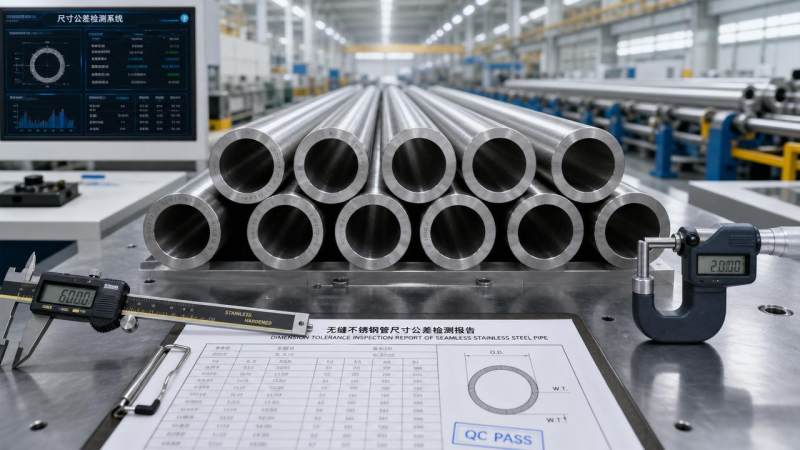
In simple terms, size tolerance is the permitted variation between the specified dimension and the actual measured dimension of a pipe.
For seamless stainless steel pipe, the most common dimensional checks include outside diameter, wall thickness, length, straightness, and ovality.
These values are never judged in isolation. They are compared against the relevant standard, purchase order, and intended service condition.
A pipe may look acceptable visually, yet still fail tolerance requirements. That difference matters in systems where welding preparation, pressure containment, or support spacing must stay consistent.
Why the market pays close attention to tolerance control
Across construction, processing plants, energy facilities, and manufacturing lines, tolerance consistency has become more important than nominal size alone.
There are several reasons for that shift.
- Prefabrication requires parts to fit without repeated field adjustment.
- Pressure-rated systems depend on predictable wall thickness.
- Third-party inspections are stricter on documented dimensional compliance.
- Global supply chains need stable quality across different batches and destinations.
For this reason, seamless stainless steel pipe is often reviewed not only by grade and finish, but also by tolerance performance under ASTM, EN, JIS, or GB requirements.
This aligns with the operating approach of suppliers such as Hongteng Fengda, where steel exports rely on stable production, standard compliance, and strict quality control for international projects.
The dimensions that usually create the most risk
Not every dimensional variation carries the same consequence. Some affect assembly speed. Others affect safety margins.
Among these, wall thickness deserves special attention. In many cases, a seamless stainless steel pipe can pass diameter checks while still presenting an unacceptable minimum thickness at local points.
How tolerance is checked in real inspection work
Actual verification should follow a defined method, not a quick visual estimate.
Measurement tools and reference points
Outside diameter is commonly measured with calipers or circumference tools. Wall thickness is checked with ultrasonic gauges or micrometers, depending on access and specification.
Length is usually straightforward, but straightness and ovality need defined locations and repeatable measurement points.
Sampling and acceptance logic
A few random readings may not reflect the whole batch. Heat number, lot size, and production shift can all influence variation.
Usually, the safer approach is to confirm:
- which standard defines the tolerance,
- how many samples are required,
- whether minimum values or average values apply,
- and whether end sections need separate checking.
This is especially relevant when seamless stainless steel pipe will be cut, beveled, welded, or exposed to high temperature and cyclic loading.
Tolerance decisions rarely stand alone in steel projects
In many projects, pipe inspection is connected to a wider steel package. Structural sections, supports, brackets, and reinforcement materials also need dimensional consistency.
That is one reason integrated sourcing can reduce control gaps. A supplier familiar with ASTM, GB, EN, DIN, and JIS expectations can support more consistent documentation and traceability.
For example, where plant construction combines piping with general steel use, related materials such as Rebar may also be reviewed for standard grade, dimensional range, and application suitability.
Typical grades include GB1499.2 HRB400, HRB500, ASTM A615 Grade 60, BS4449 460B, 500B, 500C, and AS/NZS 4671 500N.
As a carbon steel bar product, it is supplied in round shape, commonly from 1 to 12 meters, with recognized standards such as ASTM, GB, EN, DIN, and JIS.
That broader view matters because dimensional discipline in one steel category often reflects the quality culture behind the entire supply chain.
Where seamless stainless steel pipe tolerance has the highest practical impact
Some applications are more forgiving than others. In low-risk uses, minor variation may only slow assembly. In critical systems, it may affect approval or safe operation.
- Process piping in petrochemical plants, where pressure and corrosion margins are closely controlled.
- Sanitary or precision lines, where alignment and internal consistency matter.
- Fabricated skid systems, where pre-cut lengths must match assembly drawings.
- Export projects, where documentation and dimensional evidence may be checked before release.
In these situations, seamless stainless steel pipe should be evaluated against both standard tolerance and project-specific tolerance, because the two are not always identical.
Practical points for reviewing supplier control
When judging whether a supply source is dependable, dimensional results should be connected to process control.
Useful questions to verify
- Which standard governs the seamless stainless steel pipe tolerance?
- Are actual inspection records available by heat or batch?
- Is wall thickness controlled by minimum point, not only nominal average?
- How are nonconforming pieces segregated and reported?
- Can the supplier support OEM or tighter project tolerances when required?
Suppliers with modern facilities and disciplined quality systems are usually better positioned to answer these questions with evidence, not only declarations.
That is particularly relevant in international sourcing, where lead time pressure should not override dimensional compliance.
A sensible next step before approval or purchase
Before finalizing a specification or releasing a batch, it helps to build a short tolerance review checklist around the actual service condition.
Start with the governing standard, then compare nominal size, tolerance range, inspection method, and documentation requirements. After that, confirm whether field installation conditions demand tighter control.
For seamless stainless steel pipe, that disciplined review often prevents much larger problems later, including rework, shutdown delays, and avoidable safety exposure.
When the dimensional basics are clear, comparing suppliers, standards, and related steel products becomes far more practical and far less risky.
Please give us a message


Please enter what you want to find