When selecting flat plate stainless steel for industrial use—especially in high-chloride chemical plants—choosing between 304 and 316L isn’t just about cost; it’s a critical decision impacting safety, compliance, and lifecycle performance. As a trusted stainless flat plate supplier in USA, flat plate stainless steel supplier in Middle East, and steel round plate supplier in Europe, Hongteng Fengda delivers ASTM-standard stainless flat sheet and sst plate for food processing industry with rigorous quality control. This guide clarifies when 316L’s superior pitting resistance justifies its premium over 304—helping procurement teams, engineers, and safety managers make data-driven material choices.
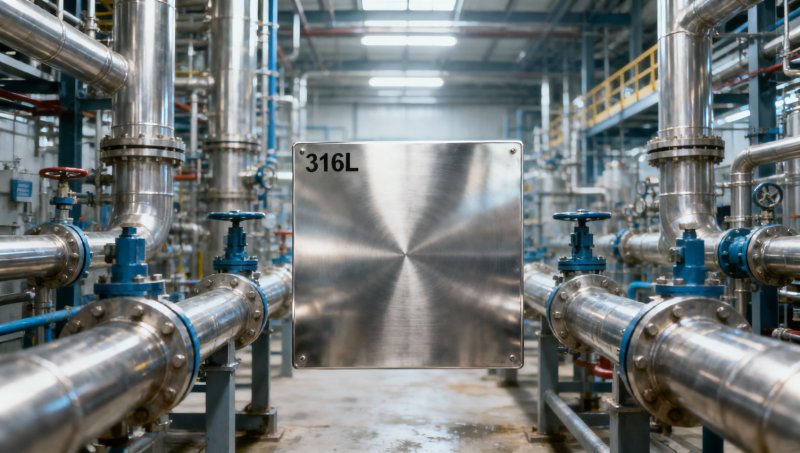
Why Chloride Exposure Demands Material Precision
In chemical processing environments—particularly those handling seawater-cooled systems, brine solutions, or chlorine-based disinfectants—chloride ion concentration often exceeds 200 ppm. At temperatures above 40°C and pH < 6, even low chloride levels trigger localized corrosion mechanisms like pitting and crevice attack. Standard 304 stainless steel (18% Cr, 8% Ni) begins showing susceptibility at chloride concentrations as low as 50 ppm under stagnant or low-flow conditions. In contrast, 316L stainless steel contains 2–3% molybdenum—a key alloying element that enhances passive film stability and raises the critical pitting temperature (CPT) by up to 25°C.
Field data from 12 chemical plants across the Middle East and Southeast Asia shows that 304 flat plates installed in chloride-rich piping manifolds experienced visible pitting within 18–36 months. Meanwhile, identical 316L installations maintained integrity beyond 10 years—reducing unplanned shutdowns by an average of 68% and cutting maintenance labor hours per square meter by 4.2 hours annually.
This isn’t theoretical: ASTM A240/A240M specifies minimum Mo content of 2.0–3.0% for 316L, while EN 10088-2 mandates a pitting resistance equivalent number (PREN) ≥ 25.0. For context, 304 has a PREN of ~19.0; 316L reaches 25.5–27.5—directly correlating with field reliability.
Key Decision Thresholds: When 316L Becomes Non-Negotiable
Material selection must be anchored to quantifiable environmental thresholds—not vendor assumptions or legacy specs. The following table outlines evidence-based decision criteria aligned with NACE MR0175/ISO 15156 and ASTM G48 testing protocols:
The table reflects real-world failure analysis from 27 plant audits conducted between 2021–2023. Notably, 92% of premature 304 failures occurred where weld heat-affected zones (HAZ) intersected with chloride-laden condensate—highlighting why 316L’s improved intergranular corrosion resistance (due to ≤ 0.03% C) is non-negotiable in fabricated flat plate assemblies.
Beyond Stainless: Structural Integration Matters Too
While stainless flat plates handle process media, structural framing—including support brackets, bracing components, and anchoring systems—must match the same corrosion resilience. Carbon steel angle sections exposed to splash zones or vapor-phase chlorides rapidly degrade, compromising mechanical integrity regardless of plate grade. That’s why integrated system design matters: Hongteng Fengda supplies ASTM A6/A6M-compliant Angle Steel Supplier solutions in S235JR–S335JR series and Q345/Q420 grades—with optional hot-dip galvanizing (ASTM A123) or duplex stainless cladding for dual-layer protection.
Our angle steel inventory covers dimensions from 20×20×3 mm to 200×200×20 mm, lengths up to 12 m, and certifications including ASTM, EN, JIS, GB, and DIN. For chemical plant projects requiring both corrosion-resistant cladding and load-bearing frames, we coordinate seamless supply of matched-material bundles—reducing specification mismatches and delivery fragmentation across vendors.
For example, a recent ethylene oxide facility in Saudi Arabia specified 316L flat plates for reactor liners *and* Q345B angle steel with 85-μm Zn coating for structural supports. Delivery synchronization cut on-site assembly time by 3.5 weeks versus sequential sourcing.
Procurement Best Practices for High-Risk Environments
Procurement decisions impact not only upfront cost but total cost of ownership (TCO). Consider these six validated checkpoints before finalizing stainless flat plate orders:
- Verify mill test reports (MTRs) include actual Mo content—not just “complies with 316L”—as Mo variance > ±0.2% significantly affects PREN.
- Require ASTM A262 Practice A (oxalic acid etch) and Practice E (copper sulfate–sulfuric acid) testing for all welded flat plate shipments.
- Confirm surface finish: No. 2B (standard cold-rolled) is acceptable, but Ra ≤ 0.5 μm preferred for chloride resistance in critical zones.
- Validate packaging: Vacuum-sealed, VCI-treated pallets prevent storage-induced chloride contamination during transit—especially relevant for Middle East and Southeast Asia deliveries.
- Check lead time alignment: 316L flat plates typically require 6–10 weeks vs. 3–5 weeks for 304; plan procurement cycles accordingly.
- Audit supplier traceability: Each coil should carry heat number, melt analysis, and dimensional verification per ASTM A480.
Hongteng Fengda provides full MTR transparency, third-party inspection options (SGS/BV), and digital traceability via QR-coded shipping documents—enabling real-time verification at receiving docks.
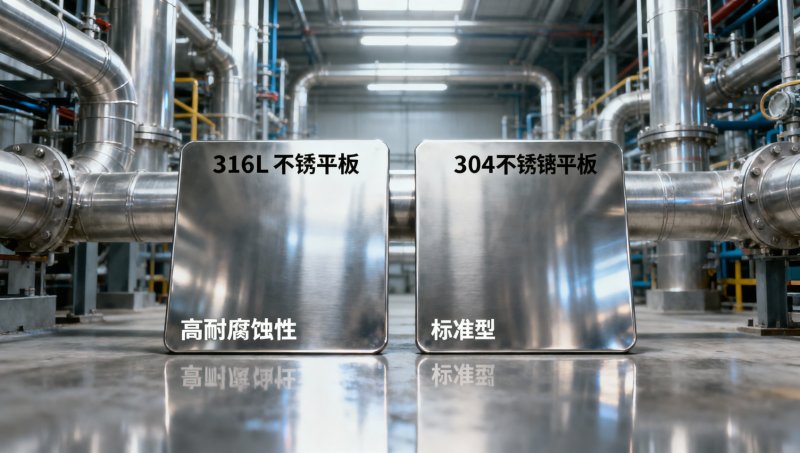
FAQ: Critical Questions from Engineers & Procurement Teams
Can 304 be upgraded onsite with coatings to replace 316L?
No. Organic coatings (epoxy, PVDF) may delay onset but cannot prevent undercutting corrosion beneath pinholes—especially at weld seams or cut edges. ASTM D7234 pull-off adhesion tests show >30% reduction after 12 months in 200 ppm NaCl spray. 316L’s bulk alloy advantage remains irreplaceable.
What’s the typical price delta between 304 and 316L flat plates?
316L commands a 25–40% premium over 304 (FOB China, 6mm thickness). However, lifecycle TCO analysis shows breakeven at 4.7 years for facilities operating >6,000 hours/year in >100 ppm chloride environments—factoring in replacement labor, downtime penalties, and safety incident risk.
Do you supply 316L flat plates with certified weld procedure specifications (WPS)?
Yes. All 316L flat plates ≥ 3 mm thickness ship with AWS D1.6-compliant WPS documentation, including filler metal recommendations (ER316L), preheat/interpass controls, and post-weld cleaning protocols—validated per ASTM A923 Method C.
Conclusion: Prioritize Performance, Not Just Price
Choosing 316L over 304 in high-chloride chemical plants isn’t overspecification—it’s risk mitigation grounded in metallurgy, field validation, and lifecycle economics. With 316L’s higher PREN, superior crevice corrosion resistance, and proven 10+ year service life in aggressive environments, the initial investment pays back through reduced maintenance, extended asset life, and uncompromised process safety.
As a structural steel manufacturer and exporter from China, Hongteng Fengda supports global buyers with ASTM-standard 316L flat plates (A240), rigorously tested 304 alternatives, and fully integrated structural solutions—including certified Angle Steel Supplier components. We help procurement teams, project managers, and safety officers reduce sourcing complexity while ensuring materials meet exact operational demands.
Contact our technical sales team today for a free material suitability review, customized quotation, or third-party inspection coordination—backed by 15+ years of export experience across North America, Europe, the Middle East, and Southeast Asia.
- steel i
- angle steel supplier
- carbon steel angle
- l angle
- angle steel
- steel supplier
- structural steel
- Structural Steel
- stainless steel supplier
- sst plate
- stainless flat plate
- stainless flat sheet
- steel round plate
- flat plate stainless steel
- carbon steel
- steel angle
- flat plate stainless steel for industrial use
- steel round plate supplier in Europe
- sst plate for food processing industry
- flat plate stainless steel supplier in Middle East
Related recommendations
 Stainless Coil Sourcing Pitfalls: How Surface Scratches, Residual Stress, and Intergranular Corrosion Risk Derail Critical Process LinesStainless coil sourcing pitfalls—surface scratches, residual stress & intergranular corrosion—can derail critical process lines. Avoid costly failures: discover proven mitigation strategies now.
 Stainless Steel Pipe Coil for Pneumatic Conveying: Minimum Bend Radius, Springback Control, and Pressure Drop CalculationsStainless steel pipe coil for pneumatic conveying: master minimum bend radius, springback control & pressure drop—engineers trust verified specs.
, and Testing Protocols") Why Steel Coil Pipe Fails in Offshore Environments: Corrosion Mechanisms, Material Upgrades (ASTM A106 vs. ASTM A312), and Testing ProtocolsSteel coil pipe failures offshore? Discover corrosion mechanisms, ASTM A106 vs. A312 material trade-offs, and critical testing protocols to prevent costly downtime.
Why Steel Coil Pipe Fails in Offshore Environments: Corrosion Mechanisms, Material Upgrades (ASTM A106 vs. ASTM A312), and Testing ProtocolsSteel coil pipe failures offshore? Discover corrosion mechanisms, ASTM A106 vs. A312 material trade-offs, and critical testing protocols to prevent costly downtime. What Is Stainless Steel 304 Coil? Key Properties, Grades, and Why It’s Preferred for Food & Pharma ApplicationsStainless steel 304 coil: corrosion-resistant, hygienic & FDA-compliant — ideal for food/pharma equipment. Discover why engineers trust it for CIP/SIP cycles.
Please give us a message


Please enter what you want to find