Struggling to verify ASTM A6 tolerances on mill certs without delaying QA? You're not alone—especially when juggling mill order meaning, ASTM A36 round bar specs, HRB600 steel rebar compliance, or #sstlavar traceability. For structural steel manufacturers and global buyers like Hongteng Fengda, fast, accurate mill cert audits are critical to maintaining ASTM/EN/JIS/GB conformity—without bottlenecks in procurement, production, or project handover. This guide cuts through the noise: practical steps to validate tolerances, spot red flags, and keep your QA workflow lean and audit-ready.
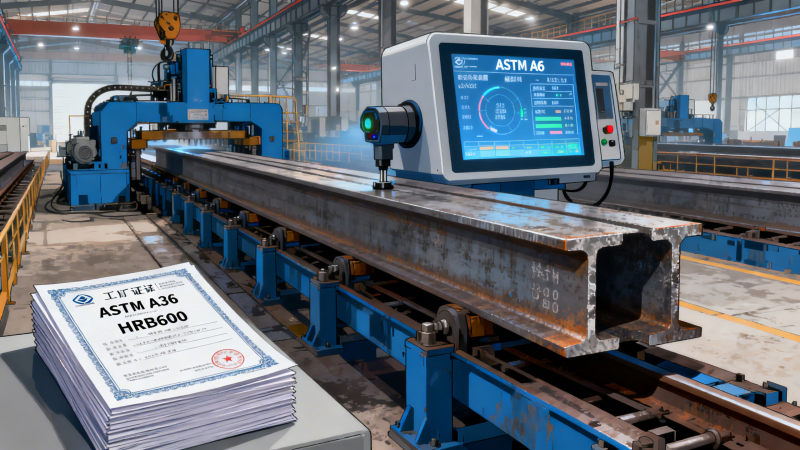
What ASTM A6 Tolerances Really Mean — Beyond the Table
ASTM A6 is not a product standard—it’s a *dimensional tolerance framework* governing hot-rolled structural shapes (beams, channels, angles) and plates. Its tolerances define permissible deviations in depth, flange width, web thickness, leg length, and surface flatness—not mechanical properties. Confusing ASTM A6 with material-grade standards like ASTM A36 or HRB600 is a top-tier audit risk. When reviewing a mill certificate, always confirm: Is the cert referencing ASTM A6 *for dimensional acceptance*, while citing ASTM A36 (or GB/T 1591, EN 10025-2) for chemical/mechanical compliance? That dual-layer verification is non-negotiable.
Hongteng Fengda applies ASTM A6 tolerances across all structural profiles—whether exporting angle steel to Dubai or cold-formed beams to Germany. Our internal QA checklist cross-references each mill cert against the latest ASTM A6-23 revision, including updated allowances for camber, sweep, and twist in rolled sections. We treat tolerances not as pass/fail checkboxes—but as continuous process indicators tied directly to rolling mill calibration logs and post-heat-treatment straightening data.
The Mill Order Meaning Trap: Why Context Changes Everything
“Mill order meaning” isn’t defined in any ASTM document—it’s operational jargon rooted in supply chain execution. A mill order includes contractual terms beyond specs: delivery sequence, packaging method, test report requirements (e.g., “full heat analysis + tensile per ASTM A6/A370”), and even traceability tags for #sstlavar digital logging. Ignoring this layer means misreading a cert that *technically complies* with ASTM A6 but omits required impact testing at –20°C for Arctic projects—or fails to declare the exact ladle number needed for HRB600 steel rebar batch reconciliation.
At Hongteng Fengda, every mill order undergoes dual-track review: engineering validates dimensional and metallurgical alignment with ASTM A6 and ASTM A36; logistics verifies packaging, marking, and documentation scope—including whether the cert supports downstream welding procedure specifications (WPS) or EN 1090-1 execution class requirements. This prevents “cert-approved-but-site-rejected” scenarios common in EU infrastructure tenders.
Spotting Red Flags: 5 Audit Shortcuts for Busy QA Teams
Time-strapped quality teams can’t re-measure every beam. Use these field-proven shortcuts:
- Thickness divergence >0.3mm on adjacent flanges? Signals uneven cooling or roll wear—flag for full section scan.
- Mill cert lists “ASTM A6” but no revision year? Reject unless confirmed via supplier letter—A6-19 allows ±0.8mm on 300mm flanges; A6-23 tightens it to ±0.6mm.
- No ladle/heat number next to HRB600 steel rebar tensile results? Invalidates traceability—critical for seismic zones.
- ASTM A36 round bar cert cites only yield strength, no elongation or reduction of area? Incomplete per ASTM A370—request full test report.
- Cert references “#sstlavar” but lacks QR-linked batch ID? Breaks digital audit trail—verify with supplier’s blockchain platform or SGS-certified portal.
How Hongteng Fengda Streamlines Compliance — Without Slowing You Down
We embed ASTM A6 validation into our ERP-to-mill interface: real-time tolerance checks auto-flag deviations before cert generation. Every shipment includes a dual-language (EN/CN) QA summary highlighting ASTM A6 conformance status, heat-specific chemistry, and third-party test references (SGS/BV). For urgent projects, we offer pre-audit certification packages—validating ASTM A6 tolerances, ASTM A36 round bar tensile curves, and HRB600 steel rebar bend test reports within 48 hours of mill release.
Need seamless integration with your BIM or ERP system? Our digital mill certs support API-driven ingestion—including structured fields for mill order meaning, heat traceability, and #sstlavar metadata. And for high-precision applications, we recommend pairing ASTM-compliant structural steel with our 201 Stainless Steel Plate—offering exceptional formability and corrosion resistance where carbon steel interfaces with aggressive environments.
Why Global Buyers Choose Hongteng Fengda
You need more than certificates—you need confidence. As a certified structural steel manufacturer compliant with ISO 9001, EN 1090-2, and GB/T 19001, Hongteng Fengda delivers:
Whether you’re auditing a single mill cert or scaling procurement across 12 countries, Hongteng Fengda ensures compliance never competes with velocity. Contact us today for a free ASTM A6 audit readiness assessment—and discover how our integrated quality ecosystem supports your next structural steel milestone.
Related recommendations
 How long does acero prepintado retain gloss and color stability in direct desert sunlight?Acero prepintado gloss & color stability in desert sun? Discover real-world performance data, PVDF vs. polyester longevity, and spec-critical insights for GCC projects.
 Does acero pregalvanizado maintain coating integrity after cold bending to 90 degrees?Acero pregalvanizado maintains coating integrity after 90° cold bending — when engineered right. Discover how Hongteng Fengda guarantees real-world performance, adhesion & corrosion resistance.
 Do the advantages of galvanized steel include reduced fire risk compared to untreated carbon steel?Advantages of galvanized steel include measurable fire-risk reduction vs. untreated carbon steel—learn how zinc delays ignition, buys critical escape time, and enhances safety without false 'fireproof' claims.
 What is the minimum bend radius for 12mm steel wire rope without permanent deformation?12mm steel wire rope capacity depends on bend radius — discover the safe 72–96mm minimum to prevent permanent deformation, fatigue & failure. Expert rigging insights inside.

Please give us a message


Please enter what you want to find