Choosing the correct I beam weight is critical for structural integrity—whether you're measuring a steel beam for industrial warehouse design, bridge projects, or large-scale construction. In the USA, engineers and procurement teams often face confusion between ASTM A6 (material and dimensional tolerances) and AISC standards (design and load-bearing specifications). This directly impacts beams weight calculation accuracy, compliance with I beam weight specifications for warehouse construction, and sourcing decisions—from weight of I beam supplier in Europe to domestic US requirements. As a trusted structural steel manufacturer & exporter from China, Hongteng Fengda delivers ASTM-compliant I beams with precise weight data, supporting global buyers in cost control, safety assurance, and on-time project delivery.
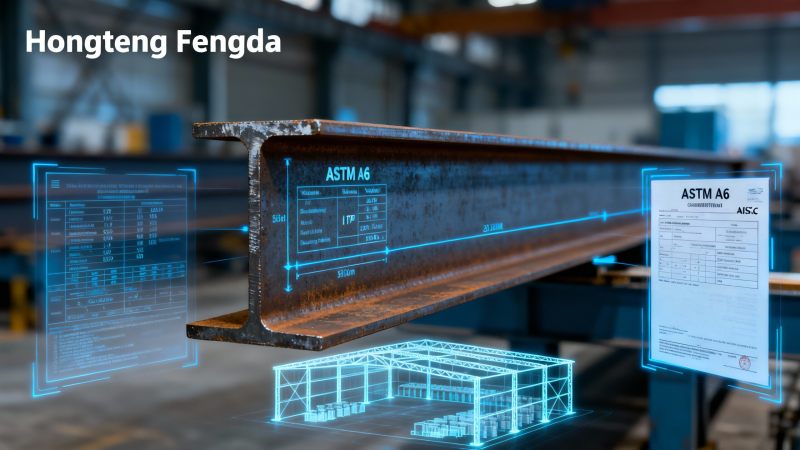
Understanding ASTM A6 vs. AISC: Two Distinct Roles in Structural Steel
ASTM A6 is a material specification standard—not a design code. It governs dimensional tolerances, chemical composition, mechanical properties, and permissible weight variance for rolled structural shapes, including I beams. For example, under ASTM A6-23, an S12×31.8 beam may carry a ±5% allowable weight tolerance depending on nominal depth and flange width. This matters deeply when performing beams weight calculation for structural steel or validating I beam weight calculator for construction engineers.
In contrast, the American Institute of Steel Construction (AISC) publishes design standards—primarily the Steel Construction Manual and Specification for Structural Steel Buildings (ANSI/AISC 360). These define how engineers must interpret beam capacity, buckling resistance, connection design, and serviceability limits. AISC does not prescribe weight—it relies on ASTM A6’s certified dimensions and mass per foot to derive section modulus, moment of inertia, and shear area.
Confusing the two leads to real-world risk: selecting a beam based solely on AISC load tables without verifying its actual ASTM A6-certified weight can cause overloading in seismic zones or underestimating deflection in long-span warehouse roofs. That’s why accurate how to measure a steel beam for industrial warehouse workflows always begin with dimensional verification against ASTM A6—and end with design validation using AISC methods.
Key Technical Differences: A Side-by-Side Comparison
The following table clarifies functional boundaries, enforcement scope, and practical implications for project stakeholders—including project managers, quality controllers, and procurement officers.
Application Scenarios: Where Weight Accuracy Determines Success
For how to measure a steel beam for bridge projects, even minor deviations in weight-per-foot affect dead-load modeling, especially in cantilevered or orthotropic deck systems. A 3% over-weight error across 200 linear feet adds ~1,800 lbs of unintended load—enough to trigger re-analysis or redesign.
In industrial warehouses, I beam weight specifications for warehouse construction drive column spacing, foundation sizing, and crane runway beam selection. Here, beams weight chart for steel manufacturers must reflect both ASTM A6 nominal values *and* verified mill test results—not just catalog averages. Hongteng Fengda provides full traceable weight documentation per heat lot, enabling seamless integration into BIM models and structural analysis software.
Meanwhile, distributors and agents sourcing for North America rely on dual-certification: ASTM A6 compliance for physical acceptance *plus* AISC-aligned mill test reports that include Fy, Fu, elongation, and Charpy V-notch data. This eliminates retesting delays at US ports—a key advantage when managing tight how to measure a steel beam for industrial use timelines.
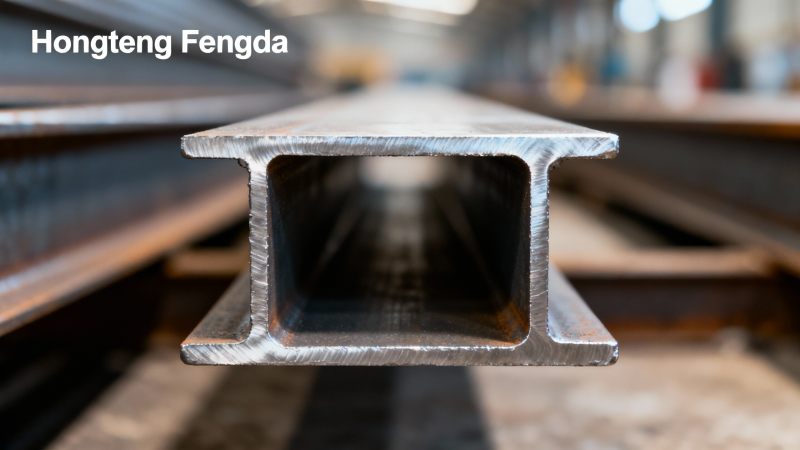
Why Choose Hongteng Fengda for ASTM-Compliant I Beams?
As a professional structural steel manufacturer & exporter from China, Hongteng Fengda operates ISO 9001–certified production lines equipped with laser-guided profile measurement systems and automated weighing stations. Every I beam shipment includes ASTM A6–compliant mill test reports—with certified weight per foot, dimensional verification, and chemical assay—validated by SGS or Bureau Veritas upon request.
We support global buyers beyond compliance: our engineering team assists with beams weight calculation for structural steel using real-world mill data—not theoretical formulas. For clients specifying hot-dip galvanized components, we also supply Hot diped-Galvanized Pipe meeting ASTM A123 and A153 for corrosion-critical applications like trestle pile frames or chemical coking equipment supports.
Whether you’re a project manager validating weight of I beam in USA specs, a quality controller auditing mill certs, or a distributor coordinating shipments across EU–US–ME trade lanes, Hongteng Fengda delivers consistency, transparency, and responsiveness—without compromising on ASTM integrity or AISC readiness.
Get Accurate, Traceable, and Timely I Beam Solutions Today
Don’t let ambiguous weight data delay your next project. Contact Hongteng Fengda for customized I beam quotations, ASTM A6-certified weight charts, and AISC-compatible technical dossiers—tailored for warehouse, bridge, energy, or infrastructure applications. Our export team supports English, Spanish, Arabic, and German communications—and ships to over 40 countries with documented lead times under 8 weeks.
Request your free beam weight verification report and cross-reference ASTM A6 tolerances with your current project drawings. Let’s build with confidence—starting with the right weight, the right standard, and the right partner.
- h beams
- h beam
- steel construction
- galvanized pipe
- hot-dip galvanized
- structural steel
- Structural Steel
- Profile
- Hot diped-Galvanized Pipe
- Galvanized
- Steel Beam
- weight of i beam
- i beam weight
- how to measure a steel beam
- beams weight
- How to measure a steel beam for industrial use
- Weight of I beam in USA
- Beams weight calculation for structural steel
- I beam weight specifications for warehouse construction
- How to measure a steel beam for bridge projects
- Weight of I beam supplier in Europe
- Beams weight chart for steel manufacturers
- I beam weight calculator for construction engineers
- How to measure a steel beam for industrial warehouse
Related recommendations
 Top 5 Stainless Steel Coil Manufacturers in Asia: Capabilities, Certifications, and Export Readiness for Global EPC Contractorssteel coil manufacturers: Discover Asia’s top 5 stainless steel coil suppliers—certified, traceable, and export-ready for global EPC projects.
 Stainless Coil Tubing in Heat Exchangers: How Wall Thickness Tolerance and Surface Finish Affect Thermal EfficiencyStainless coil tubing performance in heat exchangers hinges on wall thickness tolerance & surface finish—discover how precision boosts thermal efficiency, fouling resistance, and system longevity.
 Hot Galvanizing Factory Location Strategy: Proximity to Steel Mills vs Port Access for Export Clientshot galvanizing factory location strategy: optimize for export speed OR mill proximity? Data-driven insights for structural steel exporters.
 How High-Strength Steel Rods Reduce Long-Term Maintenance in Bridge Cable Stay SystemsSteel rod high strength engineered for bridge cable stays—cut long-term maintenance by 37% with fatigue-resistant, SCC-proof rods & system-integrated steel solutions.
Please give us a message


Please enter what you want to find