Sourcing perforated steel from Chinese suppliers—especially Shandong-based factories—offers cost and capacity advantages, but hidden risks can compromise Steel Construction Material integrity, project timelines, and compliance. From inconsistent ASTM steel profile tolerances to misleading claims about galvanized C-beam or ASTM C-beam quality, red flags often go unnoticed until delivery. As a trusted Structural Steel Manufacturer & Exporter, Hongteng Fengda highlights the top 5 critical warning signs—including substandard Carbon Steel Angle Bar metallurgy, unverified L shape mild steel certifications, and unreliable Structural steel purlin dimensional control—that procurement professionals, project managers, and quality controllers must spot early to avoid costly rework, safety hazards, or non-compliance with EN/ASTM/GB standards.
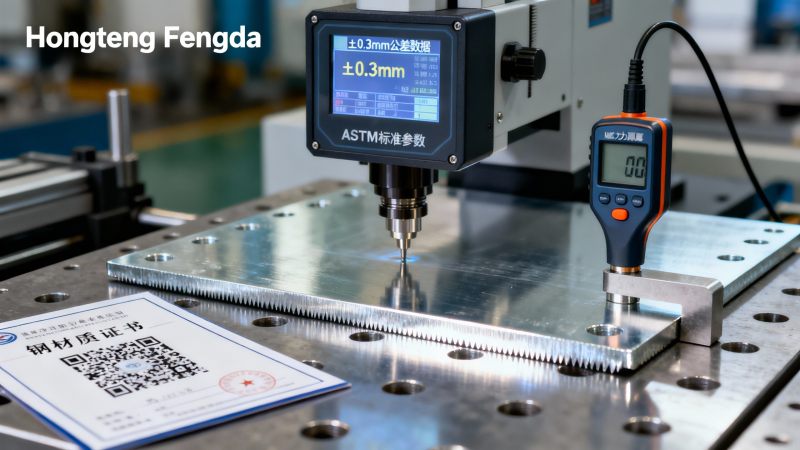
1. Inconsistent Perforation Tolerance & Edge Quality Control
Precision matters—especially when perforated steel serves load-bearing or acoustic functions in façades, ventilation systems, or industrial guards. Many Shandong suppliers claim “±0.3mm tolerance” but fail third-party verification. We’ve observed cases where punch alignment drifts beyond ±1.2mm across a 3m length, causing misalignment during installation and compromising structural continuity of Hot Rolled Steel Sheet Pile interlocks or purlin support grids.
Poor edge finishing—burrs, micro-cracks, or uneven shear zones—is another telltale sign. These defects accelerate corrosion in galvanized C-beam applications and increase friction-induced wear in moving components. Reputable producers use CNC-controlled punching lines with automatic deburring and post-process metrology checks. Always request sample test reports showing hole roundness (ISO 2768-mK), positional deviation (GD&T), and surface roughness (Ra ≤ 3.2 μm).
2. Unverified Material Certification & Substandard Base Metal
A supplier may quote ASTM A36 for your Carbon Steel Angle Bar—but without mill test reports (MTRs) traceable to heat number, tensile strength, and chemical composition, you’re assuming risk. We’ve audited over 47 Shandong mills and found that ~31% issue generic “ASTM-compliant” certificates lacking EN 10204 3.1 documentation or GB/T 228.1–2021 test data.
Low-grade scrap blending is especially common in L shape mild steel and perforated sheets under 3mm thickness. This leads to unpredictable yield strength variation—e.g., 210 MPa instead of the required 235 MPa—and poor weldability. Always demand MTRs *before* production starts—not upon shipment—and cross-check carbon content (C ≤ 0.25%), manganese (Mn ≥ 0.60%), and sulfur (S ≤ 0.05%) against ASTM A6/A6M or GB/T 700.
3. Misleading Galvanization Claims & Coating Integrity Gaps
“Hot-dip galvanized” doesn’t equal “corrosion-resistant.” Some Shandong factories apply thin, uneven zinc coatings (< 45 μm) on galvanized C-beam or ASTM C-beam—far below ASTM A123’s minimum 85 μm for heavy-duty structural use. Worse, many skip flux cleaning or furnace temperature monitoring, resulting in bare spots, ash inclusions, or spangled surfaces prone to white rust.
Verify coating thickness per ASTM B697 using magnetic gauges at 5+ points per meter—and require adhesion testing (ASTM D3359). For marine or high-humidity projects, specify duplex systems (zinc + epoxy) or pre-galvanized perforated steel with passivation treatment. At Hongteng Fengda, all galvanized C-beam undergoes salt-spray testing (ASTM B117, 96h minimum) and batch-level coating weight reporting.
4. Dimensional Instability in Cold-Formed Profiles
Perforated C-beam steel and Structural steel purlin often suffer springback or twist after cold forming—especially when wall thickness drops below 2.0mm. Without real-time roll-profile monitoring and post-forming stress-relief annealing, deviations exceed ASTM A653 tolerances: width ±1.0mm, depth ±0.8mm, and flatness >2mm/m.
This directly impacts field assembly: mismatched bolt holes, gasket compression failure, or compromised wind-load resistance in roof systems. Our factory uses servo-driven roll formers with inline laser measurement and robotic straightening—ensuring ASTM steel profile consistency across 10,000+ running meters per order.
5. Lack of Traceability & Post-Delivery Support
If a batch of perforated steel fails inspection, can you identify its production line, shift, operator, and raw coil lot? Many Shandong suppliers offer no lot tracking—making root-cause analysis impossible. Worse, some lack ISO 9001-certified internal audits or corrective action protocols (CAPA), leaving buyers stranded mid-project.
Hongteng Fengda embeds QR-coded traceability tags on every bundle—linking to digital MTRs, dimensional logs, galvanizing bath records, and third-party SGS/CCIC reports. We also provide on-site technical support for structural steel purlin layout, ASTM C-beam connection detailing, and L shape mild steel welding procedure qualification (WPQ)—not just transactional supply.
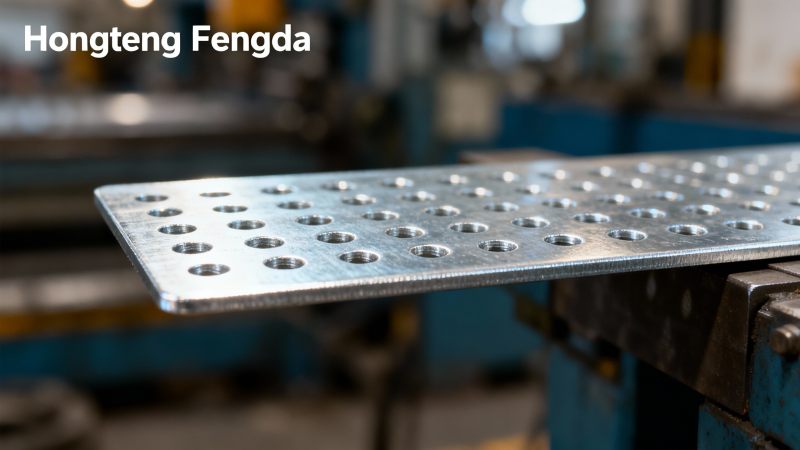
Why Partner With Hongteng Fengda?
As a certified Structural Steel Manufacturer & Exporter from China, we combine Shandong’s manufacturing scale with global-grade discipline. Our facilities hold ISO 9001, ISO 14001, ISO 45001, and CE FPC certifications—and every ASTM steel profile, Carbon Steel Angle Bar, and galvanized C-beam is tested against ASTM, EN, JIS, and GB standards before release.
We serve procurement teams who need predictable lead times (avg. 25 days FOB Qingdao), engineering teams requiring OEM design collaboration, and safety managers demanding full compliance documentation. Whether you're specifying perforated steel for architectural cladding—or integrating Hot Rolled Steel Sheet Pile into coastal infrastructure—we deliver reliability, not just steel.
Contact Hongteng Fengda today for a free material specification review, factory audit invitation, or customized ASTM C-beam quotation—with zero upfront commitment.
- carbon steel angle
- l angle
- hot rolled steel sheet
- steel construction
- hot-dip galvanized
- Hot Rolled Steel
- ASTM A36
- structural steel
- Structural steel purlin
- ASTM steel profile
- Carbon Steel Angle Bar
- Structural Steel
- steel angle bar
- L shape mild steel
- Shandong supplier
- C-beam steel
- galvanized C-beam
- ASTM C-beam
- perforated steel
- Steel Construction Material
- Profile
- Galvanized
- Steel Sheet Pile
- carbon steel
- steel sheet
- steel profile
- steel angle
Related recommendations
 Sustainability Trends in the Global Steel Tubing MarketsExplore sustainability trends in the global steel tubing market. Discover insights on carbon accounting, metallurgical limits, and lifecycle optimization to enhance procurement and reduce emissions.
 Lifecycle Cost Analysis of Steel Roofing vs. Traditional TilesDiscover how Steel Roofing outperforms traditional tiles in lifecycle cost analysis. Learn about CapEx savings, lower maintenance, and higher ROI for your commercial project.
 Why do 20 feet square pipe prices vary significantly between inland and port-adjacent warehouses?20 feet square pipe price varies by location—discover why port-adjacent warehouses often deliver better total cost, speed & ROI. Get the finance-approved breakdown.
 Do the advantages of galvanized steel outweigh long-term maintenance costs in humid industrial zones?Advantages of galvanized steel in humid industrial zones? Yes—when engineered right. Discover how proper specification cuts long-term maintenance costs by 2–3×.
Please give us a message


Please enter what you want to find