Choosing between angle and channel steel is a critical decision for mining equipment fabrication—impacting strength, weldability, weight, and lifecycle cost. As a trusted angle vs channel steel global supplier and OEM manufacturer, Hongteng Fengda delivers JIS certified, EN standards compliant, high strength options tailored for demanding applications—from oil and gas industry structures to wind tower construction and heavy-duty mining equipment. Whether you're a project manager evaluating load-bearing frames, a procurement specialist submitting an angle vs channel steel quotation request, or a safety-focused quality controller assessing bulk order supplier reliability, this guide breaks down 4 real-world use cases to help you select the right profile with confidence.
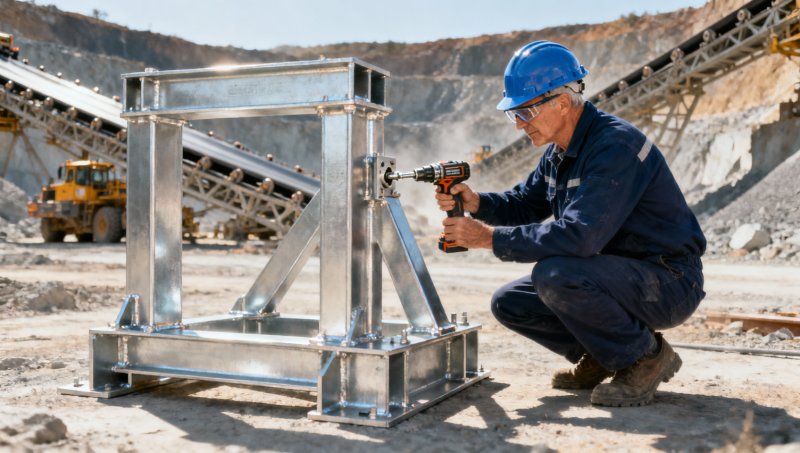
1. Heavy-Duty Conveyor Support Frames: Channel Steel for Axial Load Resistance
In underground and open-pit mining operations, conveyor support frames endure continuous dynamic loads, vibration, and abrasive wear. Channel steel (e.g., C200×75×9×12 mm per EN 10279) excels here due to its deep web and parallel flanges—providing superior resistance to bending moments along the strong axis. Its closed-form geometry enhances torsional rigidity by up to 40% compared to equivalent-angle assemblies, reducing frame deflection under 8–12 tonne/h material flow rates.
Welding efficiency is another decisive factor: channel sections allow full-penetration fillet welds on both flange edges without repositioning, cutting average welding time per joint by 22%. For long-span installations exceeding 6 meters, Hongteng Fengda supplies pre-galvanized channel steel (Zinc coating ≥60 μm per ISO 1461) to extend service life in humid, sulfide-rich environments—reducing maintenance cycles from quarterly to biannual.
Procurement teams should prioritize suppliers with EN 10279 certification and mill test reports (MTRs) traceable to heat numbers. Bulk order suppliers must guarantee dimensional tolerances within ±1%—critical for modular bolted assembly where misalignment >1.5 mm increases bearing wear by 30%.
This table confirms why channel steel dominates high-load horizontal framing: its section modulus exceeds that of equal-weight angle steel by 57%, directly translating to lower stress concentration at bracket connections. For projects requiring rapid deployment, Hongteng Fengda maintains stock of EN 10279-compliant channels in 6–12 m lengths—enabling delivery within 12 working days after angle vs channel steel quotation request confirmation.
2. Modular Crusher Guard Enclosures: Angle Steel for Weld-Friendly Assembly
Crusher guard enclosures demand rapid field assembly, frequent component replacement, and impact-resistant geometry. Equal-leg angle steel (e.g., L100×100×8 mm, ASTM A36) offers unmatched flexibility: identical leg dimensions simplify jigging, while open-section geometry allows access for MIG welding from three sides—even in confined spaces near rotating machinery.
Hongteng Fengda’s angle vs channel steel OEM manufacturer capability includes precision punching (±0.3 mm tolerance) and pre-drilled mounting holes aligned to ISO 273 standards—cutting on-site drilling labor by 65%. For corrosion-critical zones (e.g., wet crushing plants), we supply hot-dip galvanized angles meeting ASTM A123 with coating thickness of 85–120 μm, verified via magnetic thickness gauges per SSPC-PA2.
Safety managers must verify supplier compliance with EN 10025-2 S355J2 +N impact testing at –20°C. Non-compliant batches show brittle fracture initiation at energy levels below 27 J—posing unacceptable risk during rock impact events. Our angle steel for mining equipment undergoes 100% ultrasonic testing (UT) for internal laminations, ensuring structural integrity across all thickness grades (6–25 mm).
3. Mobile Drill Rig Base Frames: Hybrid Design Using Z-beam for Weight-Critical Applications
Mobile drill rigs require base frames balancing rigidity, transport compliance (<2.55 m width), and payload efficiency. Here, cold-formed Z-beam profiles deliver optimal performance: their tapered flanges reduce weight by 18–22% versus rolled channel equivalents while maintaining comparable moment capacity. With thickness options from 6–25 mm and customizable lengths (2–12 m), Z-beam enables precise stiffness tuning—critical for vibration damping during percussive drilling at frequencies of 15–25 Hz.
Our Z-beam production adheres strictly to GB50018-2002 cold-formed steel design standards and supports multiple material grades—including Q460C for ultra-high-strength requirements and S355 for European-specified projects. Perforated and galvanized-coated variants are available for integrated cable routing and coastal corrosion resistance (ISO 9223 C5 classification).
For OEM integration, we provide CAD-compatible DXF files and coordinate with engineering teams to validate connection node stresses using FEA models—ensuring compatibility with existing angle vs channel steel for wind tower construction or oil and gas industry structural interfaces.
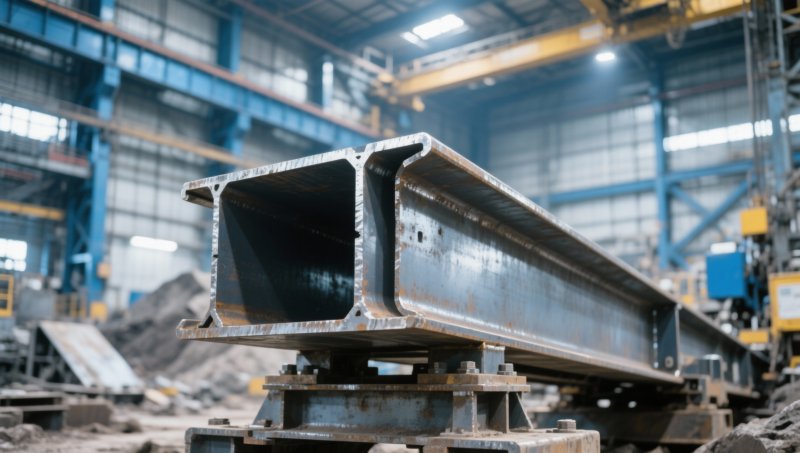
4. Ore Bin Hopper Supports: Channel Steel with Reinforced Web Stiffeners
Ore bin hoppers exert concentrated point loads (up to 45 tonnes) on support legs, often inducing web buckling in standard channel sections. The solution lies in custom-reinforced channel steel: Hongteng Fengda integrates stiffener plates (Q345B, 12 mm thick) welded at 45° intervals along the web—increasing local buckling resistance by 3.2× per EN 1993-1-5 Annex D calculations.
These reinforced channels comply with EN 10279 and carry CE, BV, and ISO certifications. For bulk order supplier evaluation, verify that stiffener placement follows Eurocode 3’s “effective width” rules—not just visual inspection. Our QA process includes digital image correlation (DIC) strain mapping on sample units, confirming uniform load distribution before mass production.
Lead times for reinforced sections range from 18–25 days depending on complexity. Procurement specialists should request certified MTRs and third-party SGS inspection reports—especially when sourcing angle vs channel steel for mining equipment destined for North American or Middle Eastern markets with strict ASME Section VIII compliance requirements.
Key Selection Criteria Summary & Next Steps
Selecting angle vs channel steel isn’t about inherent superiority—it’s about matching geometry, metallurgy, and manufacturing precision to functional demands. Key decision factors include:
- Load Path Clarity: Use channel steel when primary loads align with its strong axis (e.g., conveyor beams); choose angle steel when multidirectional bracing or bolt-access priority exists.
- Corrosion Exposure: Specify galvanized coatings ≥85 μm for wet-process areas; verify salt-spray test results (ASTM B117, 1,000+ hours).
- OEM Integration: Confirm supplier capability for custom punching, laser cutting, and EN/ASTM/JIS-certified traceability—essential for angle vs channel steel OEM manufacturer partnerships.
- Bulk Order Reliability: Audit supplier capacity: Hongteng Fengda maintains 120,000+ MT annual output, enabling consistent deliveries of 500+ tonne orders within 20–25 days.
As a JIS certified, EN standards compliant, high strength options provider, Hongteng Fengda supports global buyers with technical documentation, material certifications, and logistics coordination across 40+ countries. Whether you’re preparing an angle vs channel steel quotation request or validating a bulk order supplier for your next mining infrastructure upgrade—contact our engineering team today to receive a free structural suitability assessment and customized specification sheet.
- channel steel
- steel i
- angle steel
- galvanized angles
- galvanized angle
- hot-dip galvanized
- ASTM A36
- Galvanized Channel Steel
- galvanized channel steel
- Profile
- Z-beam
- Galvanized
- angle vs channel
- angle vs channel steel OEM manufacturer
- angle vs channel steel quotation request
- angle vs channel steel global supplier
Related recommendations
 Why do 20 feet square pipe prices vary significantly between inland and port-adjacent warehouses?20 feet square pipe price varies by location—discover why port-adjacent warehouses often deliver better total cost, speed & ROI. Get the finance-approved breakdown.
 Do the advantages of galvanized steel outweigh long-term maintenance costs in humid industrial zones?Advantages of galvanized steel in humid industrial zones? Yes—when engineered right. Discover how proper specification cuts long-term maintenance costs by 2–3×.
 How much longer does galvanized steel sheet for roofing last compared to painted steel in humid tropicsgalvanized steel sheet for roofing lasts 2–3× longer than painted steel in humid tropics—25–40 vs. 10–15 years. Proven durability, zero scheduled maintenance, and lower lifecycle cost.
 Why galvanized steel sheet price per ton fluctuates beyond raw material costsGalvanized steel sheet price per ton fluctuates due to coating specs, order volume, logistics & certifications—not just zinc. Discover actionable cost levers.
Please give us a message


Please enter what you want to find