For Tier-1 automotive and industrial suppliers evaluating material alternatives, the question arises: Can SPCD steel high strength reliably replace DP600 in structural brackets—especially where yield-to-tensile ratio, formability, and crash performance are critical? As a leading structural steel manufacturer & exporter from China, Hongteng Fengda supports global buyers with ASTM stainless steel for chemical processing, corrosion-resistant plate supplier in Middle East solutions, cold rolled steel for warehouse construction, and SPCC steel for automotive industry applications. This analysis compares mechanical behavior, standards compliance (ASTM/EN/GB), and real-world bracket performance—helping procurement teams, engineers, and project managers make data-driven, cost-optimized sourcing decisions.
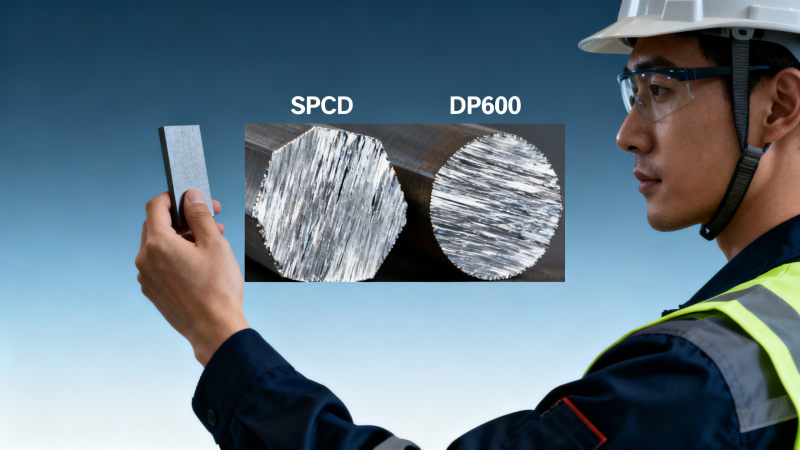
Why Yield-to-Tensile Ratio Matters More Than Tensile Strength Alone
In structural brackets—particularly those used in automotive B-pillars, seat frames, or chassis reinforcements—the yield-to-tensile (Y/T) ratio directly influences energy absorption during crash events. A high Y/T ratio (>0.85) indicates limited plastic deformation capacity, increasing risk of brittle fracture under dynamic loading. DP600, a dual-phase steel per EN 10336, typically exhibits a Y/T ratio of 0.62–0.72, enabling controlled yielding and progressive collapse.
SPCD high-strength variants—often mislabeled as “high-strength” in procurement sheets—typically deliver tensile strength up to 440 MPa but lack defined minimum yield strength requirements under JIS G 3141. Their Y/T ratio frequently exceeds 0.80 due to ferritic microstructure dominance, reducing formability margins by 15–25% compared to DP600 in deep-drawn bracket geometries.
This distinction is not academic: Tier-1 suppliers report 3–7% higher tool wear and 12–18% scrap rates when substituting unqualified SPCD for DP600 in bracket stamping lines operating at 12–15 strokes per minute. Real-world validation requires tensile testing across three lot batches—not just mill certificates.
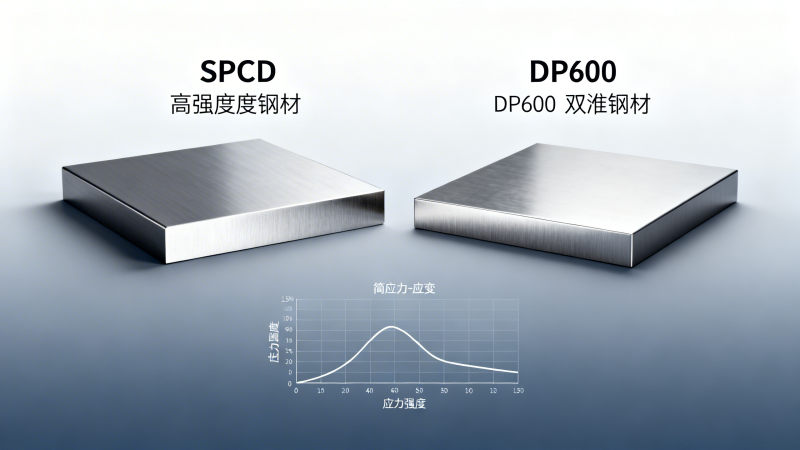
Key Mechanical Behavior Comparison
The table confirms that while SPCD-HS meets basic strength thresholds, its elevated Y/T ratio compromises ductility-critical functions. For brackets requiring ≥18% total elongation after forming, DP600 remains non-substitutable without engineering revalidation—including springback compensation and fatigue cycle testing at 500,000+ cycles.
When SPCD *Can* Work—and What You Must Verify First
SPCD-based alternatives may be viable—but only under strict conditions: non-safety-critical brackets with static load paths, thickness ≥1.8 mm, and no bending radii<12t (where t = material thickness). In such cases, Hongteng Fengda’s certified SPCD-HS coils—produced on 20-roll cold mills with tension-controlled annealing—deliver consistent surface finish and edge quality compliant with ASTM A1039 Grade C.
Critical verification steps include: (1) batch-specific tensile curve reporting (not just min/max values), (2) bend test at 180° over 2t mandrel per EN ISO 7438, and (3) zinc coating uniformity audit for galvanized variants—especially relevant for brackets exposed to coastal or de-icing salt environments.
For applications demanding both corrosion resistance and structural integrity—such as offshore crane brackets or photovoltaic mounting systems—Hongteng Fengda recommends pairing DP600 with hot-dip galvanizing (75–260 g/m² zinc coating) or integrating 0.7mm 0.8mm 1.2mm 1.6mm 1.8mm 2mm diameter Galvanized Steel Wire Rope in auxiliary tensioning assemblies, where precise coating thickness control enables predictable service life across 10–25 years depending on exposure class.
Certification Requirements for Bracket Material Substitution
- EN 10336 certification with full traceability to heat number and rolling date
- Third-party lab report confirming Y/T ratio ≤0.75 at ambient temperature (23±2°C)
- Formability validation: Nakajima test showing ≥22% major strain at fracture
- Zinc coating adhesion per ASTM B669 (for galvanized variants)—minimum 5 cycles without flaking
Procurement Decision Framework: 5 Checks Before Approving SPCD
Tier-1 procurement teams should apply this checklist before authorizing any SPCD substitution:
- Confirm bracket function: Is it load-bearing, crash-relevant, or vibration-dampening? If yes, DP600 remains mandatory.
- Verify supplier’s mill test report includes actual Y/T ratio—not just tensile/yield minima.
- Require dimensional stability data: ±0.15 mm tolerance retention after 72-hour humidity exposure (85% RH, 40°C).
- Validate compatibility with existing lubricants and die coatings—SPCD’s lower hardness increases galling risk in high-speed presses.
- Cross-check zinc coating specification: Thin (15–135 g/m²) suits indoor use; thick (75–260 g/m²) required for marine or desert installations.
Hongteng Fengda supports rapid validation through pre-shipment sample kits—including tensile coupons, bend specimens, and coated surface replicas—delivered within 7–10 working days to North America, EU, or GCC destinations.
Why Partner With Hongteng Fengda for Structural Steel Sourcing
As a structural steel manufacturer & exporter from China with ISO 9001, GB/T 20116-2008, and ABS-certified production lines, Hongteng Fengda delivers more than raw material: we provide bracket-grade steel with documented mechanical consistency, traceable to single-hearth melts, and validated against ASTM A653, EN 10336, and JIS G 3141.
Our value-add includes: (1) free engineering consultation on Y/T ratio implications for your specific bracket geometry, (2) OEM-specific packaging to prevent edge damage during transit, (3) dual-standard compliance (e.g., EN + ASTM) for multi-market projects, and (4) lead times locked at 25–35 days—even during Q4 peak demand.
Contact our technical sales team today to request: DP600 tensile curve datasets, SPCD-HS substitution feasibility assessment, zinc coating specification guidance, or customized coil packaging quotes. We support all stages—from prototype sampling to full-volume delivery—with documentation aligned to IATF 16949 requirements.
- ASTM stainless steel
- corrosion-resistant plate
- cold rolled steel
- SPCC steel
- SPCD steel
- structural steel
- Structural Steel
- SPCD steel high strength
- SPCC steel for automotive industry
- cold rolled steel for warehouse construction
- corrosion-resistant plate supplier in Middle East
- ASTM stainless steel for chemical processing
Related recommendations
 What Affects the Cost of Galvanized Steel in Fabrication Projects?Galvanized steel costs vary far beyond raw material price. Learn how coating, steel grade, fabrication, logistics, and hidden quote items affect project budgets before you buy.
 Steel Wire Strand Applications in Lifting and Support: Key Load and Safety ConsiderationsSteel wire strand selection for lifting and support starts with real load, fatigue, corrosion, and anchoring conditions. Learn how to improve safety, service life, and structural reliability.
 Architectural Steel Angle in Facades, Edges, and Clean LinesArchitectural steel angle improves facade edges, clean lines, and structural precision. Discover how it supports durability, faster installation, and smarter project control.
 Where Cold Formed Steel Angle Works Best in Modern BuildsCold formed steel angle works best in modular builds, secondary framing, and utility supports. Learn where it adds value, what to verify, and how to choose the right profile with confidence.
Please give us a message


Please enter what you want to find