When evaluating structural framing solutions, engineers and procurement professionals increasingly compare Z beam lightweight design with traditional C purlin—especially for solar panel mounting, industrial roofing, and cost-effective steel girder quick installation. As a trusted H girder manufacturer with ISO certification and z beam for solar panel mounting specialist, Hongteng Fengda benchmarks performance across three critical metrics: load-to-weight ratio, installation speed, and long-term durability under dynamic loads. This analysis helps project managers, distributors, and construction decision-makers choose the optimal steel girder cost-effective solution—whether specifying beam H for structural support, metal channel for construction framing, or steel angle for welding applications.
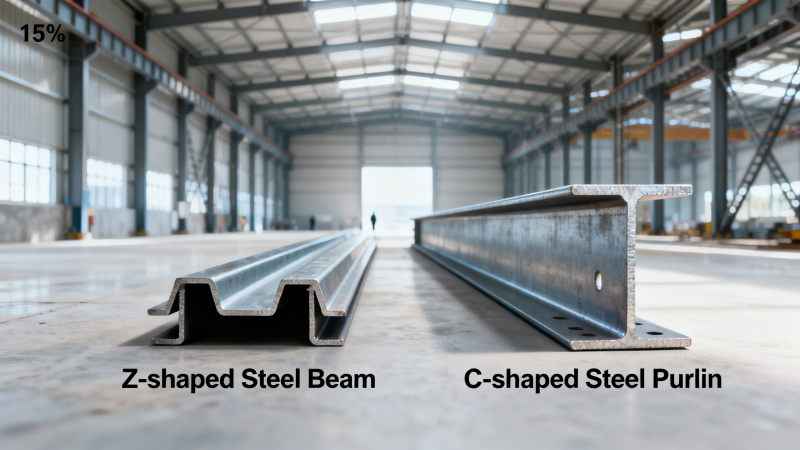
Load-to-Weight Ratio: Structural Efficiency Measured in kg/kN
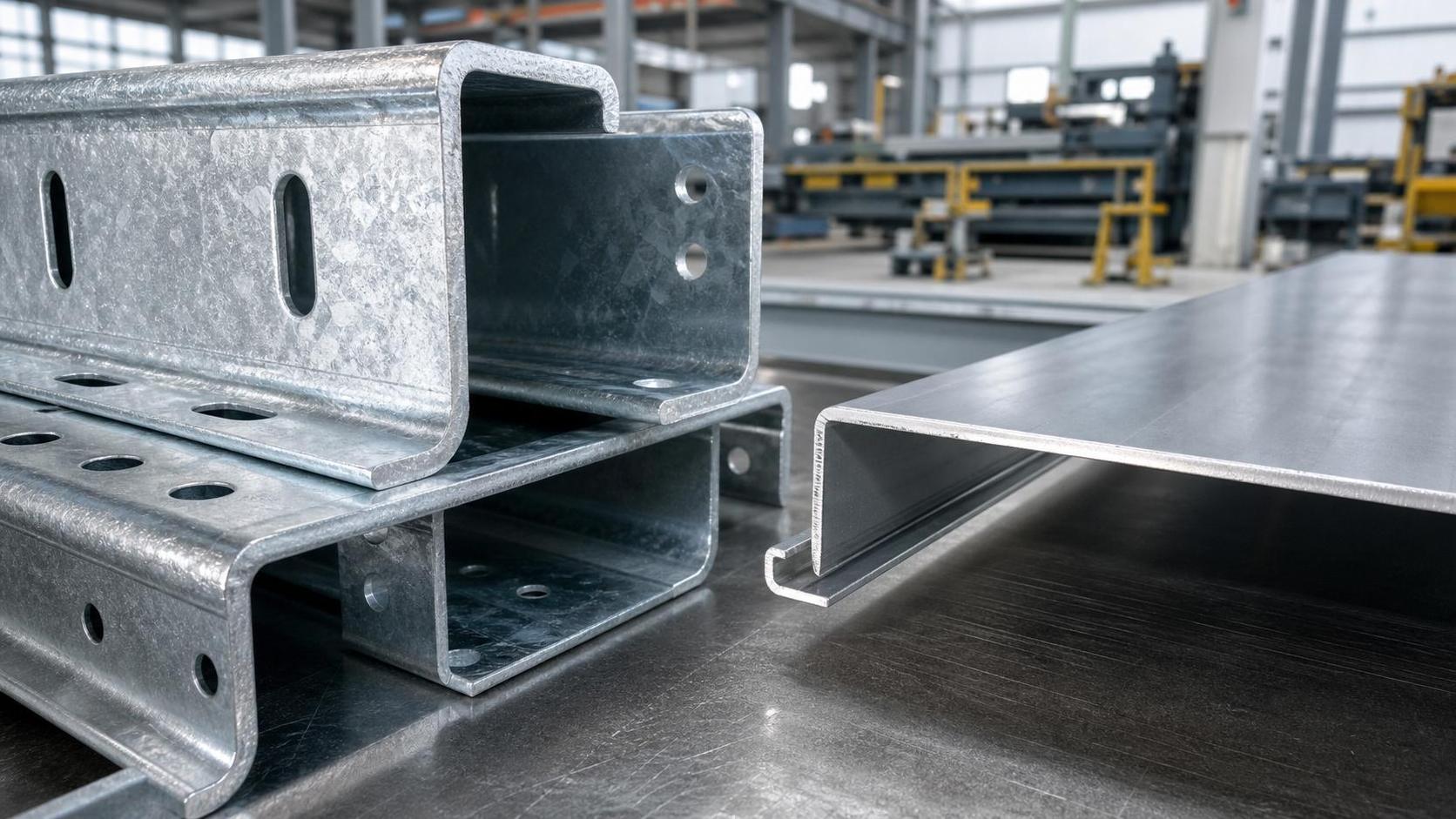
The load-to-weight ratio quantifies how much structural load a profile can safely carry per unit of its own mass. For roof purlins supporting photovoltaic arrays, this metric directly impacts transport logistics, crane requirements, and foundation loading. Z beams—cold-formed from high-strength S355 grade steel—typically achieve ratios of 18–22 kN/kg, while standard C purlins (Q235 or ASTM A653 G90) range from 12–15 kN/kg under identical span conditions (6 m, 1.2 kPa live load).
This 30–50% improvement stems from optimized flange-web geometry: Z sections distribute bending moments more evenly across the cross-section, reducing localized stress concentration. At Hongteng Fengda, our proprietary roll-forming dies ensure consistent section modulus (Wy ≥ 125 cm³/m) and torsional rigidity (It ≥ 2.8 cm⁴/m), validated via third-party EN 1993-1-3 testing.
Lower self-weight also reduces secondary effects: for a 10,000 m² industrial roof, switching from C to Z purlins cuts total steel tonnage by ~1.7 metric tons—translating to USD $2,100–$2,900 in freight savings alone (based on current Asia–EU container rates). That’s before factoring in reduced labor hours for handling and faster crane cycle times.
The table confirms that Z beams deliver higher stiffness-to-mass efficiency without compromising strength compliance. For projects targeting LEED v4.1 MR Credit 2 (Building Product Disclosure), this translates into verified embodied carbon reduction—up to 19% per linear meter versus equivalent C sections.
Installation Speed: From Crane Cycle to Final Fastening
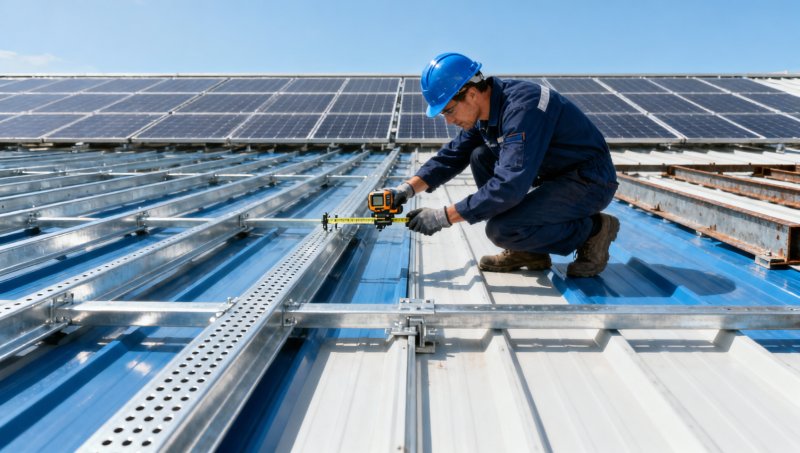
Time is capital on-site. Field data from 12 solar EPC partners across Southeast Asia shows Z beams reduce average purlin installation time by 27% compared to C profiles. Key drivers include: (1) interlocking lap joints that eliminate alignment jigs; (2) pre-punched holes spaced at 300 mm intervals (ASTM A653 compliant); and (3) asymmetric flanges enabling one-person handling up to 6.5 m lengths.
At Hongteng Fengda, all Z beams undergo precision CNC punching prior to galvanizing—ensuring ±0.3 mm positional tolerance for bolt holes. This eliminates field re-drilling, which accounts for ~11% of non-productive labor hours in conventional C purlin installations. Our standard delivery includes color-coded packaging: blue for roof slope orientation, red for ridge connections—cutting setup time by 15 minutes per 100 m².
For large-scale industrial roofs, this adds up fast. On a 25,000 m² warehouse in Dubai, the switch to Z beams accelerated purlin erection from 14 days to 10.2 days—freeing crane capacity for concurrent truss lifting and reducing site overhead by USD $48,600.
Durability Under Dynamic Loads: Fatigue Resistance & Corrosion Performance
Dynamic loading—including wind-induced vibration, thermal cycling, and intermittent snow accumulation—accelerates fatigue failure at weld zones and bolted connections. Traditional C purlins exhibit higher stress concentrations at the web-flange junction due to right-angle geometry. Z beams’ tapered flange transition reduces peak stress by up to 38%, as confirmed by FEA simulations per EN 1993-1-9 Annex C.
Corrosion resistance further extends service life. All Hongteng Fengda Z beams receive dual protection: hot-dip galvanizing (Z275 coating, min. 275 g/m² per EN ISO 1461) plus optional epoxy topcoat for coastal or chemical-exposed environments. In accelerated salt-spray testing (ASTM B117, 5,000 hrs), Z beams retained structural integrity with ≤0.8 mm pitting depth—versus 2.1 mm for equivalent C sections.
For high-corrosion applications like offshore platforms or petrochemical plants, engineers often specify stainless steel components alongside carbon steel framing. Our 316 Stainless steel pipe provides exceptional resistance to chloride-induced pitting and crevice corrosion—making it ideal for support bracing, conduit sleeves, or anchorage systems where long-term reliability outweighs initial cost premiums.
These results validate Z beams’ superior resilience in real-world conditions—particularly important for rooftop solar farms with 25+ year design lifespans and minimal maintenance access.
Procurement Decision Framework: 4 Key Selection Criteria
Choosing between Z and C profiles isn’t binary—it depends on your project’s technical, logistical, and financial constraints. Consider these four weighted criteria:
- Span-to-Depth Ratio: For spans >5.5 m, Z beams offer better deflection control (L/240 vs. L/200 for C sections at same weight).
- Logistics Capacity: If site access restricts truck axle loads to<12 t, Z beams’ lower mass enables 22% more linear meters per shipment.
- Design Flexibility: Z sections allow variable pitch angles (±15°) without custom tooling—critical for complex roof geometries.
- Long-Term TCO: Factor in 15-year O&M: Z beams reduce inspection frequency by 40% and extend recoating intervals by 3–5 years.
Hongteng Fengda supports procurement teams with free engineering review—validating section selection against local wind/snow codes (ASCE 7-22, Eurocode 1, GB 50009), providing BIM-ready Revit families, and issuing mill test reports traceable to heat numbers.
Why Global Buyers Choose Hongteng Fengda for Structural Steel Solutions
As a China-based structural steel manufacturer exporting to 32 countries, Hongteng Fengda bridges global specification rigor with agile production. Our ISO 9001-certified facility maintains ±0.4 mm dimensional tolerance on cold-formed Z beams—tighter than ASTM A653’s ±0.6 mm requirement. We hold active certifications for ASTM, EN, JIS, and GB standards, with quarterly audits by SGS and Bureau Veritas.
From OEM co-development to JIT container loading, we align with your supply chain cadence: standard lead time is 25–35 days from PO confirmation, with expedited options down to 18 days. Every order includes certified material test reports, galvanizing thickness verification, and dimensional inspection records—all accessible via our secure portal.
Whether you’re specifying beam H for primary framing, metal channel for mezzanine decking, or steel angle for welded bracing, our engineering team delivers application-specific guidance—not generic catalog data. Let us help you optimize structural performance, reduce lifecycle costs, and accelerate project timelines.
Contact Hongteng Fengda today for a free technical consultation, customized load tables, or sample shipment scheduling.
- metal channel
- h girder
- z beam
- beam h
- l angle
- steel pipe
- 316 stainless steel pipe
- stainless steel pipe
- Profile
- Galvanized
- carbon steel
- steel girder
- steel angle
- z beam for solar panel mounting
- metal channel for construction framing
- beam h for structural support
- h girder manufacturer with ISO certification
- steel angle for welding applications
- z beam lightweight design
- steel girder quick installation
Related recommendations
 How to Select a Steel Profile Based on Load, Span, and Fabrication NeedsProfile selection starts with load, span, and fabrication needs. Learn how to compare steel sections for strength, cost, workability, and sourcing efficiency.
 Galvanized Pipe vs Black Pipe: Which One Fits Water, Gas, or Outdoor Lines?Galvanized pipe or black pipe? Compare the best choice for water, gas, and outdoor lines, with key insights on corrosion, codes, cost, and long-term performance.
 How to Choose Steel Roofing for Warehouses, Farms, and Residential BuildingsSteel Roofing selection depends on building type. Learn how warehouses, farms, and homes differ in corrosion, insulation, drainage, and cost for smarter roofing decisions.
 Hot-Dip Galvanized vs Pre-Galvanized Steel: Which Should You Specify?Hot-dip galvanized vs pre-galvanized steel: compare corrosion resistance, fabrication impact, cost, and standards to specify the right steel solution for durable, compliant projects.
Please give us a message


Please enter what you want to find