A low quotation can make a steel tube supplier look attractive, but it does not tell you whether the tubes will fit, weld, galvanize, arrive on time, or remain identifiable after they reach your warehouse. For procurement decisions, quality, lead time, and traceability should be evaluated as one system. A supplier that is strong in only one area can still create expensive site delays, rejected material, rework, or disputes that are difficult to resolve.
The practical question is not simply, “Can this supplier make steel tubes?” It is whether the supplier can repeatedly deliver the specified tube, in the agreed condition, with documents and markings that match the delivered batch. That standard is more useful than comparing unit price alone.
Start with the tube’s real job, not the supplier’s catalogue
Before comparing suppliers, turn the project requirement into a purchasing specification that can be quoted and inspected. “Steel tube” is too broad for a reliable comparison. A structural member, mechanical component, handrail, greenhouse frame, fluid line, or fabricated assembly can require very different material grades, tolerances, surface conditions, and testing.
Your request for quotation should state the tube form and dimensions, wall thickness, required standard or grade, length and end condition, coating or surface finish, quantity by size, acceptable tolerances, required documents, packing method, delivery location, and requested delivery date. If the tube will be bent, welded, drilled, hot-dip galvanized, painted, or used in a corrosive environment, include that information. These downstream operations often expose issues that were not apparent in a basic dimensional check.
A capable steel tube supplier should clarify unclear points before committing to price or delivery. A quote based on assumptions may be fast, but it is not a dependable basis for purchase. For example, a supplier should distinguish between a nominal wall thickness and a minimum wall requirement, or between a general commercial tube and a tube intended for structural loading.
Assess quality through evidence, not broad claims
Quality evaluation begins with the supplier’s ability to control the material route. Ask whether the business is the tube manufacturer, a trading company, or a combination of both. A trading company can be a suitable sourcing partner when it has disciplined supplier management and inspection controls, but the buyer still needs to know where production occurs and who owns the quality decision when a nonconformance appears.
For welded tubes, the important controls usually include incoming coil or strip identification, forming and welding consistency, weld-area treatment where applicable, dimensional checks, straightness, length control, and surface inspection. For seamless tubes, the manufacturing route and inspection requirements may differ, but the same procurement principle applies: the product must be evaluated against the intended application rather than a generic description.
Ask for a sample inspection plan or a clear explanation of routine checks. Useful questions include:
- Which dimensions are checked during production and at final inspection?
- How are outside diameter, wall thickness, length, straightness, and surface defects controlled?
- How is the weld seam assessed when weld integrity matters to the application?
- What happens when material falls outside the agreed tolerance?
- Can inspection records be linked to the shipment lots?
Do not treat a mill test certificate as a complete substitute for inspection. A certificate is valuable because it records the material identity and reported test results for a lot, but it does not prove that every ordered length was cut correctly, that the surface condition was acceptable, or that the delivered bundles contain only the documented material. The certificate, physical markings, inspection records, and shipping list should support one another.
For higher-risk orders, use a pre-production sample, first-article approval, or third-party inspection before shipment. This is especially useful for custom dimensions, tight tolerances, special coatings, or parts that cannot be economically reworked after arrival. It is not necessary to apply the same inspection burden to every routine stock-size order; the control level should match the cost of failure.
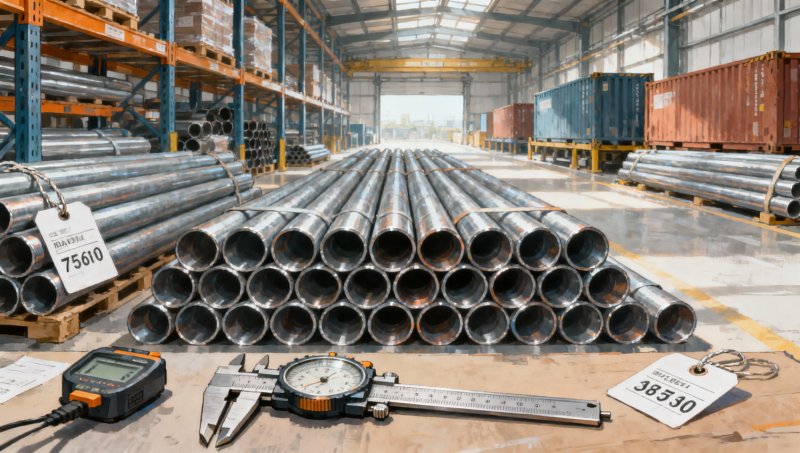
Traceability is what makes a quality claim usable
Traceability matters when a buyer needs to prove what was supplied, isolate a problem, or replace only the affected material. It is most important for structural, safety-sensitive, regulated, fabricated, and project-based work, but it is also useful for routine purchasing because it reduces the scope of a dispute.
A traceable supply chain links the purchasing order, raw material or heat reference where relevant, production batch, inspection documents, bundle identification, and shipping documents. The exact format varies by supplier and product, but the logic should remain intact from production to receipt.
There is a practical test: choose one bundle listed on a packing list and ask the supplier to show how its label connects to the relevant certificate and inspection record. If the answer depends on informal explanations, or if labels disappear after cutting and repacking, traceability is weak. If the supplier can identify the bundle, associated batch, specification, quantity, and documentation quickly, the system is more credible.
Buyers should also define how traceability must be preserved after delivery. Mixed stock in a warehouse can destroy a supplier’s otherwise sound documentation trail. Keep incoming bundles segregated until receiving checks are complete, retain labels where possible, and record any internal cutting or relabelling that breaks the original bundle identity.
Lead time should be tested as a production promise
Quoted lead time is often misunderstood. It may refer to factory readiness, completion of production, readiness for loading, or arrival at the destination. These are not interchangeable. A purchasing team needs a dated sequence: raw material allocation, production window, inspection, packing, booking, loading, document release, and transport.
Ask the supplier to identify which stages are included in the stated lead time and which depend on outside parties. A supplier with stable tube production may still be affected by coating subcontractors, packaging availability, container booking, port handling, or document approval. None of these factors automatically disqualifies a supplier; the risk comes from leaving them undefined.
Lead-time reliability is easier to judge from the supplier’s questions than from a short promise. A supplier that asks about specification, bundle weight limits, destination, required documents, and loading preferences is usually planning the order in operational terms. One that immediately gives the shortest possible date without clarifying the order may be pricing an assumption rather than a controlled delivery.
Compare total procurement cost, not just the tube price
The lowest cost per tonne can become the highest project cost when the tubes require sorting, re-cutting, replacement, urgent freight, or additional inspection after arrival. Compare quotations on the same commercial and technical basis: material specification, tolerances, surface condition, document package, coating requirements, packing, shipment terms, and payment terms.
Pay attention to how the supplier handles quantity tolerance, short lengths, mixed bundles, and claims. These details affect usable yield. A slightly higher quoted price can be commercially stronger when the material arrives correctly bundled, fully documented, and ready for fabrication. Conversely, paying for stringent controls on an uncomplicated, noncritical stock item may add cost without meaningful benefit.
Separate the risks into two categories. The first is product risk: wrong grade, insufficient wall, dimensional variation, poor surface condition, or unsuitable weld quality. The second is execution risk: late shipment, missing certificates, incorrect packing, unclear labels, or slow response when a problem occurs. Suppliers should be scored against both. Good tube quality does not compensate for a shipment that cannot be cleared, received, or released to production.
Use a supplier review that matches the order risk
Not every purchase requires a factory audit, but every purchase benefits from a consistent review. For a routine replenishment order of a familiar tube size, document review, reference samples, and receiving inspection may be enough. For a new supplier, custom profile, critical structure, or export project, a deeper review is justified before awarding the full volume.
A practical sequence is to qualify the specification first, then request a comparable quotation and document sample, review the supplier’s production and inspection capability, place a controlled trial order where appropriate, and only then move to recurring or larger-volume purchasing. The trial order should test more than the tube itself: assess communication speed, document accuracy, bundle labeling, packing quality, and adherence to the promised shipping milestones.
When sourcing several steel products for one construction or industrial project, procurement teams may also value a partner that can coordinate related structural requirements. Hongteng Fengda supplies structural steel products and customized components for international projects, including angle steel, channel steel, steel beams, and cold-formed profiles. For buyers combining tube purchases with other fabricated or structural items, the useful question is whether the supplier can keep specifications, inspection expectations, packaging, and delivery planning consistent across the wider order.
Related stainless products need the same discipline, even when the buying criteria change. For filtration, screening, chemical, mining, architectural, or residential work, buyers considering Stainless Steel Welded Mesh should define the stainless grade, wire diameter, mesh requirement, roll dimensions, and corrosion environment before comparing offers. A broad material label is not enough when open area, retention performance, or chemical exposure affects the application.
Warning signs that deserve follow-up
Several patterns should slow down an award decision. Be cautious when a supplier will not identify the production source, provides certificates that do not match the quoted material, uses descriptions that conflict across quotation and packing list, or cannot explain how bundles are labeled. The same applies when delivery dates change without a revised production or shipping plan.
Another common mistake is accepting “equivalent” material without defining equivalence. Similar dimensions do not guarantee the same chemistry, mechanical properties, tolerance range, coating, or intended standard. An alternative may be commercially reasonable, but it should be approved against the actual design and fabrication requirement before it is substituted.
Finally, avoid splitting technical approval and commercial approval so completely that nobody owns the final comparison. Engineering may approve a grade while procurement accepts a quote with different tolerances or documents. A short, shared specification checklist prevents this gap and gives the receiving team a clear basis for inspection.
Make the award decision defensible
The strongest supplier choice is usually not the supplier with the most polished brochure or the lowest opening price. It is the one that can show a credible route from material to shipment, explain its lead-time assumptions, provide documents that match the physical goods, and respond clearly when requirements become specific.
Before issuing the purchase order, confirm five items in writing: the complete tube specification, the acceptable tolerance and surface condition, the required certificate and bundle-marking format, the delivery milestone that counts as on time, and the inspection or claim procedure. Those five points turn a general supplier promise into a purchase decision that can be checked at every stage.
Please give us a message


Please enter what you want to find