Choosing the right structural steel connection can directly affect project cost, installation speed, inspection requirements, and long-term performance. For project managers, the decision between bolted and welded connections is not simply technical—it influences scheduling, labor coordination, quality control, transportation planning, and sourcing strategy.
The practical question is rarely “Which method is stronger?” Both can provide reliable load transfer when they are correctly engineered, fabricated, and inspected. The better question is: Which connection method best fits the project’s site conditions, programme, risk tolerance, and construction sequence?
A warehouse expansion with repetitive framing, a bridge repair completed during limited closures, and a heavy industrial plant assembled in a congested location may all require very different answers. Understanding where bolting and welding create value—and where they introduce risk—helps project teams make a decision before the fabrication drawings and site schedule become difficult to change.
Bolted vs. welded structural steel connections: the operating difference
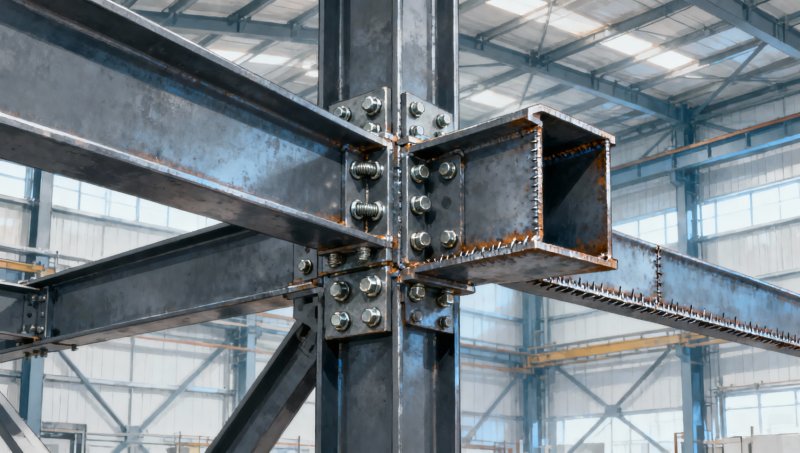
A bolted connection joins steel members using bolts, nuts, washers, and prepared holes in plates, beams, columns, bracing, or other components. Depending on the design, bolts may transfer load through bearing, friction, or a combination of both. The connection is typically fabricated in the workshop and assembled on site with controlled tightening procedures.
A welded connection fuses steel parts together through heat. It may use fillet welds, groove welds, complete-joint-penetration welds, or other specified weld types. Welding can be completed in a controlled fabrication shop, at the construction site, or through a combination of both. Shop welding is often more predictable; field welding demands closer control of weather, access, welding position, and inspection.
At first glance, welded assemblies can look cleaner because they eliminate visible bolts and connection hardware. Bolted joints, on the other hand, make it easier to see how components fit together and can simplify replacement or adjustment later. Neither appearance nor material quantity should decide the method alone. The decision must follow the project’s real constraints.
When bolted connections are usually the practical choice
Bolted structural steel connections are often preferred where fast site assembly matters. Once fabricated steel reaches the project, crews can lift, align, and secure members without waiting for welding equipment, consumables, hot-work permits, or post-weld cooling. This is especially valuable when erection activities must continue across multiple work fronts.
For projects in remote areas, busy urban sites, or locations with variable weather, bolting can reduce site uncertainty. Rain, high winds, low temperatures, and restricted working platforms can all complicate field welding. Bolted installation is not weather-proof—safe lifting and proper bolt installation still matter—but it usually has fewer environmental variables than field welding.
Bolted joints also support a more modular delivery strategy. Steel beams, columns, channels, angles, and connection plates can be fabricated, marked, packed, and shipped as coordinated assemblies, then erected in sequence. For international projects, this approach can reduce the amount of specialist welding work required after cargo arrives on site.
- Faster erection: suitable for repetitive frames, warehouses, platforms, and commercial structures.
- Less hot work on site: helpful in operating facilities, refineries, storage areas, and locations with strict fire controls.
- Simpler future modification: members can often be removed or replaced with less disruption than welded assemblies.
- Clearer erection sequencing: pre-punched or drilled holes support faster alignment when fabrication tolerances are well managed.
- Lower dependence on field welding labour: an important consideration where qualified welders are limited.
However, “bolted” does not automatically mean easy. Hole positions, steel member dimensions, bolt grades, surface conditions, and tightening methods must match the approved design. A small fabrication error can turn a fast connection into a costly site adjustment. Project managers should ensure that the fabrication drawings define bolt type, diameter, hole type, tightening requirements, washers, coatings, and any slip-critical surface preparation.
Where welded connections can make better engineering and commercial sense
Welded connections are often selected when the structure requires continuity, compact geometry, or a connection shape that would be difficult to achieve with plates and bolts. They can be highly effective in built-up members, trusses, crane girders, equipment supports, architectural exposed steel, and complex custom assemblies.
In a fabrication shop, welding offers an important advantage: controlled conditions. Fabricators can position members correctly, maintain access to the joint, use qualified welding procedures, and carry out inspections before dispatch. A shop-welded assembly may reduce the number of field connections and shorten the final erection stage, provided its size and weight remain practical for transport and lifting.
Welding can also avoid the need for bolt holes, which may be useful where connection plates would create congestion or reduce the available section. For highly loaded or geometrically demanding joints, a properly designed welded detail may provide a more direct load path than a heavily bolted arrangement.
The trade-off is that welded work requires tighter process discipline. Weld quality is affected by material preparation, fit-up, preheat requirements, welding consumables, welder qualification, environmental conditions, and inspection access. Field welding adds more variables. If the project has limited access, poor weather protection, or a compressed programme, these variables can quickly become schedule risks.
The cost comparison is not simply bolts versus weld metal
Project budgets often compare the visible unit costs of bolts and welding labour. That is too narrow. The real cost of a structural steel connection includes engineering, shop detailing, fabrication, coating repair, transportation, site labour, equipment, inspection, rework exposure, and programme impact.
Bolted connections may require more plates, bolts, drilling, and detailing, but they can lower field labour costs and reduce construction downtime. Welded connections can reduce hardware and sometimes produce more compact assemblies, yet welding labour, non-destructive testing, access arrangements, and coating repairs may offset those savings.
Transport changes the calculation as well. A large, fully welded assembly can reduce site work but may require special shipping arrangements or larger cranes. Breaking the same assembly into bolted transportable sections may make export packing and local handling easier. For globally sourced structural steel, this is often a decisive issue rather than a secondary one.
Ask the fabrication team to price the full installed solution, not only the connection detail. A lower shop price can be misleading if it creates expensive field welding. Conversely, a connection with more bolts may still be the lower-risk choice when it allows the project to maintain its erection schedule.
Inspection, traceability, and quality control
Both methods need documented quality control, but the inspection focus differs. For bolted work, inspectors normally verify bolt grade, hole condition, installed configuration, tightening or tensioning method, and any required surface treatment for slip-critical joints. The installation process should be clear enough that the site team knows whether bolts are snug-tight, pretensioned, or installed under a specified torque or tension-control procedure.
Welded work requires review of welding procedure specifications, welder qualifications, joint preparation, fit-up, visual inspection, and, where specified, testing such as ultrasonic, magnetic particle, radiographic, or dye penetrant examination. Not every weld requires the same level of testing. The inspection plan should match the connection’s design importance and applicable project standard.
A frequent management mistake is treating inspection as an activity that occurs only after fabrication. The most effective control begins much earlier: confirm material certificates, establish traceability, approve drawings, review welding procedures, and agree on hold points before production starts. For export supply, these records are particularly valuable because they give the project team confidence before the steel reaches the site.
Corrosion protection and maintenance should influence the decision
Connection selection affects coating work. Welding performed after coating typically damages the protective system around the joint and requires careful repair. Bolted connections can also create coating challenges around bolt heads, nuts, faying surfaces, and inaccessible crevices, especially in corrosive environments.
For galvanized structural components, site welding needs special attention because zinc coating near the weld is burned away and must be restored appropriately. In painted systems, the specified coating repair procedure should be agreed before erection begins. Where structures face moisture, salt exposure, industrial chemicals, or frequent washdown, the design should avoid water traps and allow practical inspection access.
Long-term maintenance is another distinction. A bolted member can often be removed for replacement, strengthening, or equipment access. Welded details may be preferable where permanent continuity is needed, but they can be more disruptive to alter after commissioning. If the building is likely to expand, carry new services, or receive future equipment loads, demountability deserves a place in the decision discussion.
A project manager’s decision checklist
Before choosing a bolted or welded solution, bring the structural engineer, fabricator, erection contractor, and procurement team into the same conversation. The following questions usually reveal the most suitable route:
- Will the majority of work be completed in a controlled fabrication shop or at the jobsite?
- How reliable are site access, weather protection, power supply, lifting capacity, and qualified welding resources?
- Is rapid erection more valuable than minimizing the number of connection components?
- Are hot-work permits, fire watch requirements, or operational restrictions likely to delay field welding?
- Does the structure need future disassembly, relocation, strengthening, or component replacement?
- Can the welded assembly be shipped and lifted safely, or should it be divided into bolted modules?
- What inspection capability is available at the shop and on site?
- Which standard governs the project—ASTM, EN, JIS, GB, or a project-specific specification—and how will compliance be documented?
There is also a third option that is common in successful steel projects: use both. Shop-welded subassemblies combined with bolted field splices often provide a balanced solution. The fabricator completes complex welding under controlled conditions, while the erection team uses bolted connections for predictable site installation. This hybrid approach can reduce risk without forcing the project into an all-or-nothing choice.
Do not overlook related reinforcement and material coordination
Connection planning does not happen in isolation. Foundations, base plates, anchor bolts, embedded items, and reinforced concrete interfaces all influence steel erection tolerances. Where a project includes civil works, managers should coordinate the steel package with reinforcement supply, bar schedules, and construction sequencing. Materials such as Wire rod may be processed for construction applications including reinforcement-related work, foundations, beams, columns, walls, and slabs, subject to the project’s specified grade and standard requirements.
Early coordination matters because a perfectly fabricated steel frame can still face delays if foundation embeds are misplaced or concrete work does not match the approved erection tolerances. The connection strategy should therefore be reviewed alongside the interface between structural steel, civil construction, and site survey control.
Choose the connection that protects the programme, not just the drawing
Bolted connections generally fit projects that need fast assembly, flexible logistics, reduced site welding, and easier future changes. Welded connections are often more suitable when compact details, continuity, or controlled shop fabrication are the priority. The strongest decision is not based on habit or visual preference; it is based on how the connection will be fabricated, shipped, erected, inspected, protected, and maintained.
For project managers, the best time to resolve this choice is before procurement and detailing are locked in. Review the connection concept with the steel supplier using actual site constraints, lifting plans, delivery routes, quality requirements, and programme milestones. A well-selected structural steel connection does more than join two members—it keeps the wider project moving with fewer surprises.
Please give us a message


Please enter what you want to find