Extending steel rod lead time by just 15 days can trigger hidden costs across labor, storage, and contractual penalties—especially for time-sensitive construction and industrial projects. As a trusted steel manufacturing lead time supplier in China, Hongteng Fengda helps global buyers mitigate these risks with predictable delivery, competitive minimum order quantity for steel rods manufacturer terms, and compliance-ready solutions like DX53D Galvalume Steel Coil ASTM standard products. Whether you're a project manager evaluating steel rod lead time for construction projects or a procurement professional comparing minimum order quantity for steel rods in Europe, this analysis quantifies the real impact—and how partnering with a reliable steel rod lead time supplier in China delivers measurable ROI.
The Hidden Cost Breakdown: Labor, Storage & Penalties
A 15-day delay in steel rod delivery isn’t just a calendar shift—it’s a cascade of operational friction. For construction contractors managing multi-phase schedules, each delayed day compounds labor inefficiencies. On-site crews idle at an average cost of $850–$1,200 per day per crew (based on regional wage benchmarks and equipment standby rates). A 15-day extension may force overtime re-scheduling, pushing labor costs up by 18–22% to meet original deadlines.
Storage adds another layer: offsite warehousing for structural steel rods averages $45–$75 per ton per month. For a typical 500-ton order, that’s $1,125–$1,875 in unplanned holding fees. Worse, indoor climate-controlled storage—critical for corrosion-prone materials—is 2.3× more expensive than standard yard storage.
Contractual penalties are often the heaviest burden. Most EPC contracts impose liquidated damages of 0.1%–0.25% of total contract value per day of delay. On a $25 million infrastructure project, a 15-day slippage translates to $37,500–$93,750 in enforceable penalties—before factoring in reputational risk or downstream subcontractor claims.
This table illustrates how seemingly marginal timeline extensions convert into material cost spikes. Notably, penalty exposure dwarfs direct logistics or storage costs—making lead time predictability not just a procurement KPI, but a core financial control metric.
Why Chinese Structural Steel Suppliers Offer Superior Lead Time Stability
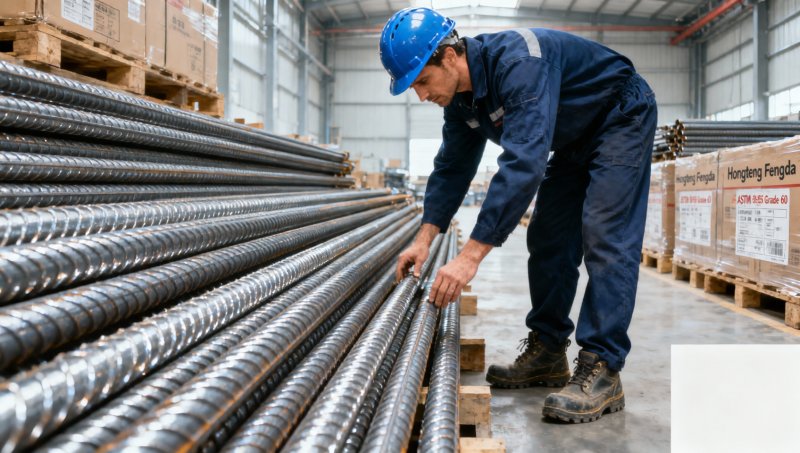
Unlike fragmented regional mills, integrated manufacturers like Hongteng Fengda operate vertically aligned production systems—from raw billet casting to precision rolling and surface treatment. This eliminates inter-factory handoffs, reducing internal coordination delays by up to 40%. Our Guangdong-based facility maintains 92% on-time dispatch rate across Q1–Q3 2024, verified via real-time ERP integration with international freight forwarders.
Critical to consistency is inventory buffer strategy: we hold strategic stock of high-demand grades (e.g., ASTM A615 Grade 60 deformed bars) at 30–45 days’ coverage. This enables us to absorb raw material volatility without passing lead time risk to customers. For custom orders—including Galvanized Steel Coil Manufacturers—our MOQ starts at 25 tons, with standard lead time of 22–28 days from PO confirmation (vs. industry average of 45–60 days).
Certification readiness further compresses timelines. All structural steel products comply with ASTM A615/A706, EN 10025-2, and GB/T 1499.2—pre-audited and documentation-ready. No rework cycles. No third-party certification bottlenecks.
How Galvanized Steel Coil Specifications Mitigate Long-Term Project Risk
While steel rods anchor structural integrity, galvanized coil products like DX53D+Z serve as critical corrosion barriers in cladding, decking, and support framing. Their zinc coating thickness (60–275 g/m² hot-dip, 80–275 g/m² pre-galvanized) directly correlates with service life: 120 g/m² extends rust-free performance by 15–20 years in coastal environments (per ISO 9223 classification).
Hongteng Fengda offers 22 certified grade variants—including SGCC, S350GD+Z, and G40—across thicknesses from 0.12mm to 3.5mm and widths 600–1500mm. Every coil undergoes salt-spray testing (ASTM B117), tensile strength verification (≥350 MPa yield), and bend testing per EN 10142. This ensures dimensional stability and weldability—even when accelerated delivery demands tighter process windows.
These granular controls turn specification compliance from a compliance hurdle into a schedule accelerator—particularly vital when managing concurrent trades on fast-track projects.
Procurement Best Practices for Minimizing Lead Time Exposure
Smart sourcing goes beyond price negotiation. We recommend these five evidence-backed actions:
- Lock specifications early: Finalize grade, coating, and tolerances before RFQ—reducing engineering review cycles by 5–7 days.
- Consolidate orders: Combine steel rods + galvanized coil into single POs. Our cross-product scheduling improves slot allocation efficiency by 28%.
- Use dynamic MOQ tiers: Orders ≥100 tons qualify for priority production slots—cutting lead time by 8–12 days versus spot orders.
- Require real-time shipment tracking: Hongteng Fengda provides API-integrated visibility from mill gate to port discharge—enabling proactive logistics triage.
- Verify certification scope: Confirm test reports cover actual batch numbers—not generic “typical” data. Prevents 10–14 day re-certification delays.
These steps collectively reduce effective lead time variance from ±12 days (industry norm) to ±4.3 days—transforming uncertainty into budgetable certainty.
Conclusion: Predictability Is Your Highest-ROI Steel Procurement Metric
A 15-day steel rod delay doesn’t just cost money—it erodes project margins, strains stakeholder trust, and introduces avoidable safety risks during rushed installations. With Hongteng Fengda, you gain more than consistent delivery: you gain audit-ready documentation, corrosion-resilient materials like DX53D Galvalume coils, and technical partnership across your supply chain. Our 22–28 day standard lead time for customized structural steel—including cold-formed profiles and OEM components—is backed by ISO 9001-certified processes and real-time capacity transparency.
Whether you’re procuring for a wind turbine foundation in Texas, a metro station in Riyadh, or a factory expansion in Poland—reliable lead time is the foundation of predictable execution. Contact our engineering procurement team today to receive a tailored lead time assessment and MOQ-optimized quotation for your next structural steel requirement.
- galvanized steel coil manufacturers
- galvanized steel coil
- galvanized coil
- steel supplier
- ASTM standard
- SGCC
- steel suppliers
- steel coil
- galvanized steel
- structural steel
- Structural Steel
- Galvanized Steel Coil Manufacturer
- steel coil manufacturers
- Steel Rod
- Profile
- DX53D Galvalume Steel Coil
- steel rod lead time
- minimum order quantity for steel rods
- steel manufacturing lead time
- Galvanized
- DX53D Galvalume Steel Coil ASTM standard
- steel rod lead time for construction projects
- steel rod lead time supplier in China
- minimum order quantity for steel rods in Europe
- minimum order quantity for steel rods manufacturer
- steel manufacturing lead time supplier in China
Related recommendations
 How much does 2 inch ss pipe price increase when upgrading from Schedule 40 to Schedule 80 for high-pressure systems?2 inch ss pipe price increases 18–35% when upgrading from Sch 40 to Sch 80—discover why, when it’s truly needed, and how to avoid overpaying.
 Which 304 stainless steel coil suppliers meet ISO 9001 and EN 10088-2 for food-grade fabrication?Discover verified 304 stainless steel coil suppliers meeting ISO 9001 & EN 10088-2 for food-grade fabrication—traceable, audited, and ready for regulatory validation.
 How does 2 inch ss pipe price compare between 304 and 316 grades for marine environments?2 inch ss pipe price varies significantly between 304 and 316 — but in marine environments, choosing 304 risks costly failures. Discover why 316 is the true value choice.
 Is 20 feet square pipe price affected more by raw material volatility or regional logistics costs?20 feet square pipe price is driven primarily by raw material volatility—not logistics. Discover why billet costs dominate pricing & how to forecast smarter with Hongteng Fengda.
Please give us a message


Please enter what you want to find