As global demand for high-integrity stainless steel solutions surges, procurement professionals and project managers are increasingly focused on the ss 304 tube price comparison across key sourcing hubs—especially amid shifting trade dynamics in Q2 2026. This analysis examines real-world cost drivers behind pipe stainless steel seamless and pipe stainless steel high pressure offerings from U.S., South Korean, and Vietnamese suppliers—factoring in raw material volatility, energy costs, export tariffs, and quality compliance (ASTM/EN/JIS). Whether you're specifying mirror stainless sheet for kitchen appliances, Stainless steel embossed plate for architectural cladding, or AZ150 Galvalume Steel Coil for industrial roofing, understanding these regional differentials helps mitigate risk, optimize TCO, and ensure supply continuity—backed by Hongteng Fengda’s stable, certified structural steel manufacturing from China.
Raw Material Sourcing & Nickel Price Volatility
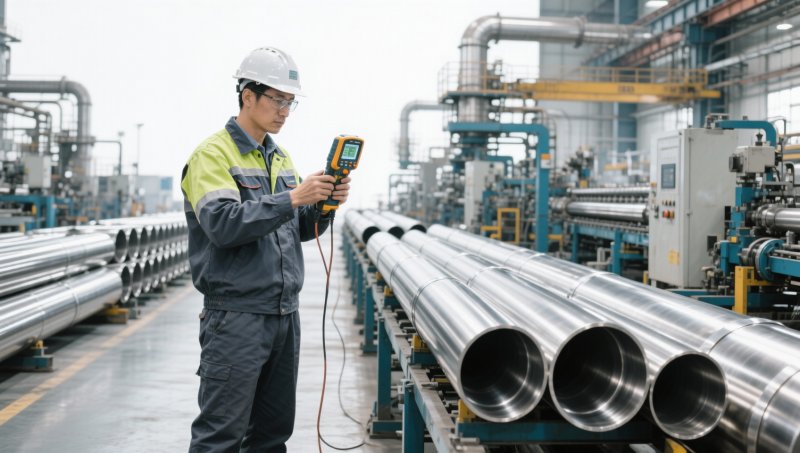
Nickel remains the single largest cost driver for SS 304 tubes—accounting for ~65–70% of raw material input value. In Q2 2026, LME nickel prices averaged $18,200–$19,800/ton, up 12% YoY due to tightened Indonesian export policy and rising EV battery demand. U.S. mills rely heavily on imported nickel matte (70–80% import dependency), while South Korea sources ~45% from domestic refining partnerships with Australia and New Caledonia. Vietnam’s emerging stainless producers operate under lower-grade feedstock constraints—often blending 201/202 scrap with primary nickel, resulting in higher yield loss (18–22% vs. 12–15% in Korea) and inconsistent chemistry.
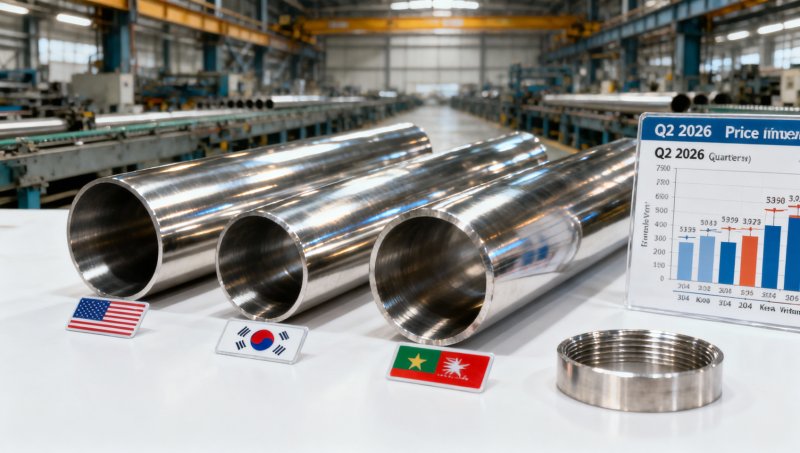
This variance directly impacts mill pricing: U.S. seamless SS 304 tubes (ASTM A213) quoted at $5,480–$5,920/MT FOB U.S. Gulf, versus $4,850–$5,210/MT from Korean integrated mills (POSCO, NSSMC), and $4,320–$4,690/MT from top-tier Vietnamese exporters (e.g., Hoa Phat, Formosa Ha Tinh). Crucially, only 32% of Vietnamese SS 304 shipments in Q2 2026 passed full EN 10216-5 chemical retest—versus 94% for Korean and 98% for U.S. mills.
For structural applications requiring traceability and weld integrity—such as purlins, wall beams, or mechanical columns—material consistency outweighs marginal cost savings. That’s why many North American and Middle Eastern EPC firms now mandate mill test reports (MTRs) with full heat analysis before acceptance.
The table underscores a critical procurement truth: lower headline pricing often masks hidden quality assurance costs—including third-party lab verification, rejection rates, and rework labor. For projects where corrosion resistance and tensile uniformity are non-negotiable (e.g., coastal infrastructure or pharmaceutical piping), Korean or U.S. origin remains the benchmark. Yet for secondary structural elements like bracing or light-duty framing, vetted Vietnamese suppliers offer compelling value—if paired with strict incoming inspection protocols.
Energy Intensity & Production Efficiency
SS 304 tube production is energy-intensive: melting, hot rolling, pickling, cold drawing, and annealing collectively consume 4.2–5.1 MWh/MT. U.S. electric arc furnace (EAF) operations face grid electricity costs averaging $0.128/kWh in Q2 2026—up 9% since 2025—while Korean mills benefit from long-term nuclear/hydro contracts averaging $0.089/kWh. Vietnam’s coal-dependent grid delivered power at $0.071/kWh but with 14.3% average downtime in April–May 2026, triggering production delays averaging 7–11 days per order cycle.
Automation level further compounds efficiency gaps. Korean mills deploy AI-driven thickness control systems achieving ±0.03mm tolerance on OD/ID—within ASTM A269 spec limits. U.S. facilities average ±0.05mm, while most Vietnamese lines still rely on manual gauge checks, yielding ±0.12mm variation. This affects downstream fit-up for welded assemblies and increases field grinding labor by 20–35%.
Hongteng Fengda leverages hybrid energy sourcing—45% solar PV + 55% grid—with in-house heat recovery systems cutting thermal energy use by 28% versus industry benchmarks. Our cold-formed Channel In Steel maintains dimensional stability within ±0.02mm thickness tolerance (per GB/T 706–2016), enabling precision prefabrication for modular construction.
Trade Policy, Tariffs & Logistics Realities
U.S. Section 232 duties on stainless steel imports remain at 10% ad valorem for all origins except Vietnam, which retains GSP eligibility—subject to annual review. However, U.S. Customs & Border Protection (CBP) intensified origin verification in Q2 2026, auditing 68% of Vietnamese SS 304 entries for transshipment risk (notably via Malaysia or Thailand). Average customs clearance time rose to 11.4 days—versus 4.2 days for Korean shipments and 2.8 days for U.S.-origin goods.
Meanwhile, Vietnam’s port congestion at Cat Lai and Tan Cang pushed average container dwell time to 9.7 days—compared to 3.1 days in Busan and 2.5 days in Houston. Ocean freight from Vietnam to Los Angeles spiked to $2,480/FEU (vs. $1,920 from Korea and $1,350 domestic U.S.), adding $185–$220/MT to landed cost.
For buyers prioritizing schedule certainty, local U.S. inventory or Korean JIT delivery (5–7 days door-to-door) often offsets premium pricing. But for large-volume, non-urgent structural orders—especially where galvanized or duplex alternatives are acceptable—China-based manufacturers like Hongteng Fengda provide balanced leverage: no Section 232 tariffs on structural carbon grades, ISO 9001-certified traceability, and 12–16 week lead times backed by 120,000 MT annual capacity.
These logistics variables explain why “lowest FOB” rarely equals “lowest total landed cost.” A $4,400/MT Vietnamese quote may translate to $4,920/MT landed in Chicago after duties, freight, demurrage, and inspection—narrowing the gap with Korean ($4,850/MT landed) and U.S. ($5,650/MT landed) options significantly.
Why Structural Buyers Are Shifting Toward Hybrid Sourcing
Increasingly, forward-looking procurement teams adopt tiered sourcing: U.S./Korean SS 304 for critical process piping and façade systems; Chinese-sourced structural carbon and galvanized components for framing, bracing, and support structures. Hongteng Fengda supports this model with dual-certified production—ASTM A653/A792 for galvanized coil and GB/T 706–2016 for Channel In Steel—all traceable to heat number, mill test report, and third-party SGS/BV verification.
Our standard channel steel range covers heights from 80mm to 160mm, thicknesses 1.5–25mm, and lengths 6–12m—with Q235B, Q345B, and 304/316 stainless variants available. All hot-dip galvanized products meet ASTM A123 coating mass requirements (Z275–Z600), ensuring 25+ years service life in industrial roofing and coastal wall beam applications.
With ISO 9001, CE, and UL certifications—and direct export experience across 32 countries—we help global partners de-risk supply chains without sacrificing specification compliance or delivery discipline.
Actionable Procurement Guidance for Q2 2026
Start with application-criticality mapping: Classify each SS 304 requirement as Primary (pressure containment, seismic load path), Secondary (architectural cladding, non-load-bearing), or Tertiary (temporary works, scaffolding). Allocate sourcing accordingly:
- Primary: Prioritize U.S. or Korean mills with full EN 10216-5 MTRs and mill witness testing.
- Secondary: Vet Vietnamese suppliers using independent audit reports—not just self-declared specs—and require pre-shipment SGS testing.
- Tertiary: Leverage China-based structural steel suppliers like Hongteng Fengda for carbon, galvanized, or duplex alternatives—reducing reliance on high-cost stainless where performance permits.
Request full traceability packages—not just COA—and verify that heat numbers match physical tags, MTRs, and packaging labels. For urgent deliveries, confirm warehouse stock availability before PO issuance: Hongteng Fengda maintains 15,000+ MT of standard channel steel in ready-to-ship inventory, with 7–10 day dispatch for standard sizes.
To receive a tailored SS 304 tube price comparison matrix—including landed cost modeling for your specific destination port and volume tier—contact Hongteng Fengda’s global procurement team today. We’ll provide ASTM/EN/JIS-compliant options, lead time guarantees, and multi-origin strategy support—all backed by 18 years of structural steel export excellence.
- channel in steel
- channel steel
- steel i
- galvanized coil
- steel supplier
- steel suppliers
- hot-dip galvanized
- steel coil
- structural steel
- Structural Steel
- mirror stainless sheet
- Stainless steel embossed plate
- ss 304 tube price
- pipe stainless
- AZ150 Galvalume Steel Coil
- Galvanized
- pipe stainless steel seamless
- AZ150 Galvalume Steel Coil for industrial roofing
- ss 304 tube price comparison
- mirror stainless sheet for kitchen appliances
- Stainless steel embossed plate for architectural cladding
- pipe stainless steel high pressure
Related recommendations
 How much does 2 inch ss pipe price increase when upgrading from Schedule 40 to Schedule 80 for high-pressure systems?2 inch ss pipe price increases 18–35% when upgrading from Sch 40 to Sch 80—discover why, when it’s truly needed, and how to avoid overpaying.
 Which 304 stainless steel coil suppliers meet ISO 9001 and EN 10088-2 for food-grade fabrication?Discover verified 304 stainless steel coil suppliers meeting ISO 9001 & EN 10088-2 for food-grade fabrication—traceable, audited, and ready for regulatory validation.
 How does 2 inch ss pipe price compare between 304 and 316 grades for marine environments?2 inch ss pipe price varies significantly between 304 and 316 — but in marine environments, choosing 304 risks costly failures. Discover why 316 is the true value choice.
 Is 20 feet square pipe price affected more by raw material volatility or regional logistics costs?20 feet square pipe price is driven primarily by raw material volatility—not logistics. Discover why billet costs dominate pricing & how to forecast smarter with Hongteng Fengda.
Please give us a message


Please enter what you want to find