Sourcing the right weight of I beam supplier in Europe demands more than just competitive pricing—it requires verified reliability, accurate beams weight calculation for structural steel, and transparent lead times. Whether you're measuring a steel beam for industrial warehouse, bridge projects, or general construction, engineers rely on precise I beam weight specifications and trusted tools like an I beam weight calculator. This guide helps procurement teams, project managers, and quality controllers evaluate European suppliers critically—especially when comparing against globally compliant manufacturers like Hongteng Fengda, whose EN/ASTM-certified beams weight chart and stable delivery performance support seamless cross-border sourcing.
Why Beam Weight Accuracy Matters Across Project Phases
Beam weight isn’t just a number on a datasheet—it directly impacts structural integrity, transportation logistics, crane capacity planning, and foundation load calculations. For example, miscalculating the weight of I beam in USA or EU-sourced products by even 5% can trigger re-engineering, delayed site handovers, or non-compliance with EN 1993-1-1 (Eurocode 3). Industrial warehouse designers need consistent I beam weight for construction projects to align with fire-rated floor slabs; bridge engineers require traceable I beam weight specifications for fatigue analysis under cyclic loading. Misjudged values also inflate safety margins unnecessarily—raising material costs without added value.
Moreover, inconsistent weight reporting across suppliers often signals deeper issues: uncalibrated rolling mills, undocumented alloy variations, or lack of third-party mill test reports (MTRs). That’s why seasoned project managers prioritize suppliers who publish full beams weight calculation for structural steel—not just nominal dimensions—and back them with real-time production records.
How to Measure a Steel Beam for Industrial Use: A Practical Workflow
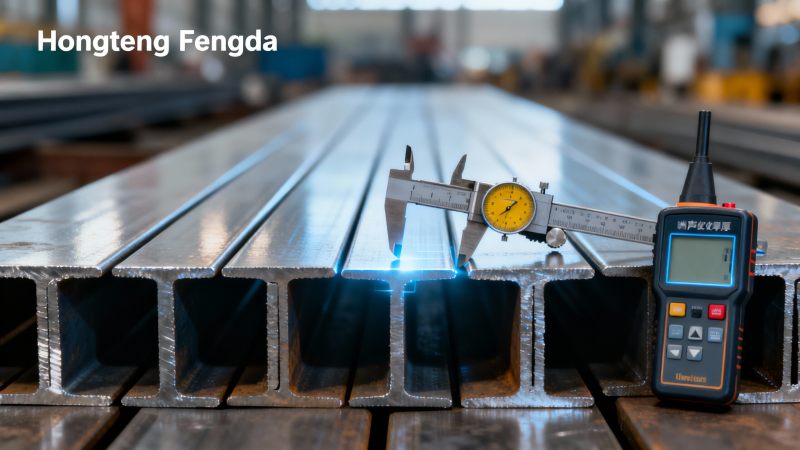
Measuring a steel beam for industrial warehouse or bridge projects begins long before tape measures hit metal. Start with design-stage verification: confirm whether your specification references nominal size (e.g., “IPE 300”) or actual section properties per EN 10365. Then cross-check with certified product documentation—not brochures. Use an I beam weight calculator for construction engineers only after validating input parameters: flange width, web thickness, overall depth, and unit length. Never assume density equals 7850 kg/m³ without confirming carbon content and heat treatment history.
On-site, verify physical dimensions using calibrated calipers and ultrasonic thickness gauges—not visual estimation. Compare measured mass against theoretical weight derived from certified dimensions and ASTM A6/A6M tolerances. Discrepancies > ±2.5% warrant immediate investigation. Also check for surface defects affecting sectional area—mill scale buildup or rust pitting can skew weight-based load assumptions.
European Supplier Evaluation: Key Verification Criteria
When vetting a weight of I beam supplier in Europe, go beyond marketing claims. Demand evidence—not promises—for three pillars: metrological traceability, process stability, and supply chain transparency. Ask for ISO/IEC 17025-accredited calibration certificates for all dimensional measurement equipment. Require quarterly audit reports from notified bodies like TÜV Rheinland or SGS—not just self-declared conformity to EN 10025-2.
Also assess lead time reliability—not just quoted duration. Request anonymized shipment data for the past 12 months: on-time delivery %, order-to-shipment variance (standard deviation), and percentage of expedited orders. A truly dependable partner maintains <±5 days variance—even during peak Q4 demand. Contrast this with fragmented regional distributors who layer multiple intermediaries, adding uncertainty at every handoff.
Comparison: Local EU Suppliers vs. Globally Compliant Exporters
The table below compares critical evaluation metrics between typical European stockholders and vertically integrated exporters like Hongteng Fengda:
Standards & Certification: Your Compliance Anchor
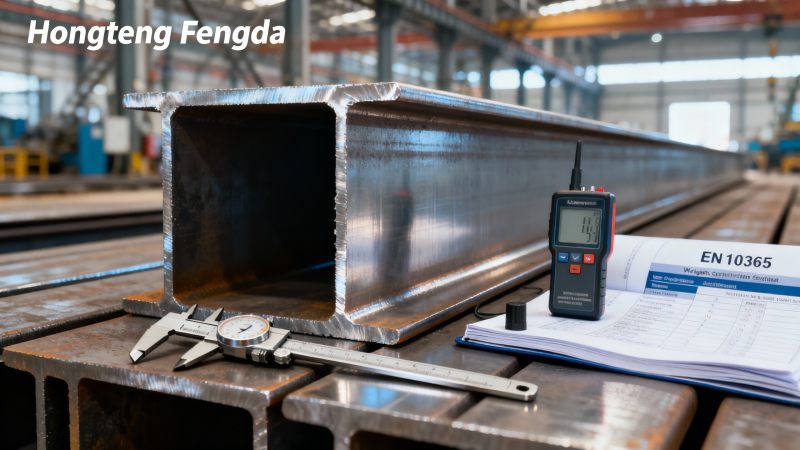
True compliance goes beyond label stickers. A credible weight of I beam supplier in Europe must demonstrate adherence to both material and dimensional standards. EN 10025-2 governs mechanical properties for structural steels like S235JR and S355JR, while EN 10365 defines exact section characteristics—including how to measure a steel beam for bridge projects down to 0.1 mm precision. ASTM A6/A6M remains essential for transatlantic projects requiring dual certification.
Look for suppliers publishing full test reports—not summaries—with tensile yield strength, elongation at break, and Charpy V-notch impact values at specified temperatures. Avoid those offering “EN-equivalent” grades without official test certificates. Hongteng Fengda’s EN-certified beams undergo mandatory ultrasonic testing (UT) per EN 10160 and receive individual heat numbers traceable to raw billet batches—critical for safety-critical infrastructure.
Why Choose Hongteng Fengda for Global Structural Steel Sourcing?
As a professional structural steel manufacturer and exporter from China, Hongteng Fengda delivers what European procurement teams increasingly demand: predictability without compromise. Our modern rolling mills produce IPE, HEA, HEB, and custom hybrid beams with certified weight consistency across 50,000+ tons annual capacity. Every shipment includes EN 10204 3.2 MTRs, dimensional inspection reports, and digital weight verification logs—accessible via secure client portal.
We reduce risk through vertical integration: in-house billet casting, hot rolling, straightening, and surface treatment—including anti-rust oil options aligned with ISO 8501-1 Sa2.5 standards. Unlike spot-market vendors, we guarantee lead times because we control the entire flow—from furnace to forklift. And for complex applications? Our engineering team co-develops solutions—like integrating A36 Carbon Steel Round Bar into composite columns or designing tapered I-beams for architectural façades.
Partner with us to replace sourcing uncertainty with documented reliability—where every I beam weight specification is verifiable, every delivery date is contractual, and every project milestone starts with confidence.
- structural steel
- Structural Steel
- Steel Beam
- weight of i beam
- i beam weight
- how to measure a steel beam
- beams weight
- I beam weight for construction projects
- How to measure a steel beam for industrial use
- Weight of I beam in USA
- Beams weight calculation for structural steel
- Weight of I beam supplier in Europe
- I beam weight calculator for construction engineers
Related recommendations
") Stainless Steel Tube Coil vs. Straight Tube: Total Cost of Ownership in HVAC Retrofit Projects (Installation Labor, Leak Points, Space Savings)Stainless steel tube coil cuts HVAC retrofit TCO by slashing labor, leaks & space needs—discover how coil outperforms straight tube in real-world retrofits.
Stainless Steel Tube Coil vs. Straight Tube: Total Cost of Ownership in HVAC Retrofit Projects (Installation Labor, Leak Points, Space Savings)Stainless steel tube coil cuts HVAC retrofit TCO by slashing labor, leaks & space needs—discover how coil outperforms straight tube in real-world retrofits. Steel Coils Suppliers vs. Direct Mills: Lead Time, MOQ, and Custom Slitting Flexibility Compared for Mid-Volume BuyersSteel coils suppliers offer faster lead times, lower MOQs (5–10 tons), and precision custom slitting—ideal for mid-volume structural fabricators seeking agility, quality, and cost control.
 How to Vet Stainless Steel Coil Suppliers: 7 Due-Diligence Checks for Quality, Traceability, and ISO ComplianceStainless steel coil suppliers vetted right mean zero surprises on site. Discover 7 field-tested due-diligence checks for quality, full traceability & real ISO compliance.
 Stainless Coil Pipe vs. Seamless Pipe: When to Choose Welded Coiled Tubing for High-Pressure Fluid SystemsStainless coil pipe delivers unmatched efficiency for high-pressure fluid systems—superior continuity, faster installation, and proven weld integrity vs. seamless.
Please give us a message


Please enter what you want to find