Accurate quantity estimates are essential for controlling costs and keeping structural steel projects on schedule. A beam weight chart helps procurement professionals calculate the approximate weight of steel beams by section size and length, providing a practical starting point for purchase orders, freight planning, and supplier comparisons. The important distinction is that a chart gives you a theoretical weight—not necessarily the quantity you will buy, the weight a supplier will invoice, or the load that arrives at the jobsite.
Start with the exact beam designation
A beam schedule might identify a member by section designation, grade, length, and quantity. All four matter, but the designation is the starting point for the weight lookup. Two beams with similar depths can have different flange widths or thicknesses, and therefore different weights per unit length.
Use a chart that matches the specified section series and dimensional standard. Do not assume that a wide-flange section in one market is interchangeable with a similarly named H-beam or I-beam in another. Even where overall dimensions appear close, connection details and structural performance may differ. A substitution should be approved by the project engineer before purchasing treats it as equivalent.
Also check the units. A metric chart commonly lists kilograms per metre, while a US chart may list pounds per foot. The number in a designation can be useful for identification, but it is safer to read the published unit weight than to infer it from the name.
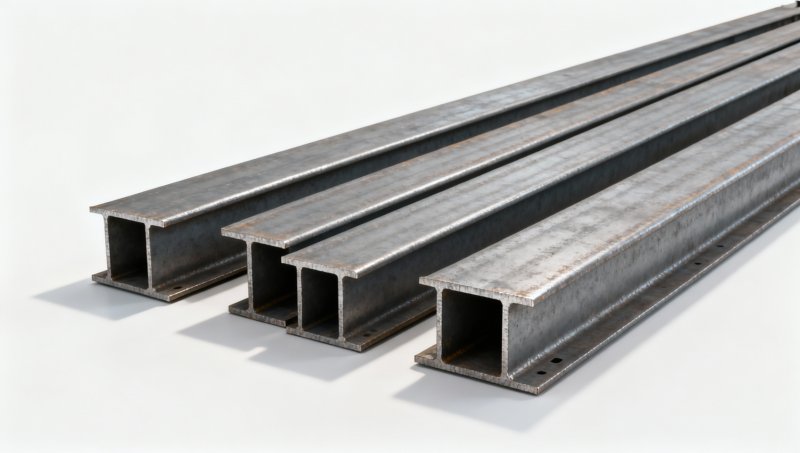
Turn the chart weight into an order estimate
For each beam line, multiply the chart weight by the required length and the number of pieces:
Theoretical line weight = unit weight × length per piece × number of pieces
For example, suppose the applicable chart lists a section at 40 kg/m and the schedule calls for 24 pieces, each 6 m long. The calculation is 40 × 6 × 24 = 5,760 kg, or 5.76 metric tonnes. The 40 kg/m figure is an illustrative input, not a claim about a particular section.
Repeat the calculation for each distinct section and length, then add the line weights. Keep the quantities visible rather than combining everything into one total too early. A supplier needs to know whether the requirement is 24 identical pieces or several different cut lengths, even when the overall tonnage is the same.
A useful estimating sheet includes the section designation, governing dimensional standard, grade, piece length, piece count, unit weight, calculated weight, and any fabrication notes. Add a separate column for the supplier’s offered stock length and quoted weight. That makes it easier to see whether a low headline price depends on a different cutting arrangement or an unapproved section.
Do not confuse finished length with purchased length
The 5.76-tonne example assumes that the purchase can be based on exactly 144 m of beam. In practice, the supplier may sell full stock lengths, supply cut pieces, or quote a combination. If pieces must be cut from longer bars, the purchasing quantity depends on how efficiently those lengths can be nested.
Consider cutting loss as well as the width of each saw cut. An offcut is not automatically waste: it may be usable elsewhere in the project. But unless it has an identified use and can be retained, it should not be treated as free material. Ask whether offcuts remain with the supplier, ship to the buyer, or are included in the quoted weight.
Avoid adding the same blanket waste percentage to every line. Long repetitive pieces cut efficiently from an available stock length can behave very differently from a schedule containing short, mixed lengths. Where the tonnage is significant, a cutting plan is more defensible than a guess.
Theoretical weight is only one billing basis
Steel sections are manufactured within permitted dimensional tolerances, so actual mass can differ from the chart calculation. The relevant tolerance depends on the product and applicable standard. Do not assume that the same allowance applies to every beam or that a dimensional tolerance translates directly into the same percentage variation in mass.
Before comparing prices per tonne, establish whether each quotation uses theoretical weight, actual scale weight, or another agreed basis. A theoretical-weight quote should identify the dimensions and unit weights used. An actual-weight quote should explain the weighing method and documentation. If the supplier charges for full stock lengths, cutting loss may already be embedded in the billable quantity.
For fabricated beams, clarify whether the quoted weight includes connection plates, stiffeners, end plates, bolts, weld metal, or coatings. These items should not silently disappear from the estimate, but neither should they be counted twice when the fabricator prices them separately. A plain beam chart does not capture the full mass of an assembled member.
Compare the delivered cost, not just the steel rate
A quote that looks cheaper per tonne can become more expensive after cutting, handling, inland transport, ocean freight, or destination charges. The comparison is especially sensitive when one supplier offers cut-to-length material and another offers full lengths. Use the same scope and delivery point for both quotations wherever possible.
Long beams also create a constraint that weight alone will not reveal. A shipment may be limited by vehicle length, loading equipment, packaging arrangement, or route restrictions before it reaches a carrier’s weight limit. Confirm the maximum piece length and unloading capability with the logistics provider and receiving site rather than assuming the lowest freight rate applies to every bundle.
When requesting a freight estimate, provide the number of pieces, section sizes, lengths, estimated gross weight, and proposed bundling. Gross shipment weight may include packing and securing materials. If the freight provider is working from a preliminary chart calculation, label it as an estimate and update it when packing details are available.
Keep flat products on a separate calculation
Some projects purchase beams alongside plate or coil for further fabrication. Do not use a beam chart to estimate those items: flat-product weight depends on dimensions and material density, and the buying unit may be a coil rather than a finished piece. The supplier’s available coil size and processing yield can change the quantity required.
For example, Rolled Coil is offered in carbon steel grades including Q235 and Q235B. If coil is being considered for fabricated components, confirm the actual thickness, width, grade, coating, and applicable standard for the intended use. A listed grade or general application does not by itself establish suitability for a pressure-retaining or boiler component; that decision requires the project’s governing specification and appropriate approval.
Check the specification before issuing the purchase order
A sound quantity estimate can still lead to the wrong order if the technical description is incomplete. Section dimensions and steel grade are separate requirements: matching the shape does not establish that the material has the specified mechanical properties. Similarly, referring only to “ASTM,” “EN,” “JIS,” or “GB” is not enough; identify the relevant standard, grade, and edition required by the project.
For cross-border sourcing, ask the supplier to confirm the offered section against the drawing and provide the expected material documentation. If an alternative is proposed because the specified section is unavailable, request a dimensional comparison and supporting material information. Purchasing can assess cost and lead time, but the designer should decide whether the alternative is technically acceptable.
Hongteng Fengda, a China-based structural steel manufacturer and exporter, supplies beams and other structural profiles for international projects. When seeking a quotation from such a supplier, send the actual beam schedule rather than only a target tonnage. A clear schedule allows the supplier to identify stock lengths, cutting needs, documentation requirements, and any section availability issues before the price becomes a purchase order.
Make the final quantity traceable
Before release, reconcile the takeoff against the latest approved drawings and check that revisions have not changed member lengths or counts. Confirm the scope boundary too: temporary members, spares, connection material, and fabrication allowances may sit outside the structural beam schedule.
The final purchase order should show the agreed piece count and lengths, section and grade, delivery requirements, weight and invoicing basis, and any cutting or documentation obligations. Keep the calculation sheet with the quotation and approved schedule. If the delivered or invoiced weight later differs from the initial estimate, those records provide a practical way to determine whether the cause was stock-length purchasing, fabrication additions, weighing, or a change in scope.
Please give us a message


Please enter what you want to find