Choosing between perforated steel and solid steel sheets for roof purlin design involves critical trade-offs in cost, weight, and load-bearing capacity—factors that directly impact structural integrity, installation efficiency, and long-term durability. As a trusted Shandong supplier and ASTM steel profile manufacturer, Hongteng Fengda delivers high-performance options including galvanized C-beam, ASTM C-beam, carbon steel angle bar, and L shape mild steel—engineered to meet global Steel Construction Material standards (ASTM, EN, JIS, GB). Whether you're a project manager evaluating structural steel purlin solutions or a procurement professional sourcing reliable cold-formed profiles, this comparison helps optimize performance without compromising safety or budget.
Definition & Structural Role of Roof Purlins
Roof purlins are horizontal structural members that support roof decking or sheeting and transfer loads to primary framing systems such as rafters or trusses. In modern steel construction, they’re commonly fabricated from cold-formed C-beam steel, Z-beam profiles, or custom-fabricated angle bars—each selected based on span requirements, wind/snow loading conditions, and compatibility with cladding systems.
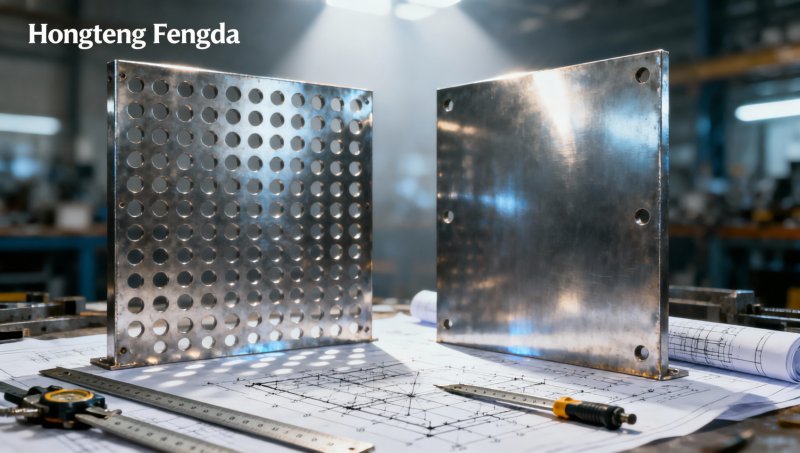
Perforated steel sheets refer to flat or profiled steel substrates with uniformly spaced holes—typically round, square, or slotted—designed to reduce mass while retaining sufficient stiffness. Solid steel sheets, by contrast, offer full cross-sectional continuity, delivering maximum strength-to-thickness ratio but at higher material and handling costs. Both types serve as base substrates for composite purlins or standalone lightweight supports in industrial and commercial roofing applications.
Technical Performance: Load-Bearing Capacity vs. Weight Savings
The core engineering dilemma lies in balancing moment resistance, deflection control, and self-weight. Perforated steel reduces mass by 20–35% depending on hole size, pitch, and pattern density—but introduces stress concentration zones and lowers effective section modulus. For example, a 2.0 mm thick perforated C-beam with 8 mm diameter holes at 25 mm centers may achieve only 68% of the bending resistance of its solid counterpart under identical boundary conditions.
Solid steel maintains uniform fiber distribution across the section, enabling predictable plastic hinge formation and higher ultimate load capacity. However, it demands heavier lifting equipment during installation and increases dead load on supporting columns and foundations—especially critical in seismic or high-wind regions where cumulative inertial forces affect structural stability.
Cost & Alternatives: Total Project Economics
While perforated steel sheets often carry a 12–18% premium per ton over standard hot-rolled or cold-formed solid equivalents, lifecycle cost analysis reveals deeper implications. Reduced shipping volume cuts freight expenses—particularly impactful for export projects across North America or Southeast Asia. Lighter purlins also lower crane rental time, scaffolding duration, and labor hours during erection, yielding up to 9% overall schedule acceleration in mid-rise warehouse builds.
However, procurement professionals must weigh these gains against increased fabrication complexity. Custom hole patterns require CNC punching or laser cutting—raising tooling setup fees and minimum order quantities. In contrast, standard galvanized C-beam or ASTM C-beam profiles from Hongteng Fengda ship within 15 days from Shandong production hubs, backed by ISO9001-2008-certified quality assurance and traceable mill test reports.
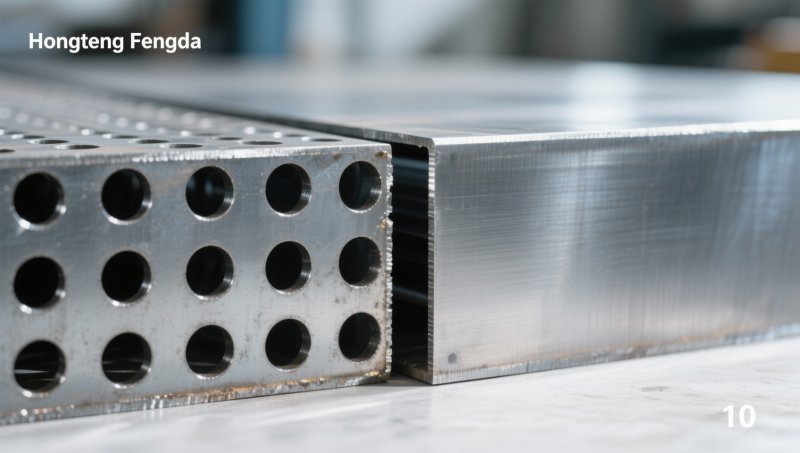
For hybrid solutions, some engineers specify solid flanges with perforated webs—a configuration we routinely supply as OEM cold-formed steel profiles. This balances localized rigidity with global weight savings and integrates seamlessly with our Rail anchoring systems used in elevated platform railings and deck handrails.
Standards & Certification: Compliance Beyond Spec Sheets
Global buyers rely on standardized verification—not just supplier claims. All Hongteng Fengda structural steel purlin products comply with ASTM A653/A792 (galvanized sheet), ASTM A1003 (cold-formed steel framing), and EN 10346 for hot-dip galvanized coatings. Our carbon steel angle bar and L shape mild steel undergo tensile testing per ASTM E8, while galvanized C-beam receives salt-spray validation exceeding 1,200 hours per ASTM B117.
Crucially, perforated variants undergo additional fatigue cycle testing under EN 1993-1-3 Annex D to ensure serviceability over 50+ years. Unlike generic importers, we provide full certification packages—including third-party SGS or Bureau Veritas reports—so project managers and safety officers can verify compliance before shipment.
Why Choose Hongteng Fengda?
As a vertically integrated Structural Steel Manufacturer & Exporter from China, Hongteng Fengda controls every stage—from raw billet sourcing in Hebei to precision roll-forming in our ISO14001:2004-certified Shandong facility. We don’t just sell Steel Construction Material—we engineer context-aware solutions.
Whether you need ASTM steel profile samples for load testing, customized perforation layouts validated via FEA simulation, or consolidated container shipments combining galvanized C-beam, carbon steel angle bar, and Rail components for multi-trade coordination—we deliver consistent quality, stable lead times, and responsive technical support in English, Spanish, and Arabic.
Contact us today for a free purlin specification review, comparative BOQ analysis, or factory audit scheduling. Let’s build trust—not just structures.
- carbon steel angle
- l angle
- galvanized sheet
- angle bars
- steel construction
- hot-dip galvanized
- structural steel
- steel profiles
- Structural steel purlin
- ASTM steel profile
- Carbon Steel Angle Bar
- Structural Steel
- steel angle bar
- L shape mild steel
- Shandong supplier
- C-beam steel
- galvanized C-beam
- ASTM C-beam
- perforated steel
- Steel Construction Material
- Profile
- Z-beam
- Galvanized
- carbon steel
- steel sheet
- steel profile
- steel angle
Related recommendations
 How much does 2 inch ss pipe price increase when upgrading from Schedule 40 to Schedule 80 for high-pressure systems?2 inch ss pipe price increases 18–35% when upgrading from Sch 40 to Sch 80—discover why, when it’s truly needed, and how to avoid overpaying.
 Which 304 stainless steel coil suppliers meet ISO 9001 and EN 10088-2 for food-grade fabrication?Discover verified 304 stainless steel coil suppliers meeting ISO 9001 & EN 10088-2 for food-grade fabrication—traceable, audited, and ready for regulatory validation.
 How does 2 inch ss pipe price compare between 304 and 316 grades for marine environments?2 inch ss pipe price varies significantly between 304 and 316 — but in marine environments, choosing 304 risks costly failures. Discover why 316 is the true value choice.
 Is 20 feet square pipe price affected more by raw material volatility or regional logistics costs?20 feet square pipe price is driven primarily by raw material volatility—not logistics. Discover why billet costs dominate pricing & how to forecast smarter with Hongteng Fengda.
Please give us a message


Please enter what you want to find