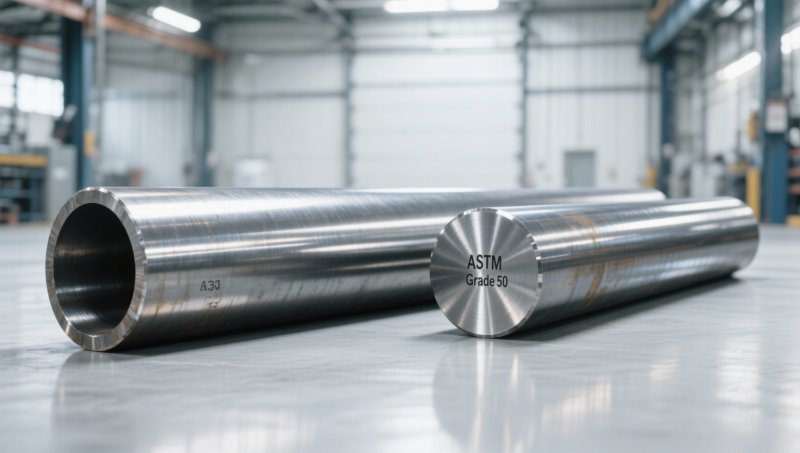
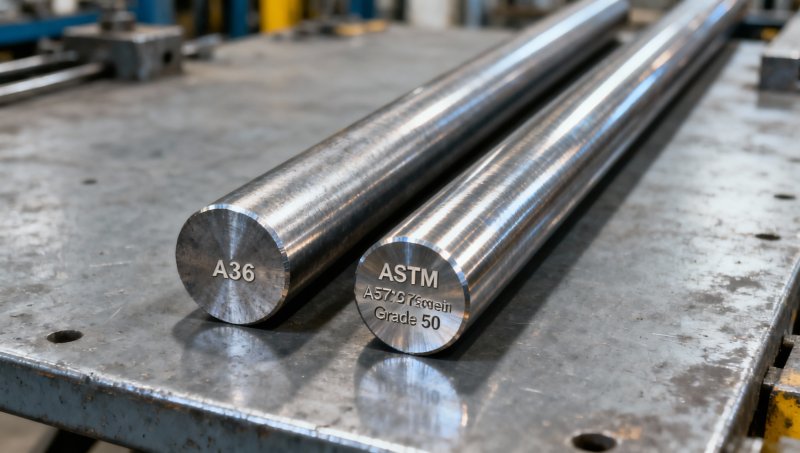
Choosing between high strength A36 Carbon Steel Round Bar and ASTM A572 Grade 50 is a critical decision for structural steel fabrication—impacting strength, weldability, cost, and compliance. As a trusted A36 Carbon Steel Round Bar supplier in China, Hongteng Fengda delivers ASTM-certified, mill-tested round bars with consistent mechanical properties and full traceability. Whether you're a project manager evaluating material specs, a procurement officer comparing value, or a quality engineer verifying standards compliance, this comparison breaks down real-world performance across load-bearing capacity, fabrication ease, and international code alignment—helping global builders make confident, standards-driven choices.
Mechanical Properties: Strength, Ductility & Yield Behavior
Understanding the core mechanical differences between high strength A36 Carbon Steel Round Bar and ASTM A572 Grade 50 starts with yield strength, tensile strength, and elongation—parameters that directly govern structural integrity under service loads. A36, per ASTM A6/A6M, specifies a minimum yield strength of 36 ksi (250 MPa) and tensile strength ranging from 58–80 ksi (400–550 MPa), with elongation ≥20% in 8 in. This combination delivers excellent formability and predictable plastic deformation—ideal for bending, punching, and field adjustments common in mid-rise commercial framing or equipment supports. In contrast, ASTM A572 Grade 50 mandates a minimum yield strength of 50 ksi (345 MPa) and tensile strength of 65–80 ksi (450–550 MPa), with slightly lower ductility (≥18% in 8 in). Its higher yield point enables lighter-section designs while maintaining safety margins—making it preferred for long-span trusses, crane rails, and seismic bracing where weight-to-strength ratio is critical.
The trade-off isn’t merely numerical—it’s behavioral. A36’s lower yield-to-tensile ratio (~0.45–0.65) allows more controlled yielding before fracture, supporting robust overload tolerance in non-seismic applications. A572 Gr.50’s tighter ratio (~0.75–0.85) reflects its microalloyed composition (Nb, V, Ti), which increases resistance to localized buckling but reduces cold-forming latitude. For fabricators using hydraulic benders or roll-forming lines, A36 offers wider process windows and fewer springback corrections. Both meet ASTM E8/E8M testing protocols, and at Hongteng Fengda, every heat lot undergoes third-party mill test reports (MTRs) with full chemical and mechanical certification—traceable to furnace number and rolling date.
Fabrication Performance: Welding, Machining & Cold Working
Weldability remains the most operationally decisive factor for structural steel round bar selection. High strength A36 Carbon Steel Round Bar excels here: its carbon equivalent (CE) typically falls below 0.40, enabling reliable SMAW, GMAW, and FCAW without preheat—even on sections up to 1.5 inches thick. Its uniform ferrite-pearlite microstructure minimizes hydrogen-induced cracking risk, a key concern for offshore or humid-climate installations. ASTM A572 Grade 50, while still classified as “weldable,” carries a CE of 0.42–0.49 due to microalloy additions. This necessitates preheating above 100°F (38°C) for thicknesses >¾ inch and strict control of interpass temperature—adding time and labor costs to shop welding schedules.
Machining behavior also diverges significantly. A36’s lower hardness (119–156 HB) ensures longer tool life and smoother surface finishes during threading, drilling, or turning—critical for anchor rods, tie-down systems, or custom connection hardware. A572 Gr.50’s increased hardness (130–170 HB) improves wear resistance but accelerates insert wear and requires optimized feed/speed parameters. For cold bending or swaging operations, A36 tolerates radii as tight as 3×D (diameter) without cracking; A572 Gr.50 recommends ≥5×D for consistent results. At Hongteng Fengda, all round bars undergo ultrasonic testing (UT) per ASTM A388 and dimensional verification per ASTM A484—ensuring geometric consistency that reduces rework in automated fabrication cells.
Cost Efficiency & Supply Chain Reliability
From a total-cost-of-ownership perspective, high strength A36 Carbon Steel Round Bar often delivers superior value—not just in raw material pricing, but across the fabrication lifecycle. Its broad global availability, mature production infrastructure, and minimal processing requirements translate into lead times averaging 25–35 days from order confirmation. ASTM A572 Grade 50, while widely stocked, faces tighter supply constraints in certain diameters (>4 inches) and may require extended rolling cycles, pushing delivery windows to 45–60 days. Moreover, A572’s stricter thermal treatment controls increase scrap rates during hot rolling, further impacting landed cost.
Hongteng Fengda mitigates these variables through dual-certification capability: our mills produce both A36 and A572 Gr.50 round bars under one ISO 9001:2015-compliant quality system, with parallel inventory management across Shanghai and Tianjin hubs. We maintain strategic stock of common diameters (½"–6") in both grades, enabling same-week dispatch for urgent projects. Our export experience spans over 120 countries—including strict-regulation markets like Canada (CSA G40.21), Germany (EN 10025-2 S355), and Saudi Arabia (SASO ASTM A6/A6M)—ensuring seamless customs clearance and documentation support. For rail infrastructure projects, we also supply certified Rail products meeting UIC 860 and GB/T 2585 standards, including QU100 heavy-haul rails with fatigue life exceeding 500 million gross tons.
Application Mapping: When to Choose Which Grade
There is no universal “better” grade—only context-appropriate selection. A36 remains the default choice for general-purpose structural round bar applications: base plates, column anchors, ladder rungs, handrail posts, and reinforcing dowels where predictable ductility, ease of field modification, and cost predictability outweigh marginal strength gains. It is the go-to specification for ASCE 7-compliant low-rise buildings, industrial mezzanines, and modular equipment platforms.
ASTM A572 Grade 50 enters the equation when engineering demands justify its premium: tall building bracing systems requiring slenderness ratio optimization; bridge piers subject to cyclic loading; wind turbine tower flanges; or offshore platform leg connections exposed to fatigue-critical stress ranges. Its higher strength permits section reduction—lowering shipping weight and foundation loads—while maintaining identical corrosion resistance (when galvanized or painted) and fire-rating compatibility (per ASTM E119). Notably, both grades are fully compatible with hot-dip galvanizing per ASTM A123, making them suitable for coastal or chemically aggressive environments.
Why Partner with a Trusted A36 Carbon Steel Round Bar Supplier in China?
Selecting a structural steel partner goes beyond spec sheets—it hinges on verifiable process control, responsive technical support, and end-to-end supply chain transparency. As an A36 Carbon Steel Round Bar supplier in China serving global clients since 2008, Hongteng Fengda combines deep metallurgical expertise with agile logistics. Every shipment includes full MTRs, heat traceability, dimensional inspection reports, and optional PMI (Positive Material Identification) verification. Our QC lab performs Charpy V-notch impact testing at –20°C upon request—critical for cold-climate infrastructure. With annual capacity exceeding 800,000 metric tons and certifications spanning ASTM, EN, JIS, and GB, we reduce sourcing risk without compromising on speed or compliance.
Whether your project calls for standard A36 round bar, dual-certified A572 Gr.50, or specialized rail solutions like Rail in U71Mn or PD3 grades for high-speed corridors, our engineering team provides free material selection consultation, BIM-ready CAD models, and fabrication advisories tailored to your shop’s capabilities. We don’t just supply steel—we help you build smarter, safer, and more sustainably.
Ready to optimize your structural steel specification? Contact Hongteng Fengda today for mill-certified high strength A36 Carbon Steel Round Bar, competitive quotations, and dedicated project support—delivered with the reliability your next milestone demands.
Related recommendations
") Stainless Steel Tube Coil vs. Straight Tube: Total Cost of Ownership in HVAC Retrofit Projects (Installation Labor, Leak Points, Space Savings)Stainless steel tube coil cuts HVAC retrofit TCO by slashing labor, leaks & space needs—discover how coil outperforms straight tube in real-world retrofits.
Stainless Steel Tube Coil vs. Straight Tube: Total Cost of Ownership in HVAC Retrofit Projects (Installation Labor, Leak Points, Space Savings)Stainless steel tube coil cuts HVAC retrofit TCO by slashing labor, leaks & space needs—discover how coil outperforms straight tube in real-world retrofits. Steel Coils Suppliers vs. Direct Mills: Lead Time, MOQ, and Custom Slitting Flexibility Compared for Mid-Volume BuyersSteel coils suppliers offer faster lead times, lower MOQs (5–10 tons), and precision custom slitting—ideal for mid-volume structural fabricators seeking agility, quality, and cost control.
 How to Vet Stainless Steel Coil Suppliers: 7 Due-Diligence Checks for Quality, Traceability, and ISO ComplianceStainless steel coil suppliers vetted right mean zero surprises on site. Discover 7 field-tested due-diligence checks for quality, full traceability & real ISO compliance.
 Stainless Coil Pipe vs. Seamless Pipe: When to Choose Welded Coiled Tubing for High-Pressure Fluid SystemsStainless coil pipe delivers unmatched efficiency for high-pressure fluid systems—superior continuity, faster installation, and proven weld integrity vs. seamless.
Please give us a message


Please enter what you want to find