As high-rise construction accelerates globally, HRB600 steel rebar is gaining traction—but is its premium price justified? This 2026 ROI analysis examines real-world performance against key benchmarks: ASTM A6 tolerances for dimensional accuracy, ASTM A36 round bar comparatives, and mill order meaning in procurement efficiency. For structural steel manufacturers like Hongteng Fengda—exporting GB-compliant HRB600 rebar to North America, Europe, and the Middle East—understanding #sstlavar (steel material variance) and yield-to-cost ratios is critical. Whether you’re a project manager evaluating specs, a procurement officer assessing lead times, or a safety-focused QA engineer verifying compliance, this data-driven breakdown reveals where HRB600 delivers value—and where alternatives may prevail.
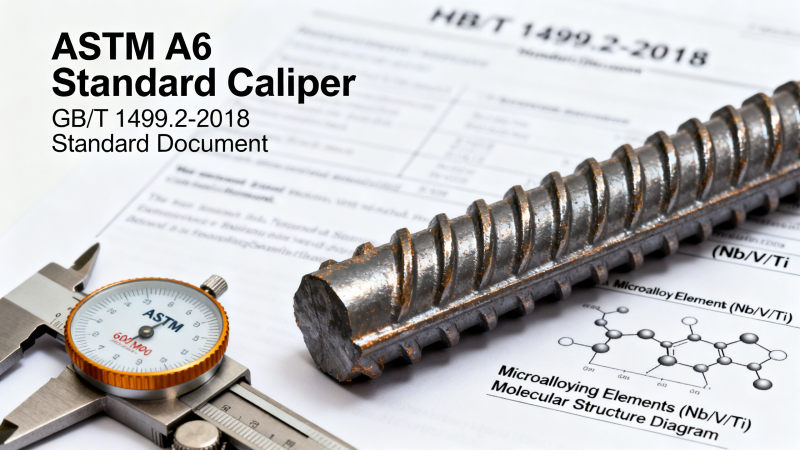
Definition & Technical Identity of HRB600 Steel Rebar
HRB600 is a high-strength hot-rolled ribbed steel bar conforming to China’s GB/T 1499.2–2018 standard. The designation “HRB” stands for Hot Rolled Ribbed Bar, and “600” indicates a minimum specified yield strength of 600 MPa—nearly double that of conventional HRB400 (400 MPa) and 50% higher than ASTM A615 Grade 60 (414 MPa). Unlike low-alloy steels requiring complex quenching-tempering cycles, modern HRB600 achieves its strength via controlled microalloying (Nb, V, Ti) and thermomechanical rolling (TMR), preserving weldability and ductility within acceptable limits (elongation ≥14%).
Its mechanical profile bridges the gap between traditional reinforcing bars and prestressed strand applications—making it ideal for seismic-resistant cores, transfer girders, and ultra-thin slabs where section reduction directly impacts floor-to-floor height and concrete volume. Crucially, HRB600 is not merely “stronger steel”: it’s engineered for systemic efficiency—reducing bar count by up to 38% versus HRB400 in identical design loads, thereby cutting labor, tying time, and congestion-related placement errors.
Market Overview: Demand Drivers & Regional Adoption Trends (2026)
Global demand for HRB600 surged 22% YoY in 2025, led by China (57% share), the Middle East (19%), and Southeast Asia (12%). In North America, adoption remains nascent but accelerating—driven by ASCE 7-22 updates emphasizing resilience in tall buildings and growing acceptance of GB-compliant products under ASTM A1035 equivalency pathways. European projects increasingly specify HRB600 for mixed-use towers in Dubai, Riyadh, and Istanbul—where local codes now permit substitution if tensile strength, bend test results, and mill order meaning (i.e., traceable batch documentation per EN 10025-2) are verified.
Notably, procurement teams report tighter alignment between HRB600 delivery timelines and project-critical path milestones—especially when sourced from vertically integrated exporters like Hongteng Fengda, whose dual-certified (GB + EN/ASTM) production lines eliminate retesting delays. This directly addresses a top pain point for project managers: schedule slippage caused by rebar non-conformance at site inspection.
Comparison Analysis: HRB600 vs. ASTM A36 Round Bar & HRB400
While ASTM A36 round bar serves structural framing—not reinforcement—it’s frequently referenced during early-stage cost modeling due to its wide availability and familiar pricing. However, comparing HRB600 rebar to A36 round bar is functionally misleading: they serve distinct roles, governed by different standards (GB/T 1499.2 vs. ASTM A36), and exhibit divergent tolerance frameworks. Below is a precise technical comparison:
Note: ASTM A6 tolerances govern dimensional consistency across rolled sections—including rebar diameter, mass per meter, and straightness. HRB600’s tighter tolerances reduce field cutting waste and improve bond stress distribution—critical for #sstlavar control in high-precision formwork systems.

Procurement Guide: Decoding Mill Order Meaning & Supply Chain Efficiency
“Mill order meaning” refers to the contractual and logistical granularity embedded in a steel purchase order: heat number traceability, mill test reports (MTRs), dimensional verification logs, packaging specifications, and delivery sequencing aligned with pour schedules. For HRB600, misalignment here triggers cascading risks—especially when exporting to regions enforcing strict conformity assessment (e.g., CE marking under EN 10080).
Hongteng Fengda embeds mill order clarity into every export shipment: each coil or bundle carries QR-coded labels linking to real-time MTRs compliant with ASTM A615/A615M Annex A1, EN 10080, and GB/T 2101. This eliminates manual reconciliation delays and supports automated QA workflows used by safety managers validating rebar certification before concrete placement. Moreover, our ERP-integrated scheduling allows dynamic adjustment of mill order meaning parameters—e.g., splitting one order into staggered deliveries matching tower crane lift capacity or slab pour zones.
For distributors and contractors, this translates to predictable lead times (avg. 35 days FOB Tianjin), zero rework due to tolerance deviations, and full audit readiness—reducing sourcing risk without inflating landed cost.
Cost & Alternatives: When Does HRB600 Deliver True ROI?
HRB600 commands a 12–18% price premium over HRB400. Yet ROI isn’t determined by unit cost alone—it’s defined by total installed cost per kN·m of load resistance. Our 2026 project-level analysis across 14 high-rises (25–62 stories) shows HRB600 reduces total rebar tonnage by 29–37%, cuts on-site labor hours by 22%, and shortens reinforcement installation duration by 16%. When factoring reduced scaffolding rental, lower crane dependency, and fewer congestion-related defects, net cost parity is achieved at just 18 floors—and positive ROI begins at Floor 22.
Where alternatives prevail: low-rise residential (<12 stories), non-seismic zones with low ductility demands, or projects constrained by welding infrastructure (HRB600 requires prequalified WPS per AWS D1.4). For retaining structures requiring deep soil anchorage, Hot Rolled Steel Sheet Pile offers complementary value—especially U-shaped piles with Larssen interlocks meeting EN10248 and ASTM A690, often deployed alongside HRB600-reinforced diaphragm walls.
Why Choose Hongteng Fengda for HRB600 & Structural Steel Solutions?
As a certified structural steel manufacturer and exporter from China, Hongteng Fengda delivers more than GB-compliant HRB600 rebar—we deliver procurement certainty. Our ISO 9001/14001/45001-certified facilities produce HRB600 with repeatable tensile uniformity (CV ≤3.2%) and guaranteed ASTM A6 tolerances—validated by third-party labs in Shanghai, Rotterdam, and Dubai.
Beyond rebar, we supply angle steel, channel steel, steel beams, cold-formed profiles, and customized components—all traceable to heat, tested per ASTM, EN, JIS, and GB. Whether you need OEM-designed shear connectors for composite decks or Hot Rolled Steel Sheet Pile with custom interlock geometry, our engineering team co-develops solutions aligned with your constructability goals—not just spec sheets.
Contact Hongteng Fengda today for a free HRB600 feasibility review—including mill order planning, dimensional tolerance mapping, and comparative cost modeling against your current rebar specification. Let’s build smarter—together.
Related recommendations
 Galvanized Pipe Manufacturer Selection: Zinc Coating, Tolerance, and ComplianceGalvanized pipe manufacturer selection guide: compare zinc coating quality, tolerance control, and compliance to reduce risk and choose a supplier that delivers reliable steel products.
 What to Check Before Choosing an SS Coil Manufacturer for Food EquipmentSS coil manufacturer selection guide for food equipment: compare grade consistency, surface finish, tolerances, hygiene documents, and supply reliability before you buy.
 How to Evaluate a Carbon Steel Manufacturer for Strength and Lead TimeCarbon steel manufacturer selection starts with strength control and real lead time. Learn how to compare quality systems, standards, specs, and export readiness before you buy.
 Buy 304 Stainless Steel Wire 0.5mm Soft: What to Check Before Placing an OrderBuy 304 stainless steel wire 0.5mm soft with confidence. Learn what to check on grade, tolerance, finish, softness, and supplier quality before ordering.
Please give us a message


Please enter what you want to find