QC teams responsible for welding 90 angle metal—whether right angle steel plate, sheet metal angle, angle bars or structural angle iron—need concise, code-focused guidance to prevent cracking and ensure compliance. This practical introduction highlights inspection checkpoints, fit‑up and tack‑weld best practices, preheat/interpass temperature control, and filler selection for steel metal angle and cold formed angle sections. Read on for checklist-ready tips that boost weld integrity, reduce rework, and streamline approvals for both shop and field applications. In addition to immediate, actionable advice for welders and inspectors, this section sets expectations for project managers and quality assurance personnel: control variables early, verify material condition, and document the justification for any deviations from standard procedures. When you face a complex joint — for example, a heavy angle bars connection at a gusset or a thin cold formed angle attached to a thicker base — a QC-driven approach reduces the risk of hydrogen-assisted cracking, lack of fusion, and unacceptable distortion. Emphasize repeatable procedures for tack welding, control of heat input, and selection of consumables that match the base metal chemistry. Whether the work is performed on a right angle steel plate subassembly in the shop or a sheet steel angle repair in the field, a consistent inspection checklist improves first-pass yield and eases certification. The upcoming sections expand on definitions, market context, technical parameters, procurement guidance, standards you should reference, and a practical QA checklist that QC teams can adopt immediately.
Definition and Practical Overview
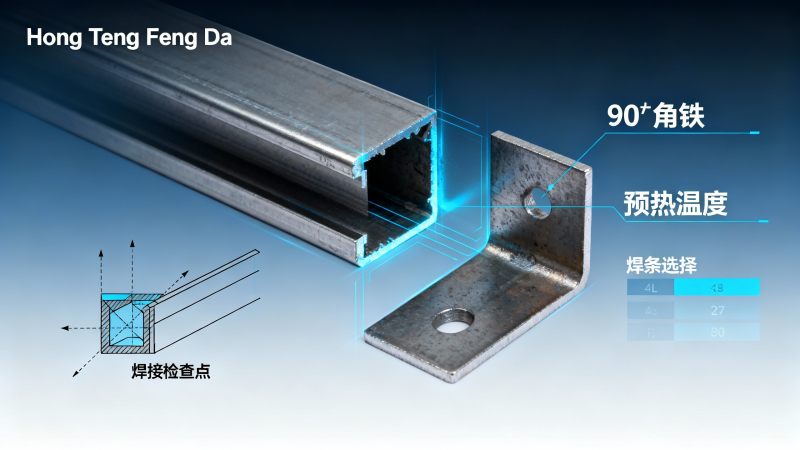
Start by clarifying what practitioners mean by 90 angle metal: in practice this includes right angle steel plate connections, prefabricated angle bars, sheet metal angle profiles and structural angle iron used as braces, frames, and stiffeners. For welding teams the geometric characteristics of these components — leg length, thickness, edge condition, and bend radius in cold formed angle — directly influence fit-up strategy and the risk profile. A thin sheet metal angle welded to a heavy plate behaves differently under heat input compared with a uniform 90 angle steel assembly; thermal expansion, localized softening and restraint create varying residual stress fields. That matters because cracking mechanisms such as hydrogen-induced cracking or cold cracking typically initiate in high restraint zones near the weld toe or root, especially on materials with higher hardness or elevated carbon equivalent. Practically, QC personnel should record and control: base metal thickness and identification (are you dealing with cold formed angle or hot-rolled structural angle iron?), surface condition (mill scale, coating, or contamination), joint gap and root face, tack weld spacing and size, and preheat and interpass temperature. During inspection, look for tight, square fit-up for sheet steel angle joints to minimize wandering weld toes; verify that angle bars are free from kinks or spring-back that can create unintended gap or overlap. For welded connections on coated products such as galvanized or Galvalume-treated coils, be aware of coating remnants at the weld area; proper cleaning and suitable filler selection reduce porosity and contamination. Documenting these baseline conditions in the weld map helps welding supervisors select appropriate procedures and prevents ambiguous failure causes during later NDT or mechanical testing.
Market Context, Supplier Advantage and Procurement Notes
Understanding supply-side capabilities and material traceability helps procurement and project leaders reduce QA overhead. The steel industry increasingly favors suppliers who combine full-process control with logistics agility: from coking and sintering to steelmaking and rolling, an integrated producer lowers variability between heats and ensures consistent mechanical properties. Shandong Hongteng Fengda Metal Materials Co.. Ltd. exemplifies such integration, with comprehensive production technology and the ability to deliver complete specifications, competitive pricing, and reliable lead times across global markets including North America, Europe, the Middle East and Southeast Asia. For welders and QC teams, that means fewer surprises in base metal chemistry and uniform performance across lots. When specifying material for angle connections, consider both hot-rolled structural angle iron for heavy fabrication and cold formed angle for lighter gauge, economical framing. A procurement checklist should include: mill test certificates, dimensional tolerances for angle bars, surface condition (e.g., pretreated or untreated), and compatibility with planned filler metals. For coated or galvanized options, confirm whether the product has been pretreated; note that some projects accept no pretreated surface — in those cases, outline the cleaning and edge-prep steps in the WPS. For example, if your project uses Galvalume options you might source coils or coils-derived profiles such as DX53D Galvalume Steel Coil for downstream rolling into sheet metal angle sections. Ensure suppliers can provide traceability and respond to remediation requests; rapid replacement and clear documentation shorten approval cycles and keep schedules on track. Finally, engage suppliers early to align heat-treatment, coating and dimensional control with welding procedure specifications to reduce rework and welding variability.
Technical Performance, Welding Best Practices and Standards
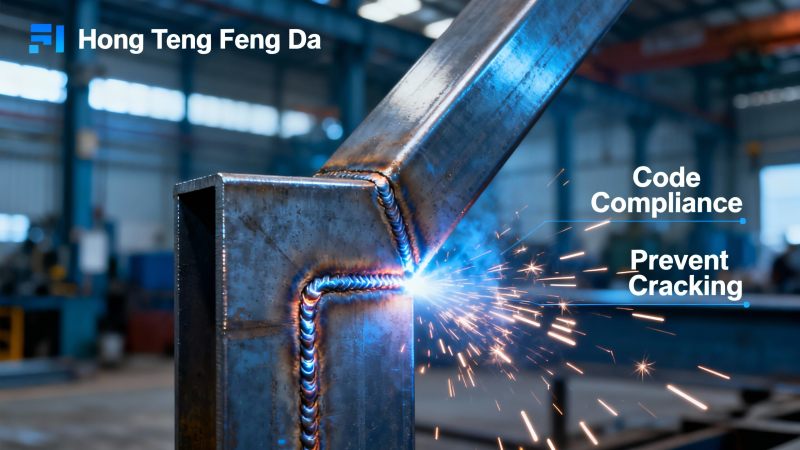
Weld integrity for 90 angle metal combines good shop practice with strict process control: fit-up, tack welding, preheat/interpass management, filler choice and post-weld inspection. Here are work-proven recommendations QC teams should enforce: 1) Fit-up and tack sequence — Use staggered tack welds to minimize distortion. For sheet metal angle and cold formed angle, small, frequent tacks prevent buckling while controlling thermal cycles. For heavy angle bars and structural angle iron, place tacks close enough to hold alignment but not so close that cumulative heat defeats preheat strategy. 2) Preheat and interpass temperature — Determine preheat temperature based on thickness and carbon equivalent; many steel grades used in angle fabrication require controlled preheat to limit cooling rate and prevent cold cracking. Always measure and record interpass temperatures with calibrated instruments. 3) Filler metal selection — Match filler chemistry to base metal; lower hydrogen consumables and appropriate tensile properties reduce sensitivity to cracking. Use low-hydrogen electrodes or GMAW wires with controlled shielding to protect against porosity when welding sheet steel angle with thin cross-sections. 4) Welding parameters and heat input — Maintain consistent heat input appropriate to joint design. Too low causes lack of fusion; too high risks excessive HAZ softening or distortion in thin sheet metal angle. 5) Post-weld cleaning and inspection — Remove slag and spatter promptly, especially on coated sections. NDT selection should be risk-based: visual plus dye-penetrant for surface flaws on thin sheet, and UT/radiography for critical structural angle iron connections. Reference applicable codes: AWS D1.1 for structural welding of steel, ISO 15614 for welding procedure tests, and local design codes for fabrication limits. Record PQR/WPS/WQT documentation and attach MTRs to assemblies to support traceability. By adopting these controls, QC teams reduce rework and keep projects compliant with code requirements, while enabling predictable performance across diverse joint types from sheet metal angle brackets to heavy 90 angle steel frames.
Procurement Guidance, Common Misconceptions, FAQ and Why Choose Us
Selecting the right product and avoiding common misconceptions are essential for procurement officers, project managers and maintenance teams. Common mistakes include assuming all angle bars perform the same, underestimating the need for preheat on medium-thickness structural angle iron, or neglecting joint cleaning on galvanized sheet metal angle. FAQ highlights: How do you decide between cold formed angle and hot-rolled structural angle iron? Choose cold formed angle when weight and cost matter and thicknesses are uniform and thin; choose hot-rolled structural angle when higher toughness, larger section modulus and weldability under heavy loads are required. Which tests are most informative for QC? Visual inspection, dye-penetrant for surface cracking, and ultrasonic testing for root and subsurface flaws are baseline; mechanical testing may be needed for acceptance criteria tied to code. What about coatings and welding? Remove coating at the weld area, or apply approved procedures for welding galvanized or Galvalume surfaces to manage fumes and defects. Cost considerations: cold formed angle tends to be more economical for light framing, while structural angle iron provides long-term value in load-bearing applications due to mechanical performance. Alternatives like welded built-up sections or box sections may be appropriate where torsional stiffness or fabrication convenience outweighs simple angle connections. Why choose us: Shandong Hongteng Fengda Metal Materials Co.. Ltd. offers comprehensive production capability, full spec coverage, and global experience that simplify procurement and ensure consistent batch properties, enabling QC teams to write robust WPS and streamline approvals. Contact us to get sample MTRs, delivery timelines, and technical support for welding procedure qualification. For direct inquiries and supply coordination, choose a partner that combines production depth with responsive logistics — a partner that helps you meet code compliance, reduce welding rework, and deliver projects on schedule. Reach out today to align material supply, inspection criteria and welding controls for your next 90 angle metal project.
Related recommendations
 How long does acero prepintado retain gloss and color stability in direct desert sunlight?Acero prepintado gloss & color stability in desert sun? Discover real-world performance data, PVDF vs. polyester longevity, and spec-critical insights for GCC projects.
 Does acero pregalvanizado maintain coating integrity after cold bending to 90 degrees?Acero pregalvanizado maintains coating integrity after 90° cold bending — when engineered right. Discover how Hongteng Fengda guarantees real-world performance, adhesion & corrosion resistance.
 Do the advantages of galvanized steel include reduced fire risk compared to untreated carbon steel?Advantages of galvanized steel include measurable fire-risk reduction vs. untreated carbon steel—learn how zinc delays ignition, buys critical escape time, and enhances safety without false 'fireproof' claims.
 How much does 2 inch ss pipe price increase when upgrading from Schedule 40 to Schedule 80 for high-pressure systems?2 inch ss pipe price increases 18–35% when upgrading from Sch 40 to Sch 80—discover why, when it’s truly needed, and how to avoid overpaying.
Please give us a message


Please enter what you want to find