Specifying Stainless Steel Welded Mesh for corrosion-prone sites demands balancing material grade, testing and QC to ensure long-term performance. This guide helps users, technical evaluators, procurement and project managers choose appropriate grades, from duplex and 316/316L options, and integrates inspection steps alongside related steel products selection—H-beam, Z-beam, Rebar, DX53D and AZ150 Galvalume steel coil, Galvanized Steel Wire Rope 1470Mpa to 1960Mpa and hot-diped-Galvanized Pipe—so distributors, maintenance teams and decision-makers can mitigate galvanic corrosion, meet project specs and streamline purchasing with Shandong Hongteng Fengda's production and testing insights. In corrosion-prone environments such as coastal, industrial or chemically aggressive sites, stakeholders confront overlapping technical and commercial challenges: choosing the correct stainless grade to resist pitting and crevice corrosion; verifying weld integrity and mesh geometry for structural performance; ensuring compatibility with adjacent carbon-steel structures like H-beam and Z-beam sections to avoid accelerated galvanic attack; and aligning procurement specifications with realistic lead times and factory testing capacities. This introduction frames those pain points from multiple vantage points—users and operators who require safe, maintainable assemblies; technical evaluators who must quantify performance with measurable metrics; procurement teams needing clear acceptance criteria and cost/benefit trade-offs; and project managers who must integrate vendor QC outputs into site acceptance. The subsequent sections present material selection criteria, required laboratory and factory tests, a practical QC checklist for incoming goods and on-site verification, and guidance on how to specify complementary products—Rebar, Hot diped-Galvanized Pipe and Galvanized Steel Wire Rope—so that the stainless steel welded mesh achieves service life expectations while fitting into the overall structural and budgetary constraints of engineering projects. This document emphasizes repeatable tests, clear acceptance limits and preventive strategies such as isolation and sacrificial coatings to control galvanic interactions with DX53D Galvalume and other coated steels used in the same assemblies, helping procurement and maintenance to reduce lifecycle costs and unplanned downtime.
Material grades and metallurgical criteria for welded mesh in aggressive environments
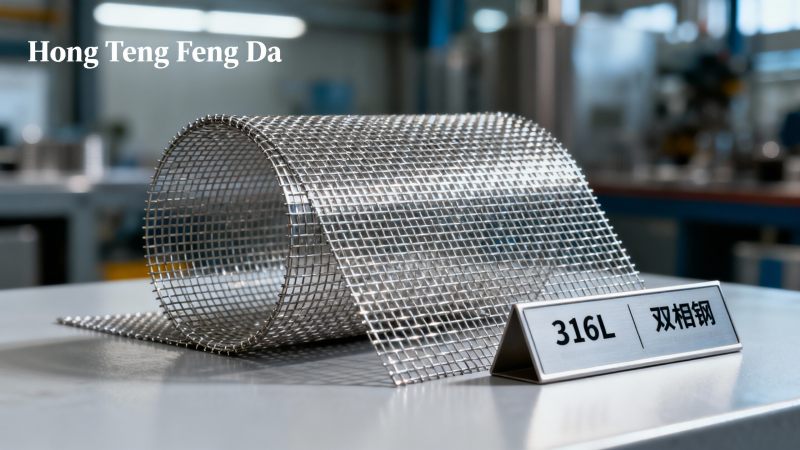
Selecting a stainless steel grade for welded mesh is the single most influential decision for long-term corrosion performance. For offshore platforms, coastal structures, wastewater facilities and chemical plant enclosures, duplex (e.g., SAF 2205/1.4462), superaustenitic alloys and the austenitic 316/316L family are commonly specified because of superior resistance to pitting, crevice corrosion and stress corrosion cracking compared with standard 304. Duplex alloys combine high strength with elevated pitting resistance equivalent number (PREN), providing a cost-effective alternative when mechanical loading and corrosion resistance must be balanced. When specifying mesh, buyers and technical evaluators should require vendors to supply mill certificates with chemical composition and hardness readings, and to report measured PREN values or provide corrosion test data appropriate to the project environment. For sites exposed to chlorides or acidic condensates, insist on 316L over 316 where welding is extensive, because lower carbon minimizes sensitization and intergranular attack near welds. For extremely aggressive or long design lives, consider duplex or superaustenitic options; although initial material cost is higher, lifecycle cost often favors higher alloy content due to reduced maintenance and replacement. Beyond base metal, the welding consumables and welded joint metallurgy matter: specify matching filler metals and heat inputs that avoid excessive grain growth or undesired phase formation in duplex alloys. Welded mesh manufacturing must control dimensional tolerances, strand straightness and weld fusion quality; technical evaluators should request microstructural cross-sections from welds and hardness profiles to detect heat-affected zone anomalies. Finally, compatibility with adjacent structural elements—H-beam and Z-beam members, galvanized steel wire rope or hot dip galvanized pipes—should be addressed with galvanic series assessments and isolation strategies (nonconductive spacers, coatings, or sacrificial anodes) to prevent accelerated corrosion at contact points and to ensure the stainless mesh performs as intended over the project lifespan.
Testing protocols: factory tests, lab verifications and in-service benchmarks
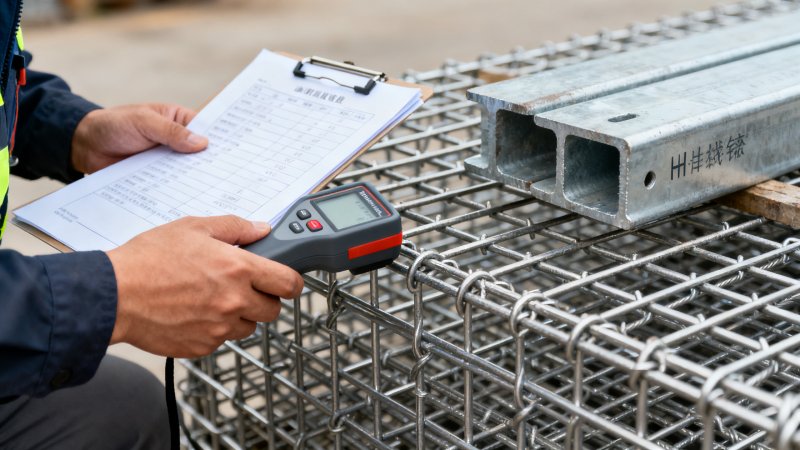
Robust testing protocols separate reliable welded mesh from commodity supply. A layered testing approach includes factory-level controls, third-party laboratory verification and on-site acceptance checks. Factory tests should include chemical analysis (certificate of conformity to standards such as AISI/ASTM/JIS/DIN), tensile and yield strength verification, weld shear tests, dimensional inspections and visual defect screening. For corrosion-prone applications, require salt spray testing (ASTM B117) as a comparative measurement, though evaluators must understand its limitations for predicting field life. More relevant are pitting and crevice corrosion tests (ASTM G48 or ISO 21457 variants), potentiodynamic polarization tests to estimate pitting resistance and electrochemical impedance spectroscopy for coating assessments when applied. Weld integrity testing should combine non-destructive examinations—dye penetrant for surface cracks, ultrasonic testing for sub-surface discontinuities—and mechanical tests such as transverse weld rupture and bend tests to confirm ductility and fusion. For duplex alloys, microstructural analysis is essential to confirm phase balance (ferrite/austenite ratio) and to ensure heat input during welding has not generated brittle intermetallics. Sampling plans must be defined in the contract: lot size, random sampling frequency and acceptance criteria (AQL). In parallel, inspectors should verify product marking, traceability and mill test reports on delivery. Field acceptance checks include visual inspection after erection, continuity checks across joints to identify potential galvanic paths, and targeted coupon testing if immediate environment monitoring is required. For assemblies that integrate other materials—Rebar embedded in concrete adjacent to stainless mesh, or DX53D Galvalume Steel Coil panels near stainless elements—establish environmental cells and monitor chloride deposition rates and coating condition to refine maintenance plans and warranty expectations. These multiple verification layers give procurement and quality teams the documented evidence required for long-term performance guarantees.
Practical QC checklist for procurement, inspection and on-site acceptance
A concise, technical QC checklist simplifies vendor selection and site acceptance while ensuring consistent application across projects. The checklist should be embedded in procurement documentation and tied to invoice release milestones. Key checklist items include: 1) Material certification: valid mill test certificates showing composition, yield and tensile strengths, and conformance to specified standards (AISI/ASTM/JIS/DIN). 2) Welding records: filler metal specification, welding procedure specification (WPS), welder qualifications and post-weld heat treatment (if applicable). 3) Dimensional and mechanical verification: mesh aperture tolerances, strand diameter checks, weld shear strength and dimensional conformity reports. 4) Corrosion testing records: salt spray results, pitting resistance test reports and, for duplex/alloyed grades, phase balance micrographs. 5) Surface condition: passivation reports, surface roughness measurements and surface cleaning protocols for post-fabrication. 6) Traceability: batch numbers, heat numbers and clear labeling to enable future failure analysis. 7) Protective handling and packaging: evidence of packaging suitable for transit to corrosion-prone sites (desiccants, waterproof wrapping, separation from carbon-steel items). 8) Compatibility declaration: documented assessment of galvanic potential when stainless mesh is in contact with H-beam, Z-beam, Hot diped-Galvanized Pipe, Galvanized Steel Wire Rope 1470Mpa to 1960Mpa or DX53D Galvalume panels, and recommended isolation measures. 9) On-site checks: incoming visual inspection, random destructive weld testing (if contract permits), continuity and grounding checks to prevent stray current corrosion, and pre-installation mock-up approval. 10) Warranty and corrective action plan: clear timelines for defect reporting, root-cause analysis methods and replacement criteria. Distributors and project managers should use this checklist as a contractual attachment to ensure each shipment meets the documented acceptance thresholds and that QA holds across supply chain nodes, from Shandong Hongteng Fengda’s production lines to on-site installation.
Integrating stainless welded mesh with complementary steel products and mitigation strategies
Successful assemblies in corrosive environments are rarely single-material solutions; they are systems that include H-beam and Z-beam primary members, Rebar within concrete, panels formed from AZ150 Galvalume or DX53D Galvalume coils, galvanized wire rope and hot dipped galvanized pipes. Each interface is a potential galvanic couple and must be addressed in specifications. Start with a galvanic compatibility matrix that ranks materials by their electrode potential; avoid direct contact between high-noble stainless grades and low-noble hot-dip galvanized steel without insulation. Practical mitigation methods include non-conductive washers and gaskets, epoxy or polymeric coatings at contact surfaces, purposely applied sacrificial coatings on adjacent carbon-steel elements, and the use of end-to-end sacrificial anodes in highly aggressive marine settings. When galvanized steel wire rope of high-strength classes (Galvanized Steel Wire Rope 1470Mpa to 1960Mpa) is required for lifting or tensioning near stainless mesh, ensure that terminations and clamps are either stainless or isolated with engineered sleeves to prevent bimetallic attack. For roofing, cladding or architectural screens that juxtapose stainless mesh with coated coils such as AZ150 or DX53D options, consider differential thermal expansion and formability—DX53D Galvalume provides excellent formability and heat reflectivity for cladding and can be a complementary product when specified correctly. The galvanized or galvalume products bring lower upfront cost, but specify separation and drainage details so that runoff does not concentrate chlorides on stainless surfaces. Finally, document maintenance regimes: periodic inspection intervals, chloride washdown procedures, and reapplication schedules for protective coatings on sacrificial elements. By treating the mesh and its adjacent components as a system—from H-beam connections to Hot diped-Galvanized Pipe penetrations—project teams can prevent premature failures and rationalize lifecycle costs across structural and architectural components.
Summary, supplier advantages and next steps
In summary, specifying stainless steel welded mesh for corrosion-prone sites requires a systems mindset: choose the correct alloy (316/316L for general chloride exposure, duplex or superaustenitic grades for high-risk or load-critical applications), mandate robust testing (chemical, mechanical and corrosion-specific assays) and implement a clear QC checklist that spans factory release to on-site acceptance. Shandong Hongteng Fengda’s integrated production capability—from steelmaking and rolling to advanced processing—supports traceability and responsive testing, helping procurement and technical evaluators align quality verification with delivery schedules. The company’s broad product portfolio also streamlines compatibility planning when projects incorporate H-beam and Z-beam structural sections, Rebar and coated coil products such as AZ150 Galvalume Steel Coil. Technical teams should use the supplied checklist, require mill reports and independent lab verification for pitting resistance where applicable, and incorporate isolation or sacrificial strategies at interfaces with galvanized components, including high-strength galvanized wire ropes and hot dipped galvanized piping. To move from specification to procurement: review the QC checklist with your engineering and maintenance stakeholders, request representative samples and test reports from prospective suppliers, and schedule a factory audit or third-party inspection for larger lots. If you would like assistance translating your project environment into a concrete material and testing specification, or to obtain sample reports and lead-time estimates from a reliable producer, contact Shandong Hongteng Fengda’s sales and technical team to discuss tailored solutions, test-data packages and logistical options. Act now to minimize lifecycle costs and ensure predictable performance—request a specification review, ask for a sample test report or arrange a supplier audit to secure compliant stainless welded mesh for your next corrosion-prone project.
- steel i
- galvanized steel wire
- galvanized wire
- galvanized pipe
- hot-dip galvanized
- hot dipped galvanized pipe
- hot dip galvanized
- steel coil
- galvanized steel
- Profile
- Hot diped-Galvanized Pipe
- AZ150 Galvalume Steel Coil
- DX53D Galvalume Steel Coil
- Rebar
- Galvanized Steel Wire Rope
- Galvanized Steel Wire Rope 1470Mpa to 1960Mpa
- Stainless Steel Welded Mesh
- Z-beam
- H-beam
Related recommendations
 Is acero galvanizado para exterior vulnerable to white rust formation during monsoon storage?Acero galvanizado para exterior *is* vulnerable to white rust in monsoons — but it’s preventable. Discover proven storage & handling strategies that protect your structural steel.
 Does ASTM A 36 plate meet impact toughness requirements for low-temperature bridge girders?Does ASTM A 36 plate meet low-temp bridge requirements? Short answer: no—unless specially tested. Discover why toughness matters more than strength in cold climates.
 Does ASTM A653 certification cover both zinc-coated and zinc-iron alloy coated steels?ASTM A653 covers both zinc-coated and zinc-iron alloy coated steels—but they’re not interchangeable. Learn key differences in testing, performance & certification.
 Does acero prepintado require surface pretreatment before welding or cutting?Does acero prepintado require pretreatment before welding or cutting? Discover when grinding is essential—and when it’s not—for safety, weld integrity & corrosion resistance.
Please give us a message


Please enter what you want to find