When mill certificates are missing, accurately measuring a steel beam becomes critical for safety, compliance, and project continuity. Whether you need to verify beams weight, confirm an i beam weight, or distinguish between angle vs channel profiles, field verification methods—like caliper measurement, dimensional surveying, and density-based weight calculation—are essential for users, procurement teams, and quality managers. This FAQ explains practical, standards-aligned techniques for measuring steel beams, girders, square rods, round bars, and more—ensuring reliability even without documentation. Backed by Hongteng Fengda’s expertise as a trusted structural steel manufacturer and exporter from China, these methods support global buyers in North America, Europe, and beyond.
Why Field Verification Is Non-Negotiable Without Mill Certificates
Mill certificates serve as the legal and technical backbone of structural steel delivery—they validate chemical composition, mechanical properties, dimensional tolerances, and traceability per ASTM A6/A6M, EN 10025, or GB/T 706. When those documents are lost, misfiled, or never issued, assumptions about weight of i beam or cross-sectional geometry become high-risk liabilities. For example, a nominal 300×150×6.5×9 mm IPE300 beam may deviate up to ±0.5 mm in flange thickness under EN 10034 tolerances—enough to shift its theoretical beams weight by 1.2–1.8%. In multi-story steel framing, such discrepancies compound across hundreds of members, affecting crane load planning, connection design, and fireproofing specifications.
Procurement personnel often face pressure to “move forward” without paperwork—but skipping verification invites cost overruns from rework, rejection during third-party inspection (e.g., TÜV or UL), or non-compliance with local building codes like IBC Chapter 22 or Eurocode 3. Quality managers must treat undocumented material as *unverified until proven*, not *assumed compliant*. That’s why Hongteng Fengda trains field teams across Southeast Asia and the Middle East to deploy calibrated tools—not guesswork—when validating steel girder dimensions or confirming steel angle leg symmetry before installation.
Step-by-Step Field Measurement Protocols for Structural Sections
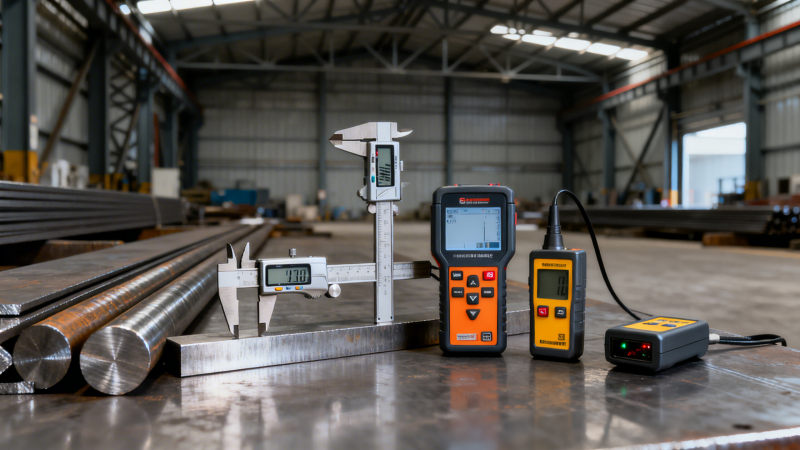
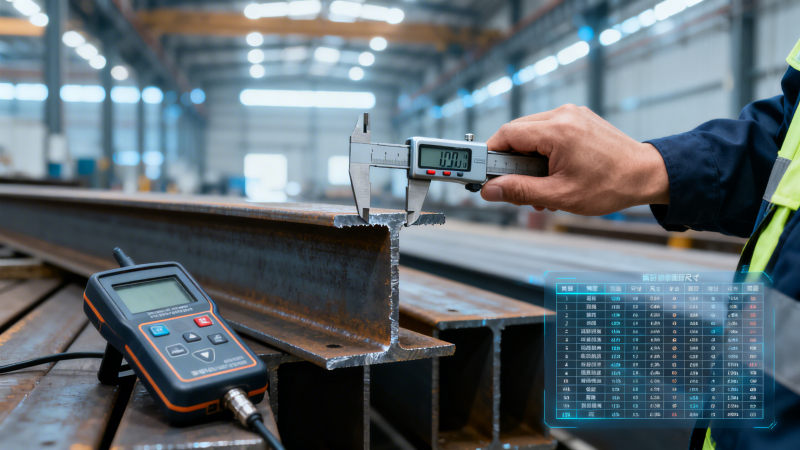
Accurate field measurement starts with instrument selection and ends with cross-referenced validation. Use digital calipers (±0.02 mm accuracy) for flange/web thickness, ultrasonic thickness gauges for corroded or painted surfaces, and laser distance meters (±1 mm) for overall length and straightness checks. Always measure at three locations along each member: near both ends and mid-span—to detect tapering or bending.
For I beam weight confirmation, record: (1) flange width & thickness, (2) web height & thickness, and (3) total length. Plug values into the standard formula: Weight (kg/m) = [2 × Flange Width × Flange Thickness + (Web Height − 2 × Flange Thickness) × Web Thickness] × 7.85 where 7.85 kg/dm³ is the nominal density of carbon steel. Compare the result against published tables (e.g., ASTM A6 Annex A or EN 10365). Deviations >±2.5% warrant full section analysis or lab testing.
Beyond Dimensions: Weight Validation Through Density & Volume
Dimensional measurement alone doesn’t guarantee correct weight of i beam—especially if steel grade differs (e.g., Q235 vs. S355). That’s where volumetric weight verification adds authority. Cut a representative 300-mm sample (with client approval), weigh it precisely on a calibrated scale (±0.1 g), then calculate actual density: ρ = mass / volume. Acceptable range: 7.75–7.88 kg/dm³ for low-carbon structural steels. Values outside this indicate alloy deviation, porosity, or contamination.
For long-span steel girder sections where cutting isn’t feasible, use water displacement (Archimedes’ principle) on smaller cut-offs—or apply portable XRF analyzers to confirm elemental composition (Fe, C, Mn, Si) and infer grade compliance. Hongteng Fengda includes optional XRF reports upon request for OEM orders, reinforcing traceability even when mill certs are delayed. This dual-layer approach—dimensional + metallurgical—builds audit-ready evidence for inspectors and insurers alike.
Practical Tips for Procurement & QA Teams in Global Supply Chains
Procurement professionals sourcing from China or other export hubs should embed field verification clauses into purchase orders—not as exceptions, but as standard terms. Specify required tolerances (e.g., “flange thickness ±0.3 mm per EN 10034”), acceptable instruments (e.g., “Mitutoyo calipers, model CD-6” ), and reporting format (PDF with timestamped photos and signed technician logs). Require pre-shipment verification for high-risk items like steel wire rope or galvanized components where coating integrity affects performance.
For instance, our Steel Wire Galvanized—available in Q195/Q235 grades with zinc coating 8–25 g/m²—is routinely verified using magnetic induction gauges and bend tests per ASTM A641. Its strong flexibility and good corrosion resistance make it ideal for barrier isolation and wire mesh applications where tensile strength (350–550 MPa) and ductility directly impact service life. Integrating such product-specific checks into broader beam verification protocols ensures holistic material confidence.
When to Escalate: Red Flags That Demand Lab Testing
Not every discrepancy requires immediate lab intervention—but certain patterns do. Flag for metallurgical testing if: (1) calculated beams weight deviates >3% from theoretical; (2) surface hardness readings vary >HV20 across one section; (3) visual inspection reveals inconsistent grain structure or slag inclusions; or (4) ultrasonic testing detects internal laminations >0.2 mm deep. These may signal rolling defects, improper heat treatment, or material substitution—issues that dimensional checks alone cannot resolve.
Hongteng Fengda maintains partnerships with CNAS-accredited labs in Tianjin and Shanghai for rapid turnaround (≤5 working days) on tensile, Charpy impact, and spectrographic analysis. We provide bilingual test reports aligned with ASTM E8/E23 and ISO 6892—supporting compliance for projects governed by ASME BPVC, API RP 2A, or EN 1090-2. This infrastructure enables buyers to close verification gaps without delaying site schedules.
In summary, verifying how to measure a steel beam without mill certs demands methodical rigor—not improvisation. From caliper-based i beam weight calculation to density validation and red-flag escalation, every step reinforces structural integrity and contractual certainty. As a certified structural steel manufacturer and exporter from China, Hongteng Fengda delivers consistent quality across steel angle, steel square rod, steel round bar, and custom profiles—backed by ISO 9001, CE, and SGS certifications. Need verified beam data, customized dimension reports, or OEM-grade galvanized solutions? Contact Hongteng Fengda today for responsive engineering support and reliable global delivery.
- l angle
- steel wire galvanized
- structural steel
- steel beams
- Structural Steel
- I-Beam
- Steel Beams
- wire mesh
- Profile
- H-beam
- Galvanized
- Steel Beam
- Steel Wire
- carbon steel
- steel girder
- steel angle
- steel wire rope
- steel round bar
- steel square rod
- angle vs channel
- weight of i beam
- i beam weight
- how to measure a steel beam
- beams weight
Related recommendations
 Is acero galvanizado para exterior vulnerable to white rust formation during monsoon storage?Acero galvanizado para exterior *is* vulnerable to white rust in monsoons — but it’s preventable. Discover proven storage & handling strategies that protect your structural steel.
 Does ASTM A 36 plate meet impact toughness requirements for low-temperature bridge girders?Does ASTM A 36 plate meet low-temp bridge requirements? Short answer: no—unless specially tested. Discover why toughness matters more than strength in cold climates.
 Does ASTM A653 certification cover both zinc-coated and zinc-iron alloy coated steels?ASTM A653 covers both zinc-coated and zinc-iron alloy coated steels—but they’re not interchangeable. Learn key differences in testing, performance & certification.
 Does acero prepintado require surface pretreatment before welding or cutting?Does acero prepintado require pretreatment before welding or cutting? Discover when grinding is essential—and when it’s not—for safety, weld integrity & corrosion resistance.
Please give us a message


Please enter what you want to find