When evaluating stainless steel sheet options for demanding environments, the ss sheet 304 price per kg is often compared head-to-head with 316—typically carrying an 18–22% premium. But does that extra cost deliver real value in marine, coastal, or highly corrosive applications? As a China-based structural steel manufacturer and exporter, Hongteng Fengda helps global buyers weigh performance, longevity, and total project cost—not just upfront pricing. This analysis breaks down the technical and economic rationale behind choosing 304 vs. 316 stainless sheets, backed by ASTM/EN-compliant quality and scalable supply for construction, infrastructure, and industrial projects.
Why Corrosion Resistance Isn’t Just About Chromium Content
Stainless steel 304 and 316 are both austenitic grades—but their alloying differences drive divergent performance in chloride-rich settings. While 304 contains ~18% chromium and 8% nickel, 316 adds 2–3% molybdenum—a critical element that enhances pitting and crevice corrosion resistance by stabilizing passive film formation under aggressive ion attack.
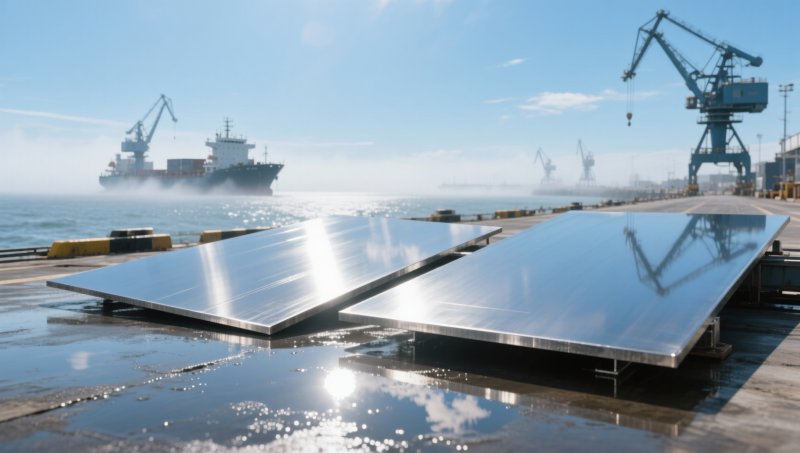
In marine environments, airborne salt concentrations can exceed 100 mg/m²/day near coastlines. Accelerated testing (per ASTM G48 Method A) shows 304 begins exhibiting visible pitting after just 24–48 hours of exposure to 6% FeCl₃ solution, whereas 316 withstands over 72 hours—demonstrating a 2–3× improvement in localized corrosion threshold. This isn’t theoretical: field data from offshore platforms in the North Sea indicates 304 handrail components require replacement every 3–5 years, while 316 equivalents last 12–18 years before maintenance intervention.
For structural applications where access for inspection or repair is costly or hazardous—such as bridge railings, port cranes, or desalination plant ductwork—the extended service life of 316 directly reduces lifecycle cost, even with its higher ss sheet 304 price per kg baseline.
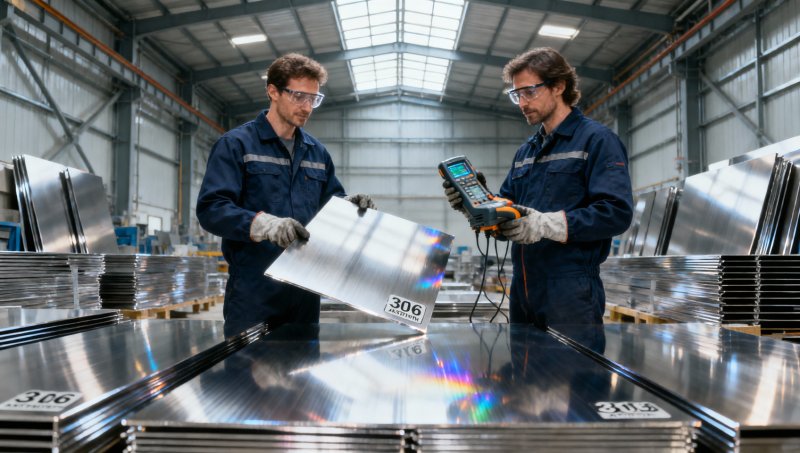
The table above highlights how minor compositional shifts yield major functional consequences. Though 316 has slightly lower chromium than 304, molybdenum’s role in repelling chloride penetration outweighs this trade-off—making it the de facto standard for ASTM A240/A480-compliant marine-grade sheet supply.
Total Cost of Ownership: Beyond the ss sheet 304 price per kg
Procurement teams often fixate on unit price—yet lifecycle cost modeling reveals that material acquisition accounts for only 25–35% of total expenditure in long-life infrastructure projects. Labor for installation, surface preparation, maintenance labor, downtime, and premature replacement dominate the remaining 65–75%.
Consider a coastal pedestrian bridge using 3mm-thick stainless sheet for cladding. At current market rates (Q2 2024), 304 averages USD 3.20/kg, while 316 trades at USD 3.85–3.95/kg—an 18–22% premium. For a 12-ton order, that’s an incremental investment of USD 7,800–9,000. However, if 304 requires full panel replacement after 7 years due to staining and micro-pitting—and labor plus scaffolding costs USD 42,000—then the “cheaper” option incurs USD 33,000 more in avoided cost over a 20-year design life.
Hongteng Fengda supports clients with TCO calculators tailored to project-specific parameters—including location salinity index, expected service duration, access constraints, and local labor rates—ensuring procurement decisions align with engineering reality, not spreadsheet defaults.
Material Selection Framework for Structural Applications
Choosing between 304 and 316 isn’t binary—it’s contextual. The following decision matrix applies to structural steel fabricators, EPC contractors, and infrastructure owners evaluating sheet specifications:
- Coastal Zone ≤ 500 m from shoreline: 316 mandatory for exposed elements; 304 acceptable for sheltered interior framing only
- Industrial Zones with Chloride Exposure (e.g., chemical processing plants): 316 required for all wet-service components; 304 may be used for dry-load-bearing members if passivated and regularly inspected
- Urban Environments with De-icing Salt: 316 recommended for bridge decks, guardrails, and drainage systems; 304 permissible for non-critical architectural trim with biannual cleaning protocols
- Indoor/Non-Corrosive Settings: 304 remains optimal—offering superior formability, weldability, and cost efficiency without compromising integrity
All Hongteng Fengda stainless sheets undergo dual-certification verification: ASTM A240 (for chemical composition and mechanical properties) and EN 10088-2 (for surface finish, dimensional tolerances, and heat treatment compliance). Each coil is traceable to melt batch, with mill test reports (MTRs) provided digitally and physically upon shipment.
Complementary Structural Solutions: When Carbon Steel Fits the Role
While stainless steels excel in corrosion-prone zones, carbon steel remains indispensable for load-bearing structures where environmental exposure is controlled or mitigated. For example, Q195 Carbon Steel Round Bar delivers excellent strength and wear resistance across applications including handrails, staircases, balcony supports, and structural framing—especially when paired with hot-dip galvanizing or epoxy coating.
Our Q195 round bars comply with GB/T 702 and ASTM A276 standards, available in diameters from 5 mm to 2500 mm and lengths up to 12 meters. Surface treatments include galvanized, black and color painting, anti-rust oil, and phosphating—each selected based on transport duration, storage conditions, and end-use environment. With production capacity exceeding 50,000 tons/year and lead times averaging 15–25 days for standard orders, we enable seamless integration of complementary materials into mixed-material structural systems.
This hybrid approach—leveraging stainless where durability is non-negotiable and carbon steel where strength and economy dominate—optimizes both performance and procurement budgets. Hongteng Fengda provides coordinated logistics, single-point QA, and unified documentation for multi-grade orders, reducing coordination overhead by up to 40% versus fragmented sourcing.
Conclusion: Making Confident, Data-Driven Material Decisions
The 18–22% ss sheet 304 price per kg premium for 316 stainless steel is not arbitrary—it reflects quantifiable gains in corrosion resistance, service life extension, and reduced maintenance liability. In marine, coastal, and industrial applications, that premium consistently pays back within 3–5 years through avoided replacement, labor, and operational disruption.
As a certified structural steel manufacturer serving global markets since 2008, Hongteng Fengda combines deep metallurgical expertise with agile manufacturing to deliver ASTM-, EN-, and GB-compliant stainless and carbon steel products—from precision-cut 316 sheets to high-tolerance Q195 Carbon Steel Round Bar—with consistent quality, reliable lead times, and responsive technical support.
Whether you’re specifying materials for a new desalination facility, retrofitting a coastal marina, or optimizing a mixed-material building façade, our engineering team offers free material selection consultation—including comparative TCO analysis, coating compatibility guidance, and fabrication advisories. Contact us today to request a customized quote, sample pack, or ASTM/EN certification dossier.
Related recommendations
 How long does acero prepintado retain gloss and color stability in direct desert sunlight?Acero prepintado gloss & color stability in desert sun? Discover real-world performance data, PVDF vs. polyester longevity, and spec-critical insights for GCC projects.
 Does acero pregalvanizado maintain coating integrity after cold bending to 90 degrees?Acero pregalvanizado maintains coating integrity after 90° cold bending — when engineered right. Discover how Hongteng Fengda guarantees real-world performance, adhesion & corrosion resistance.
 Do the advantages of galvanized steel include reduced fire risk compared to untreated carbon steel?Advantages of galvanized steel include measurable fire-risk reduction vs. untreated carbon steel—learn how zinc delays ignition, buys critical escape time, and enhances safety without false 'fireproof' claims.
 What is the minimum bend radius for 12mm steel wire rope without permanent deformation?12mm steel wire rope capacity depends on bend radius — discover the safe 72–96mm minimum to prevent permanent deformation, fatigue & failure. Expert rigging insights inside.
Please give us a message


Please enter what you want to find