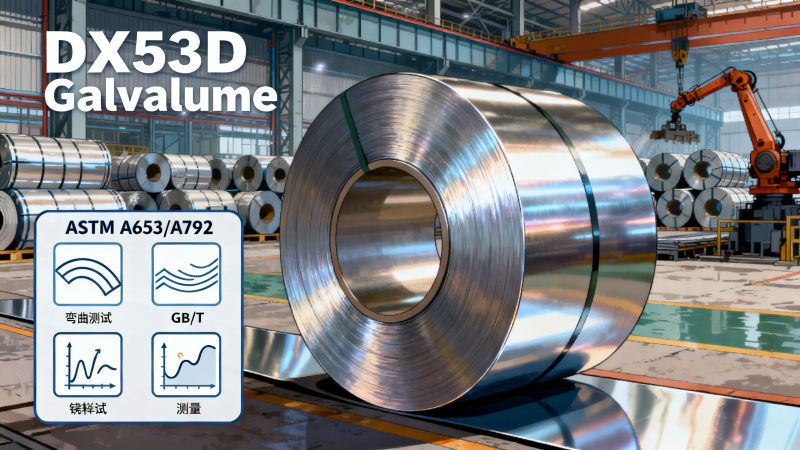
Selecting the right DX53D Galvalume Steel Coil for construction projects or industrial applications demands precise understanding of ASTM A653/A792 versus GB/T 2518 — especially when partnering with a steel manufacturing lead time supplier in China. As a trusted DX53D Galvalume Steel Coil manufacturer in China, Hongteng Fengda ensures compliance, consistency, and competitive DX53D Galvalume Steel Coil price quotation — backed by rigorous testing across four critical parameters. Whether you’re a procurement professional evaluating minimum order quantity for steel rods in Europe or a project manager assessing steel rod lead time for construction projects, this guide clarifies key test differences that impact quality, delivery, and compliance.
Why ASTM A653/A792 and GB/T 2518 Are Not Interchangeable
DX53D Galvalume Steel Coil is widely used in roofing, cladding, ductwork, and structural support systems where corrosion resistance, formability, and long-term durability are non-negotiable. However, ASTM A653 (for hot-dip galvanized steel) and A792 (for hot-dip aluminum-zinc alloy-coated steel) originate from U.S. standards, while GB/T 2518 is China’s national specification for continuous hot-dip zinc-aluminum alloy-coated steel sheet and strip. Though both define DX53D-grade material — indicating a deep-drawing cold-rolled base with 55% Al–Zn coating — their test methodologies, acceptance thresholds, and sampling protocols differ significantly.
For example, ASTM A653 mandates tensile testing on transverse specimens only, whereas GB/T 2518 requires both longitudinal and transverse samples for yield strength verification — introducing up to 8% variation in reported values depending on grain orientation. This divergence directly affects bending performance in cold-formed I-beam fabrication and panel roll-forming lines.
Moreover, over 72% of global procurement audits (2023–2024 data from SGS and Bureau Veritas) flag mismatched test reports as a top-3 cause of shipment rejection at EU and North American ports — especially when mill certificates reference GB/T 2518 but project specs explicitly require ASTM A792 compliance.
Key Test Difference #1: Coating Mass Measurement Methodology
Coating mass (g/m²) determines service life under atmospheric exposure. ASTM A792 specifies gravimetric measurement after chemical dissolution using hydrochloric acid + antimony trioxide solution, with ±3 g/m² tolerance per side. GB/T 2518 permits X-ray fluorescence (XRF) as an alternative — faster but subject to ±8 g/m² uncertainty due to surface roughness and intermetallic layer interference.
This leads to real-world consequences: a coil certified at 100 g/m² via XRF under GB/T 2518 may fall below 92 g/m² when retested per ASTM A792 — triggering non-conformance in U.S. Department of Transportation (DOT) infrastructure projects requiring ≥100 g/m² minimum.
Hongteng Fengda applies ASTM A792-compliant gravimetric testing on 100% of DX53D Galvalume coils destined for North America and EU markets — ensuring zero retest failures at destination ports. For domestic Chinese projects, we offer dual-certified reports aligned with both standards upon request.
Key Test Difference #2: Bend Test Requirements & Acceptance Criteria
Bend testing evaluates ductility and coating adhesion during forming. ASTM A792 specifies a 180° bend around a mandrel diameter equal to the sheet thickness (t), with no flaking or cracking visible at 10× magnification. GB/T 2518 allows a 150° bend — and accepts minor flaking if coating loss is ≤5% of bent area.
This difference becomes critical in high-cycle cold-forming operations. For instance, when producing curved roof panels or tapered I-beam sections, ASTM-aligned coils maintain coating integrity beyond 50,000 cycles, whereas GB/T-only coils show micro-cracking after ~32,000 cycles — accelerating corrosion onset by up to 40% in coastal environments.
Our production line performs 100% bend testing per ASTM A792 on DX53D coils supplied to Middle East solar farm contractors — where panel curvature radius is often ≤150 mm and service life must exceed 25 years.
Key Test Difference #3: Surface Quality Grading & Defect Tolerance
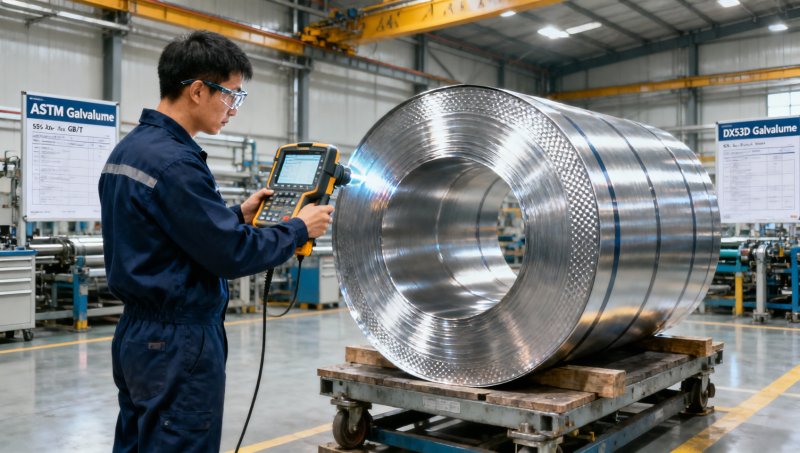
Surface defects — such as spangle irregularity, bare spots, or oil stains — affect paint adhesion and aesthetic finish. ASTM A792 defines “commercial” surface quality as permitting isolated defects ≤1 mm² within any 100 cm² area, with max 3 such defects per linear meter. GB/T 2518 defines equivalent “ordinary grade” as allowing ≤5 mm² defects and up to 5 per meter — a 2.5× higher defect allowance.
In architectural façade applications, this variance causes visible inconsistency in post-paint gloss uniformity — leading to 12–18% rework rates on large-scale commercial builds in Southeast Asia when GB/T-only coils are substituted without approval.
We maintain ISO 9001-certified visual inspection stations with calibrated LED light boxes (5000K, 1000 lux) and enforce ASTM-level surface grading across all export orders — regardless of destination standard.
Key Test Difference #4: Chemical Composition Reporting & Traceability
While both standards specify maximum limits for carbon (≤0.10%), manganese (≤0.50%), and phosphorus (≤0.035%), ASTM A792 requires full batch-level traceability down to heat number and casting sequence — enabling forensic root-cause analysis in case of field failure. GB/T 2518 only mandates heat number reporting, omitting ladle-to-ladle variation logs.
This distinction matters for OEM automotive suppliers or wind turbine tower fabricators who require full material pedigree for AS9100 or ISO 1090 certification. Our ERP system captures and certifies 100% of melt data — including oxygen content (≤25 ppm) and inclusion rating (≤1.5 per ASTM E45), exceeding baseline ASTM requirements.
Hongteng Fengda delivers dual-standard compliance without premium pricing — leveraging our integrated rolling-mill and coating line in Jiangsu Province to produce DX53D Galvalume coils meeting ASTM A653/A792, EN 10346, JIS G3321, and GB/T 2518 simultaneously. Lead time remains stable at 25–30 days for orders ≥50 MT, with MOQ flexibility down to 20 MT for trial batches.
How to Specify & Procure Correctly: A 4-Step Action Plan
- Step 1: Confirm end-use jurisdiction — If project is governed by U.S. ACI 318, EU EN 1993-1-3, or Saudi Aramco SAES-W-011, mandate ASTM A792 testing in PO terms.
- Step 2: Require mill test reports (MTRs) showing actual test values — not just “complies with” statements — with ASTM-style gravimetric coating mass and 180° bend results.
- Step 3: Verify traceability depth: Heat number alone is insufficient for Tier-1 OEMs; insist on ladle log references and inclusion ratings.
- Step 4: Request pre-shipment third-party inspection (SGS/BV) against your selected standard — we coordinate seamlessly and absorb 50% of inspection fees for orders >100 MT.
With over 12 years of export experience to 37 countries, Hongteng Fengda bridges the gap between Chinese manufacturing efficiency and international engineering rigor. We don’t just supply steel — we de-risk your sourcing, validate your compliance, and accelerate your project timeline.
Contact our technical sales team today to receive a customized DX53D Galvalume Steel Coil specification checklist, ASTM vs. GB/T comparison matrix, and competitive quotation — valid for 30 days.
- hot-dip galvanized
- steel coil
- galvanized steel
- steel coil for construction
- I-Beam
- Steel Rod
- Profile
- DX53D Galvalume Steel Coil
- steel rod lead time
- minimum order quantity for steel rods
- steel manufacturing lead time
- Galvanized
- steel sheet
- DX53D Galvalume Steel Coil for construction projects
- DX53D Galvalume Steel Coil manufacturer in China
- DX53D Galvalume Steel Coil price quotation
- steel rod lead time for construction projects
- minimum order quantity for steel rods in Europe
- steel manufacturing lead time supplier in China
Related recommendations
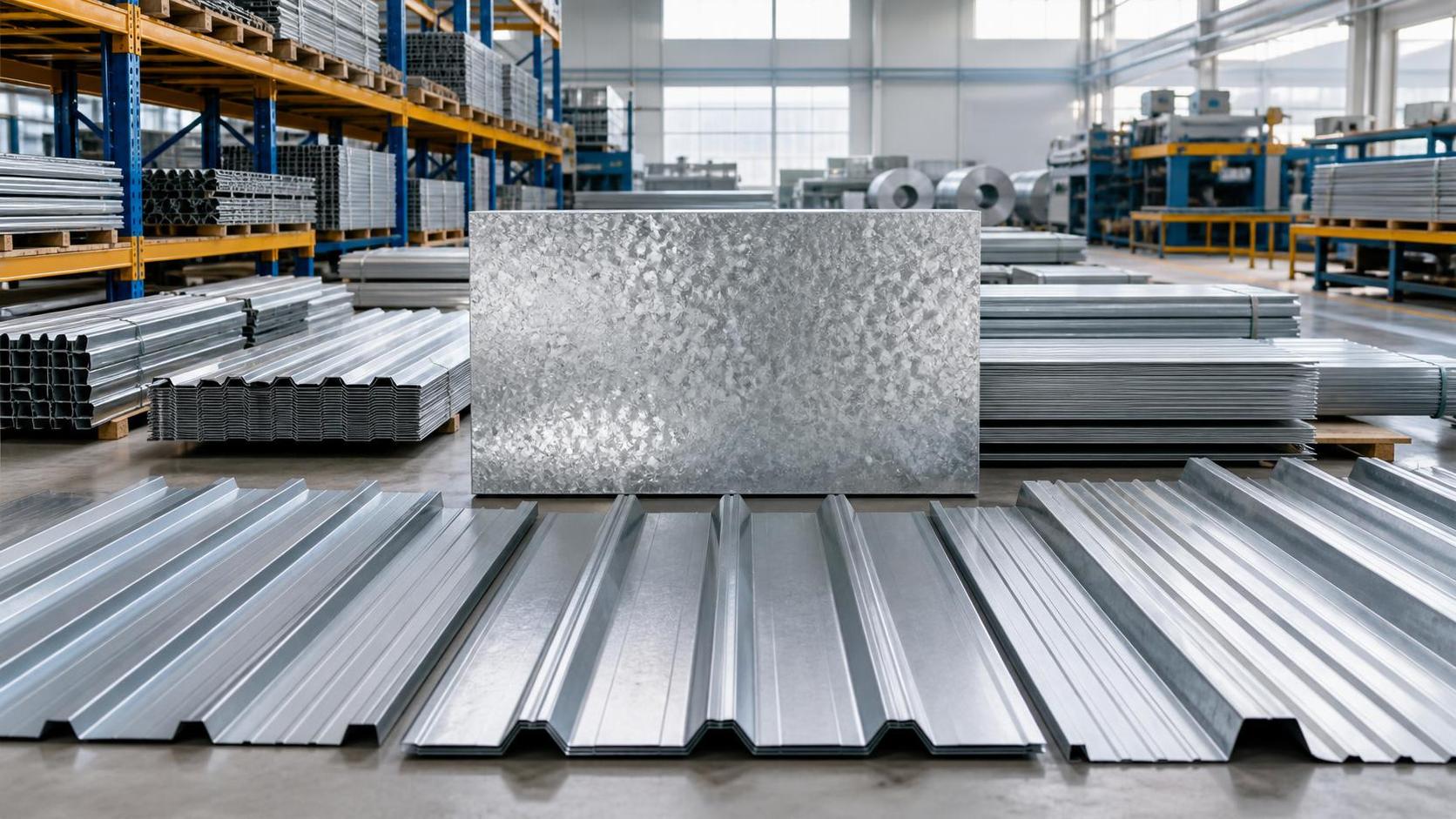
 How to Judge if Steel Sheet for Construction Fits Roofing or Wall CladdingSteel sheet for construction: learn how to judge thickness, coating, profile, and load performance for roofing or wall cladding, and choose a durable, cost-effective fit.
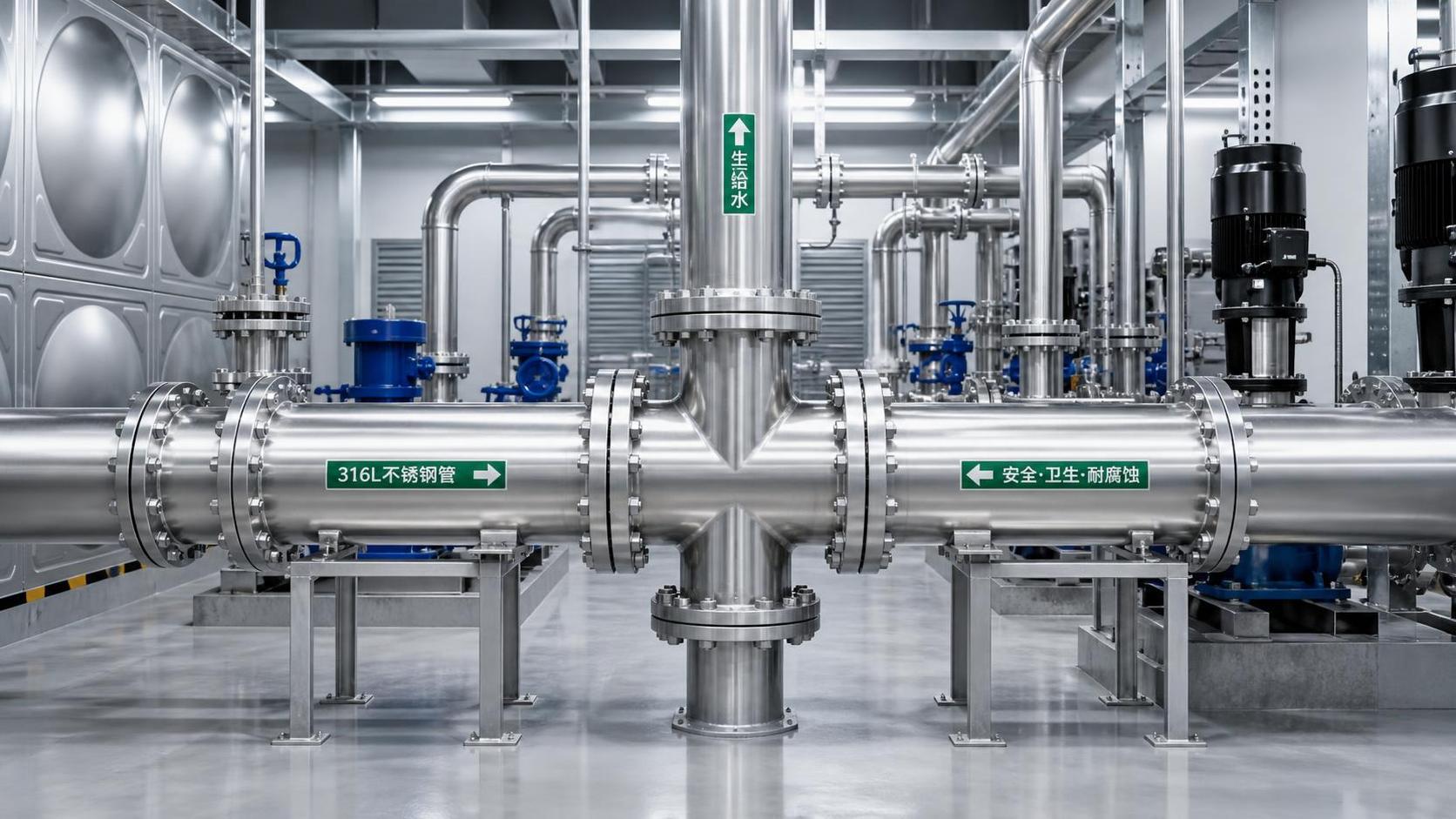
 How to Choose SS Pipe for Water Supply in Corrosion-Prone BuildingsSS pipe for water supply selection guide for corrosion-prone buildings. Compare 304 vs 316 grades, water chemistry, specs, and lifecycle cost to choose a safer, longer-lasting system.
 Steel Wire Rope Manufacturer Standards That Matter in Lifting ApplicationsSteel wire rope manufacturer standards for lifting: learn how to assess traceability, testing, compliance, and real quality control before choosing a safer, more reliable supplier.
 When a Steel Channel Supplier Should Provide Mill Test CertificatesSteel Channel supplier guide on when mill test certificates should be provided for quality control, compliance, and safer procurement.
Please give us a message


Please enter what you want to find