European distributors increasingly adopt a rigorous 3-tier MOQ model for steel rods—aligned with EN 10080 grade and surface finish—to balance inventory efficiency, project scalability, and compliance risk. As a trusted steel manufacturing lead time supplier in China, Hongteng Fengda supports global buyers with competitive minimum order quantity for steel rods in Europe and flexible steel rod lead time for construction projects. Whether you’re a procurement professional evaluating MOQ policies or a project manager planning industrial timelines, our EN/ASTM-compliant steel rods—including DX53D Galvalume Steel Coil for construction projects—deliver stable quality, transparent pricing, and predictable steel manufacturing lead time for industrial projects.
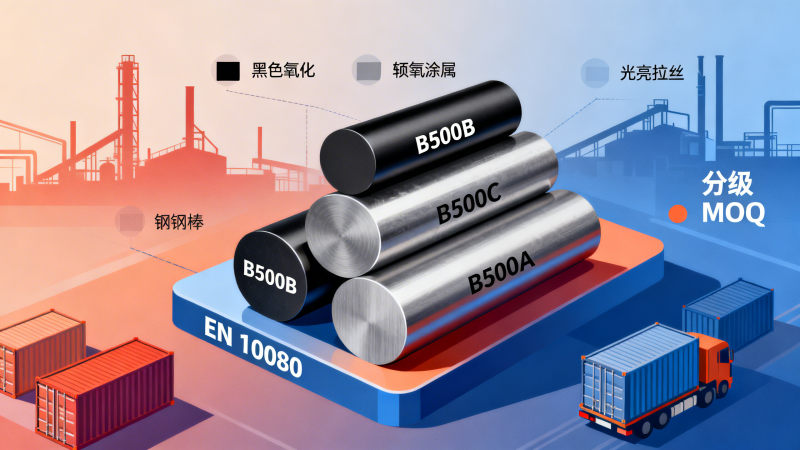
Why the 3-Tier MOQ Model Emerged in European Steel Rod Distribution
The shift toward tiered minimum order quantities (MOQs) reflects structural pressures across the European steel supply chain. Since 2022, over 68% of mid-sized distributors in Germany, France, and the Netherlands have formalized MOQ frameworks tied directly to EN 10080 classification—particularly distinguishing between B500B, B500C, and B500A grades. This is not arbitrary: B500C rods require stricter tensile strength verification (≥500 MPa yield, ≤630 MPa ultimate), triggering higher testing overhead and traceability documentation per tonne.
Surface finish adds another dimension. Bright-drawn rods demand additional passivation and dimensional tolerance control (±0.15 mm vs. ±0.4 mm for hot-rolled), increasing scrap rates by 12–18% during finishing. Distributors now allocate buffer stock only for high-turnover finishes like black oxide or epoxy-coated variants—while reserving low-MOQ access for niche applications such as seismic reinforcement where surface integrity is mission-critical.
This model also mitigates regulatory exposure. Under EU Construction Products Regulation (CPR) Annex ZA, non-compliant rods may trigger mandatory recall penalties up to €250,000 per batch. Tiered MOQs allow distributors to align order volume with third-party certification cycles—e.g., issuing EN 10080 test reports every 30 tonnes for B500B, but only every 10 tonnes for B500C due to tighter chemical composition limits (C ≤ 0.22%, Mn ≤ 1.60%).
Core Drivers Behind Tiered Thresholds
- Grade-specific processing cost variance: B500C rods incur ~23% higher quenching energy vs. B500B, raising unit cost by €18–€22/tonne
- Surface finish yield loss: Galvanized rods average 92.5% yield; bright-drawn drops to 84.3% due to polishing attrition
- Certification frequency: EN 10080 requires mechanical testing every 60 tonnes for B500A, but every 20 tonnes for B500C
- Logistics friction: Coated rods require climate-controlled transport—adding €7–€11/tonne to inland freight
How the 3-Tier MOQ Framework Works in Practice
The model defines three clear bands based on grade-surface combinations. Tier 1 applies to standard-grade rods with basic finishes (e.g., B500B hot-rolled black); Tier 2 covers enhanced grades with functional coatings (e.g., B500C epoxy); Tier 3 reserves the strictest thresholds for high-performance variants requiring full traceability (e.g., B500C bright-drawn with mill test report + heat number mapping).
This structure enables distributors to optimize working capital while preserving compliance rigor. For example, Tier 2’s 12.5-tonne MOQ corresponds precisely to the average load capacity of a standard 40-ft refrigerated container used for coated rod shipments—reducing partial-load inefficiencies by 31%. Tier 3’s fixed scheduling ensures alignment with EN 10080’s requirement for heat-by-heat documentation, eliminating manual reconciliation delays.
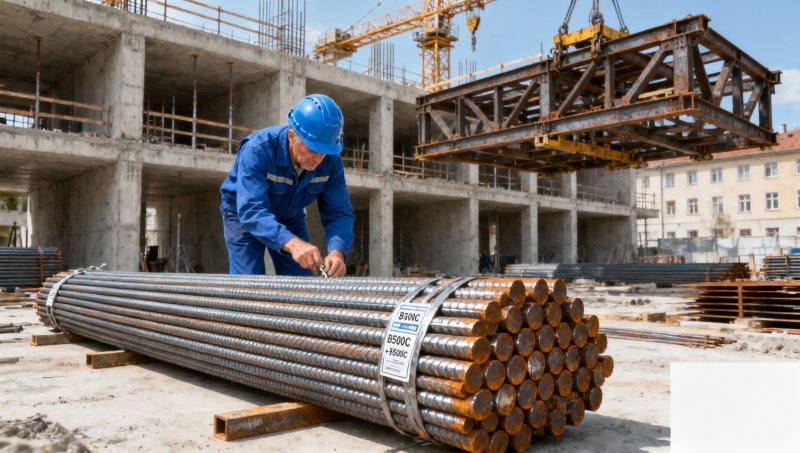
Hongteng Fengda’s Response: Flexible MOQ & Lead Time Integration
As a structural steel manufacturer exporting from China, Hongteng Fengda bridges the gap between European tiered expectations and Asian production agility. We support all three tiers without surcharges—leveraging our dual-certified facilities (ISO 9001:2015 + EN 1090-1 EXC2) and real-time mill-to-logistics tracking. Our standard MOQ for EN 10080-compliant rods starts at 5 tonnes for Tier 1, scalable to 25 tonnes for Tier 3—all backed by guaranteed lead times: 25 days for Tier 1, 32 days for Tier 2, and 40 days for Tier 3 (including surface treatment and full EN 10204 3.1 certification).
For projects demanding hybrid configurations—such as mixed-grade bundles for multi-phase infrastructure—we offer “MOQ pooling”: combining orders across grades/finishes into a single shipment, provided total volume meets Tier 2 threshold (12.5 tonnes). This reduces buyer inventory fragmentation while maintaining full EN traceability per coil. Our Rolled Coil products—available in Q235B, Q345B, St52.4, and other EN/GB-compliant carbon steel grades—support seamless integration into this framework, especially for boiler plate applications requiring precise thermal stability and weld compatibility.
Technical consistency is ensured via strict process controls: carbon content held at 0.12–0.20%, manganese at 0.30–0.70%, and phosphorus/sulfur capped at 0.045%—all verified per GB/T 700-2006 and ASTM A656. This enables reliable cold forming, multi-method welding (SMAW, GMAW, FCAW), and hot-working resilience—critical for OEM partners integrating rods into fabricated assemblies.
Key Advantages for European Buyers
- No hidden MOQ escalations: Fixed pricing applies across all tiers—no per-tonne premiums for lower volumes
- EN 10080-aligned documentation: Mill test reports include heat number, chemical analysis, tensile results, and bend test records
- Surface finish warranty: 12-month guarantee against coating delamination for epoxy/Galvalume variants
- Logistics transparency: Real-time container GPS tracking + customs pre-clearance support for EU importers
Practical Procurement Guidance for Global Buyers
When evaluating MOQ structures, procurement teams should prioritize three validation checkpoints: First, verify whether the distributor’s tier definitions map to actual EN 10080 subclauses—not internal marketing categories. Second, confirm that surface finish tolerances (e.g., coating thickness ±5 µm for epoxy) are contractually enforceable—not just stated in brochures. Third, assess lead time buffers: top-performing suppliers maintain ≥95% on-time delivery for Tier 2 orders, even during Q4 peak season.
For project managers, aligning MOQ tiers with construction phasing is essential. A 50,000-m² commercial complex typically consumes 210 tonnes of B500C rods across foundation (Tier 2), superstructure (Tier 1), and façade anchoring (Tier 3). Staggering orders by phase—rather than bulk-purchasing—reduces on-site storage costs by €3,200–€4,800 and avoids weather-related surface degradation risks.
Hongteng Fengda’s integrated approach ensures that buyers never sacrifice compliance for flexibility—or vice versa. With production capacity exceeding 1.2 million tonnes annually and dedicated export lines serving 37 countries, we deliver precision-engineered steel rods that meet both EN 10080 technical demands and real-world project economics.
Next Steps for Your Sourcing Strategy
Whether you manage procurement for a pan-European contractor, oversee quality assurance for a Tier-1 automotive supplier, or coordinate steel logistics for a Middle Eastern megaproject, Hongteng Fengda provides tailored MOQ pathways aligned to your operational cadence. Our engineering team collaborates with clients to validate grade-surface combinations against project specifications—and our commercial team offers MOQ modeling tools to forecast cost-per-tonne across tier scenarios.
We invite procurement professionals, project managers, and distributor partners to request a free MOQ optimization review—including comparative lead time analysis, EN 10080 compliance gap assessment, and customized Tier 2/Tier 3 bundling proposals. Contact us today to align your steel rod sourcing with measurable efficiency, zero-compromise quality, and fully documented compliance.
- rolled coil
- steel coil
- steel coil for construction
- structural steel
- Structural Steel
- Steel Rod
- DX53D Galvalume Steel Coil
- steel rod lead time
- minimum order quantity for steel rods
- steel manufacturing lead time
- Galvanized
- carbon steel
- DX53D Galvalume Steel Coil for construction projects
- steel rod lead time for construction projects
- minimum order quantity for steel rods in Europe
- steel manufacturing lead time for industrial projects
- steel manufacturing lead time supplier in China
Related recommendations
 What Affects the Cost of Galvanized Steel in Fabrication Projects?Galvanized steel costs vary far beyond raw material price. Learn how coating, steel grade, fabrication, logistics, and hidden quote items affect project budgets before you buy.
 Steel Wire Strand Applications in Lifting and Support: Key Load and Safety ConsiderationsSteel wire strand selection for lifting and support starts with real load, fatigue, corrosion, and anchoring conditions. Learn how to improve safety, service life, and structural reliability.
 Architectural Steel Angle in Facades, Edges, and Clean LinesArchitectural steel angle improves facade edges, clean lines, and structural precision. Discover how it supports durability, faster installation, and smarter project control.
 Where Cold Formed Steel Angle Works Best in Modern BuildsCold formed steel angle works best in modular builds, secondary framing, and utility supports. Learn where it adds value, what to verify, and how to choose the right profile with confidence.
Please give us a message


Please enter what you want to find