Evaluating cost efficiency of Hot Rolled I Beam versus welded beam in 2026 projects
In 2026 construction projects, choosing between a Hot Rolled I Beam for structural support and a welded beam will be a key factor in achieving cost efficiency and durability. As a trusted Structural Steel Manufacturer & Exporter from China, Hongteng Fengda provides comprehensive insights into material performance, fabrication costs, and long-term value. Whether sourcing ASTM steel beam for industrial shelving or structural steel purlin for commercial buildings, this evaluation helps engineers, project managers, and procurement teams make data-driven decisions for stronger, more economical steel structure construction.
1. Material and Production Differences
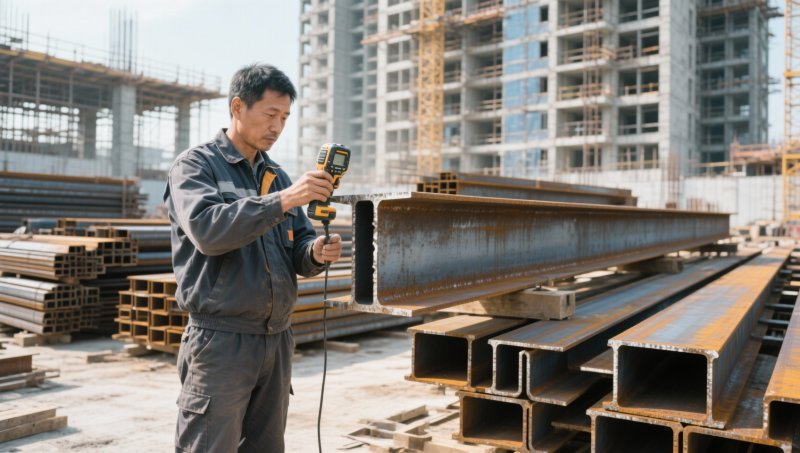
Hot Rolled I Beams are manufactured by rolling steel billets at temperatures of 1100–1250°C, creating a uniform section with integrated flanges and webs. In contrast, welded beams are fabricated by welding together individual steel plates—typically two flanges and one web—forming a tailor-made cross-section. This fundamental process difference drives much of the variation in mechanical performance, production time, and cost structure.
The hot rolling method allows continuous production with minimal waste and improved dimensional consistency, often within ±1.5 mm tolerance. Welded beams, while more customizable, rely on multiple manual or automated welding passes, resulting in a fabrication time that can extend by 20–40 % compared to hot rolling. The reliance on welding consumables and inspection processes also raises operational costs.
For projects demanding significant volume—such as infrastructure and commercial complexes planned after 2026—the scale advantage of mass-produced Hot Rolled I Beams becomes more evident. Welded beams, however, remain valuable when non‑standard dimensions or unique load profiles are required, such as in industrial machinery bases or offshore modules.
The following table outlines typical manufacturing distinctions that influence project cost and durability performance:
From the comparison above, the hot rolled option achieves around 15–25 % savings in labor and setup costs, especially in repetitive civil and commercial structures where uniform sections dominate design requirements.
2. Mechanical Strength and Structural Performance
Mechanical performance is central to a beam’s life‑cycle value. Hot Rolled I Beams, due to their integral grain flow and absence of weld seams, demonstrate superior fatigue resistance and consistent yield strength. Depending on the steel grade, yield strength typically ranges from 235 MPa for standard Q235 to 345 MPa or above for Q345 grades. Welded beams may achieve similar static capacities, but the heat-affected zones (HAZ) at welds introduce microstructural changes that can reduce fatigue life by 10–15 % in vibration environments.
Finite element analysis across 20 m spans indicates that deflection under uniform load for hot rolled H‑beams of section 400 × 200 × 8 × 13 mm is approximately 7.8 mm, whereas a welded equivalent may reach 8.3 mm given identical loads and material grades. This minor yet critical deviation could impact alignment precision in large industrial or bridge projects where tolerance limits are below 10 mm per span.
Hongteng Fengda’s quality system ensures that both beam types conform to ASTM, EN, JIS, and GB standards, allowing clients to select mechanical performance profiles that meet project-specific safety factors. Coupled with complementary products such as Rebar (available in HRB335, HRB400, HRB500), designers can create holistic frameworks integrating beams and reinforcement elements for load paths through columns, slabs, and foundations.
3. Cost Structure and Lifecycle Economics
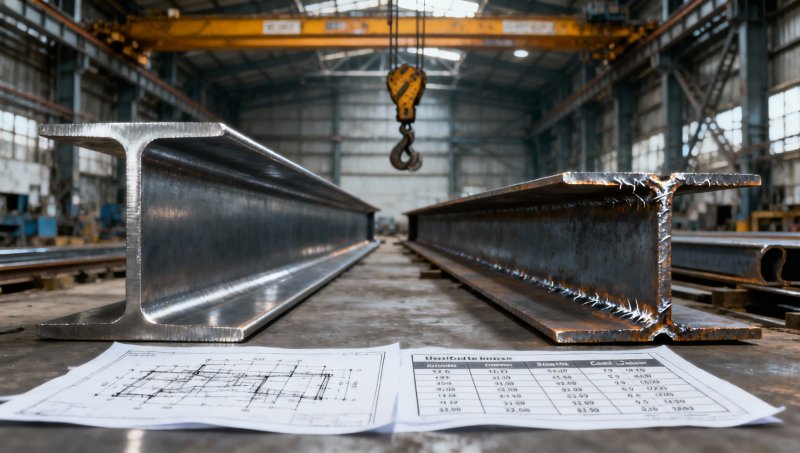
When assessing total cost efficiency in 2026 project planning, three layers must be considered: material cost, fabrication logistics, and lifecycle maintenance. Industry benchmarks show that raw steel pricing may fluctuate between 500–750 USD per metric ton depending on global supply chains, whereas welded fabrication adds an average of 80–120 USD per ton in labor and consumables.
Assuming a 10,000 m² commercial building using 500 tons of structural beams, substituting welded beams with hot rolled beams could reduce direct steel cost by approximately 7–12 %, translating to potential savings of 25,000–40,000 USD per building. Moreover, reduced welding workload limits onsite inspection frequency, cutting welding‑related quality assurance labor by almost 30 %.
The lifecycle component cannot be ignored. Corrosion initiation points at weld seams can double maintenance frequency in coastal or high‑humidity environments. By adopting hot rolled profiles enriched with protective finishes such as galvanized or anti‑rust oil coatings, maintenance intervals can extend from five years to nearly eight years in comparable conditions.
Table 2 below summarizes typical cost and maintenance differentials between the two beam solutions across an expected 25‑year service period:
From this economic model, hot rolled beams outperform welded beams by around 20–25 % on a long-term cost axis, mainly due to lower maintenance and superior corrosion resistance characteristics.
4. Application Scenarios and Project Selection Guidance
Different structural environments dictate specific beam requirements. In high‑rise buildings exceeding 30 floors or span ranges beyond 15 m, hot rolled sections are typically preferred for their predictable mechanical properties and reduced deflection. Welded beams find their niche in industrial plants, bridges, or expansion retrofits where tailored dimensions are essential for load matching.
Procurement managers and engineers can apply the following four-step evaluation to choose optimal structural beams for 2026 projects:
- Define structural load and geometry demands with at least ±2 % design tolerance.
- Calculate comparative fabrication time; hot rolled averages 0.8–1.0 hr/ton, welded 1.2–1.4 hr/ton.
- Assess corrosion environment using ISO 12944 standards and select appropriate coating (galvanized, painted, or oil‑protected).
- Estimate lifecycle cost per ton combining procurement, transport, erection, and 25‑year maintenance intervals.
In integrated civil works—especially bridges, culverts, and tunnels—a hybrid system combining Hot Rolled I Beam columns and Rebar reinforcement is frequently used. The rebar assists in distributing stress through concrete members, particularly for beams, slabs, and foundations. Hongteng Fengda’s product range (sizes from 6 mm to 50 mm, lengths up to 14 m) complements I beam configurations across diverse design classes.
5. Quality Assurance, Standards, and Global Supply Considerations
Global developers rely on predictable supply and strict compliance to standards. Hongteng Fengda ensures all structural beams meet ASTM A36/A992, EN10025, and JIS G3192 norms, supported by ISO, SGS, and BV certifications. Dimensional inspection follows ±1 % tolerance, and ultrasonic tests verify internal integrity, critical for beams exceeding 500 mm depth.
Typical production lead time is 10–20 days per 500‑ton lot, while loading and dispatch through Tianjin and Shanghai ports ensure shipment cycles within 25–35 days across North America, Europe, and the Middle East. This consistent schedule helps mitigate project delays—an increasingly vital factor as 2026 global infrastructure programs accelerate under tight timelines.
To maintain quality consistency, each batch undergoes six quality control steps covering chemical composition, dimensional accuracy, tensile testing, ultrasonic scanning, surface protection, and final packaging. Such rigorous inspection reduces rejection rates to below 0.8 %, enhancing cost efficiency across supply and installation phases.
6. Common Misconceptions and Procurement Advice
One common misconception is that welded beams always provide cost savings because they can use off‑cut plates. However, when accounting for welding consumables—often 1.5–2.0 kg per meter of weld—and quality inspection costs, total expenditure rises beyond hot rolled equivalents for projects exceeding 100 tons. Small repairs and post‑weld straightening further offset any theoretical savings.
Another concern involves transportation and handling. Welded beams with irregular sections may increase truck utilization by 10 %, raising logistics cost by approximately 5–8 USD per ton. In contrast, standardized hot rolled shapes stack efficiently, reducing both storage footprint and crane time during onsite erection.
Procurement professionals should request mill certificates with mechanical test results (yield, tensile, elongation) and NDT reports to ensure compliance. Where possible, integrating supply under one manufacturer like Hongteng Fengda reduces inter-supplier compatibility issues, streamlines documentation, and shortens lead times by one to two weeks.
7. FAQ: Practical Insights for 2026 Projects
How should engineers decide between Hot Rolled and welded beams?
Evaluate design complexity, structural repetition, and required accuracy. For large-volume standard sections, hot rolled beams deliver 15–25 % lower overall cost. Welded beams are ideal only for unique geometries or custom load orientations.
What delivery time can be expected for hot rolled beams?
Average lead time is 10–20 days depending on tonnage and finishing requirements. Surface treatments such as galvanization may add 3–5 days before shipment.
Are welded beams less reliable for seismic structures?
Welded joints can introduce stress concentrations. For seismic regions, hot rolled beams or hybrid beam‑column assemblies reinforced with ductile materials are typically favored for their energy absorption capacity.
Can different beam types be combined in one project?
Yes, but designers must ensure compatible stiffness ratios and unified coating systems. Mixing hot rolled primary beams with welded secondary beams is common in bridges or mezzanine frames where flexibility is required.
Conclusion and Next Steps
Hot Rolled I Beams and welded beams each hold strategic advantages, yet for most 2026 civil and industrial projects, hot rolled sections offer superior cost efficiency, uniformity, and lifecycle performance. Integrating these beams with complementary structural elements such as reinforcement bars or channels can further enhance durability and reduce total ownership costs.
With extensive expertise in structural steel manufacturing, Hongteng Fengda supports global clients through consistent quality, timely delivery, and engineering guidance aligned with ASTM, EN, JIS, and GB standards. Whether specifying high-strength Q345 material or project-tailored welded assemblies, the company ensures precision and reliability throughout the procurement cycle.
Contact Hongteng Fengda today to request technical data sheets, obtain customized beam and component recommendations, and secure a stable supply chain for your 2026 structural steel projects.
- h beam
- Hot Rolled I Beam
- structural steel
- ASTM steel beam
- Structural steel purlin
- Steel structure construction
- Structural Steel
- Hot Rolled Beams
- steel plate
- Profile
- Rebar
- Galvanized
- Steel Beam
- Structural steel purlin for commercial buildings
- ASTM steel beam for industrial shelving
- Hot Rolled I Beam for structural support
Related recommendations
 Sustainability Trends in the Global Steel Tubing MarketsExplore sustainability trends in the global steel tubing market. Discover insights on carbon accounting, metallurgical limits, and lifecycle optimization to enhance procurement and reduce emissions.
 Lifecycle Cost Analysis of Steel Roofing vs. Traditional TilesDiscover how Steel Roofing outperforms traditional tiles in lifecycle cost analysis. Learn about CapEx savings, lower maintenance, and higher ROI for your commercial project.
 Why do 20 feet square pipe prices vary significantly between inland and port-adjacent warehouses?20 feet square pipe price varies by location—discover why port-adjacent warehouses often deliver better total cost, speed & ROI. Get the finance-approved breakdown.
 Do the advantages of galvanized steel outweigh long-term maintenance costs in humid industrial zones?Advantages of galvanized steel in humid industrial zones? Yes—when engineered right. Discover how proper specification cuts long-term maintenance costs by 2–3×.
Please give us a message


Please enter what you want to find