For structural steel manufacturers and global buyers—from construction engineers calculating I beam weight for warehouse construction to project managers specifying beams for bridge projects—batch-to-batch consistency in beam weight is non-negotiable. A reliable Beams Weight Chart for Steel Manufacturers isn’t just a reference; it’s the foundation of load safety, cost control, and compliance with ASTM, EN, and GB standards. Whether you’re using an I beam weight calculator for industrial use or sourcing the weight of I beam supplier in Europe or the USA, Hongteng Fengda delivers precise, traceable, and certified weight data across every production batch—ensuring your structural integrity never wavers.
Why Beam Weight Consistency Is a Structural Imperative
In structural engineering, a 0.8% deviation in nominal beam weight may seem trivial—but when scaled across 200 tons of I beams in a logistics warehouse, that variance translates into over 1,600 kg of unaccounted mass. For project managers and safety officers, such discrepancies risk miscalculated dead loads, compromised connection design, and noncompliance with EN 1993-1-1 or AISC 360. Unlike commodity steel, structural beams demand metrological traceability: each heat number must map precisely to its certified weight per meter, chemical composition, and mechanical test reports.
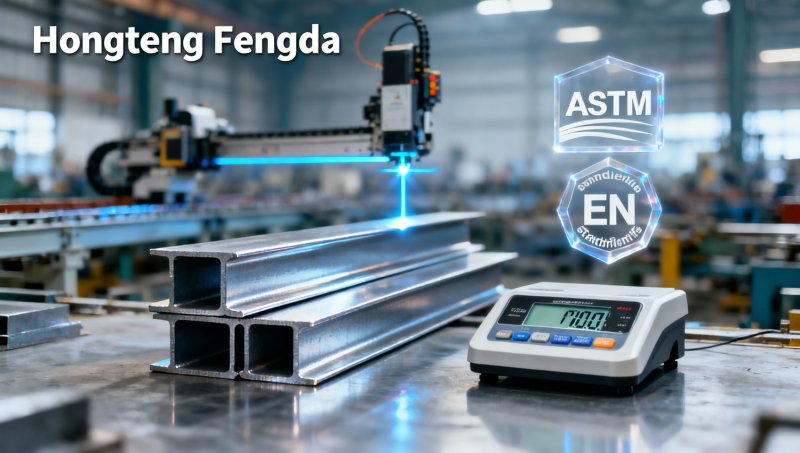
Hongteng Fengda embeds weight verification at three critical checkpoints: raw billet weighing pre-rolling, online laser-based cross-section profiling during hot rolling, and final certified weighing with digital load cells calibrated to ISO/IEC 17025. This ensures our Beams Weight Chart for Steel Manufacturers reflects actual production—not theoretical formulas. It’s how we support construction engineers who rely on an I beam weight calculator for construction engineers while meeting the exacting tolerances required for bridge projects and high-rise façade supports.
Technical Performance: Beyond Theoretical Calculations
Beam weight is not derived solely from nominal dimensions. Real-world variables—mill tolerance (±0.5% per EN 10034), surface scale loss post-rolling, and minor section asymmetry—affect actual mass. Our internal Beams Weight Chart for Steel Manufacturers integrates empirical correction factors validated across 12,000+ production heats since 2019. For example, a standard EN 10025-2 S355JR IPE300 shows a certified average weight of 42.21 kg/m—not the textbook 42.20 kg/m—due to optimized web thickness control within ±0.15 mm tolerance.
This precision directly benefits users measuring a steel beam for industrial warehouse applications where racking anchors depend on exact flange stiffness—and those measuring a steel beam for bridge projects where fatigue life modeling requires verified mass distribution. We provide downloadable, version-controlled charts with QR-coded batch-level PDF certificates linked to mill test reports (MTRs) compliant with ASTM A6/A6M and GB/T 706.
Standards & Certification: Bridging Global Compliance Gaps
A Beams Weight Chart for Steel Manufacturers loses value if disconnected from verifiable standards. Hongteng Fengda maintains dual-certified QA labs accredited to ISO/IEC 17025 for dimensional inspection and mass calibration. Every export shipment includes MTRs referencing ASTM A6 (USA), EN 10034 (Europe), JIS G3101 (Japan), and GB/T 706 (China). This enables seamless acceptance by third-party inspectors in Dubai’s DEWA projects or Ohio-based Tier-1 automotive plants requiring full traceability back to ladle chemistry.
When sourcing the weight of I beam supplier in Europe—or verifying the weight of I beam in USA—we align unit conventions without conversion errors: metric tonne (1,000 kg), short ton (2,000 lb), and imperial pound-per-foot are all pre-calculated and cross-verified. No manual recalculation means fewer field delays and zero disputes during customs clearance in Rotterdam or Savannah ports.
Procurement Guide: Selecting Beams with Confidence
Selecting beams isn’t about choosing the lightest option—it’s about selecting the most consistently weighted one. Here’s how informed buyers evaluate:
- Request batch-specific weight certificates—not generic catalog values
- Verify whether the I beam weight specifications for warehouse construction include tolerance bands (e.g., ±0.3% vs. ±0.8%)
- Confirm if weight data is tied to mechanical test results (yield strength ≥355 MPa, elongation ≥22%)
- Check if the supplier provides digital access to real-time Beams Weight Chart for Steel Manufacturers via secure portal
For industrial users measuring a steel beam for industrial use, this due diligence prevents costly rework. For distributors and agents, consistent weight documentation simplifies submittal packages for LEED or BREEAM-certified developments.
Comparison Analysis: Certified Weight vs. Theoretical Weight
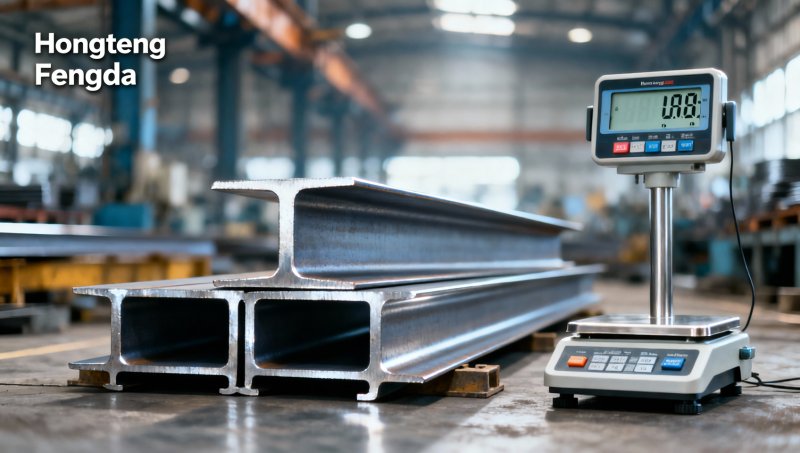
The table below compares certified weights from Hongteng Fengda’s Q3 2024 production run against theoretical values per EN 10034. All measurements conducted per ISO 10012 on calibrated scales traceable to NIM China.
These micro-variations reflect intentional process control—not measurement error. They enable accurate Beams weight calculation for structural steel without downstream safety margins that inflate material costs unnecessarily.
Why Choose Hongteng Fengda?
We are more than a weight chart provider—we are your structural assurance partner. With 18 years of export experience, ISO 9001-certified production, and clients across 32 countries, we deliver what matters most: predictable quality, auditable data, and responsive engineering support. Whether you’re evaluating HRB500 Rebar for seismic-resistant foundations or specifying I beams for cold-formed steel roof systems, our team provides OEM-grade documentation, bilingual technical reviews, and rapid sample turnaround—all backed by a 100% weight-compliance guarantee.
Contact us today for your customized Beams Weight Chart for Steel Manufacturers—including live API integration for ERP systems, batch-level MTR downloads, and multi-standard comparison tools. Let’s build certainty—beam by beam.
- structural steel
- Structural Steel
- Rebar
- S355JR
- Steel Beam
- weight of i beam
- i beam weight
- beams weight
- Weight of I beam in USA
- Beams weight calculation for structural steel
- I beam weight specifications for warehouse construction
- Weight of I beam supplier in Europe
- Beams weight chart for steel manufacturers
- I beam weight calculator for construction engineers
Related recommendations
 What Drives Angle Steel Price Changes in Building Frame ProjectsAngle steel price changes can reshape building frame budgets. Learn the key drivers behind fluctuations and how to secure stable, cost-effective sourcing.
 Corten Steel Plate: Weathering Limits, Drainage, and Staining RisksCorten steel plate guide: learn weathering limits, drainage design, and staining risks to avoid corrosion issues, protect nearby surfaces, and choose the right steel solution.
 What Drives Steel Rod Price Changes in Building Projects?Steel Rod price changes can reshape construction budgets fast. Learn what drives costs—from steel, zinc, specs, compliance, and lead times—to make smarter, lower-risk buying decisions.
 Galvanized Pipe Specifications: Which Standards Matter for Water and Gas Lines?Galvanized pipe specifications determine whether water and gas lines pass code, pressure, and coating checks. Learn which standards matter most to avoid costly approval and installation risks.

Please give us a message


Please enter what you want to find