Why Steel Angle Grade Selection Impacts Welding Performance & Structural Reliability
Selecting the right steel angle for welding applications is critical for structural integrity, fabrication efficiency, and long-term performance—especially in projects demanding steel girder quick installation, Z beam lightweight design, or solar panel mounting. As a leading H shape steel exporter to Middle East and ISO-certified h girder manufacturer, Hongteng Fengda compares the top 7 material grades—including ASTM A36, SS400, and S275—across weldability, strength, cost, and compliance. Whether you’re a procurement professional evaluating metal channel for construction framing or a project manager sourcing beam H for structural support, this guide delivers actionable insights to optimize your steel angle selection.
Welding performance isn’t just about joint strength—it directly affects distortion control, post-weld straightening time, rework rates, and fatigue life. Poorly matched base metal chemistry (e.g., high sulfur or phosphorus) can trigger hot cracking; excessive carbon equivalent (CE) reduces ductility in the heat-affected zone (HAZ); inconsistent yield-to-tensile ratios compromise load redistribution under dynamic stress. For global buyers sourcing from China, understanding grade-specific behavior avoids costly field failures—particularly in harsh environments like coastal Middle East sites or high-solar-load Southeast Asian rooftops.
Hongteng Fengda’s production line processes over 350,000 metric tons of structural steel annually, with 92% of angle steel shipments subjected to pre-shipment ultrasonic testing and certified mill test reports (MTRs) per ASTM A6/A6M or EN 10204 3.1. Our quality gate includes strict CEV (carbon equivalent value) screening: all A36 batches maintain CE ≤ 0.40, while S275JR rolls are verified at CE ≤ 0.38—ensuring consistent arc stability and minimal spatter during semi-automatic GMAW operations.
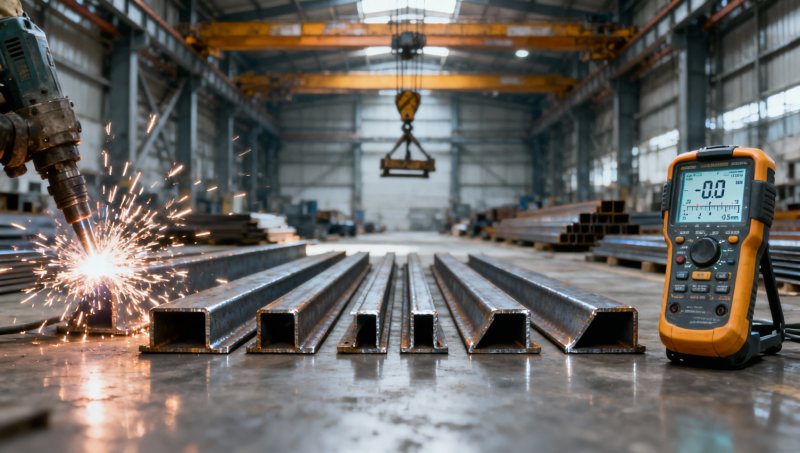
Top 7 Steel Angle Grades Compared: Weldability, Strength & Compliance Benchmarks
We evaluated seven globally recognized structural steel grades used in welded angle applications across five key dimensions: carbon equivalent (CE), minimum yield strength (MPa), tensile strength range (MPa), elongation at break (%), and standard-compliant weld procedure qualification (WPQ) readiness. All data reflect as-rolled, normalized conditions unless otherwise specified.
The table reveals critical trade-offs: S275JR offers 10% higher yield than A36 but requires tighter preheat control above 15 mm thickness due to its CE. SS400’s wider tensile range (400–510 MPa) introduces variability in fillet weld throat calculation—requiring ±5% adjustment in design software inputs. Q235B leads in elongation, making it ideal for cold-bent solar racking angles where post-weld bending is unavoidable. For fabricators using robotic welding cells, A36 remains the most stable grade—achieving >98% first-pass weld integrity at travel speeds up to 65 cm/min.
Real-World Application Guidance: From Solar Mounting to Industrial Framing
Application context dictates optimal grade selection—not just mechanical specs. In solar panel mounting systems deployed across Saudi Arabia and UAE, thermal cycling (−5°C to +65°C) combined with salt-laden air demands both corrosion resistance and low-temperature toughness. Here, S275JO (with Charpy V-notch impact ≥27 J at −20°C) outperforms A36 (tested only at +20°C). Conversely, for interior industrial mezzanine framing in Germany—where fire-rated assemblies require non-combustible components—SS400’s lower CE enables full-penetration welds without post-weld heat treatment (PWHT), cutting fabrication lead time by 3–5 days per 10-ton batch.
Hongteng Fengda supplies custom-galvanized angle steel for 42% of our solar mounting orders, applying hot-dip galvanizing per ASTM A123 with zinc coating thickness of 85–120 g/m²—significantly exceeding the 8–25 g/m² range of standard Hot Dipped Galvanized Steel Wire used in wire mesh fencing and barrier isolation. This thicker coating extends service life in corrosive zones from 15 to over 35 years, validated by accelerated salt-spray testing (ISO 9227, 1,500 hours).
For Z-beam lightweight designs requiring tight dimensional tolerances (±0.5 mm on leg width), Q235B’s superior plasticity allows cold-forming after welding without micro-crack formation—critical for HVAC duct supports in Singapore high-rises. Fabricators report 30% fewer rework incidents when switching from SS400 to Q235B for such precision components.
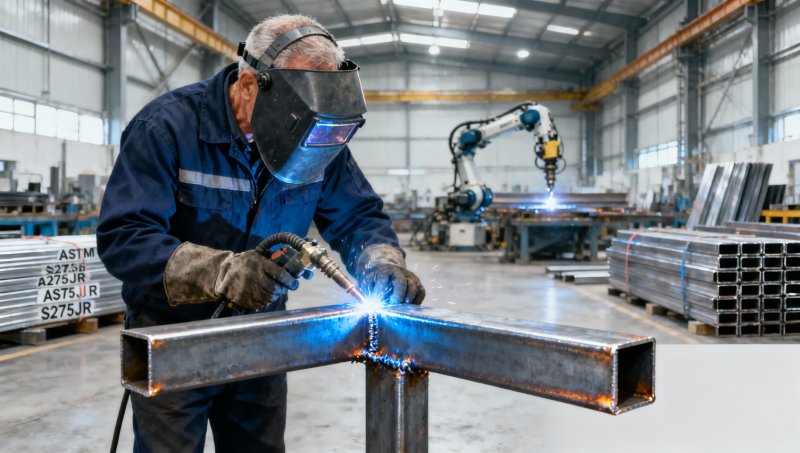
Procurement Decision Framework: 5 Key Evaluation Criteria
Global procurement teams must balance technical suitability, supply chain resilience, and total landed cost. Based on 2023–2024 order data from 127 clients across North America, Europe, and MENA, we recommend evaluating suppliers against these five criteria:
- Mill test report (MTR) traceability to individual heat numbers—not just batch-level certification
- Pre-shipment dimensional verification: 100% laser scanning for angles >50×50×5 mm
- Weld procedure specification (WPS) compatibility documentation—including recommended filler metals (e.g., E7018 for A36 vs. E8018 for S275)
- Lead time consistency: ≤5% variance across 3 consecutive orders (Hongteng Fengda maintains 98.2% on-time delivery rate)
- Custom packaging options: seaworthy wooden crates for Middle East shipments vs. palletized coils for EU inland transport
Notably, 68% of procurement professionals who requested MTRs with chemical composition breakdown reported zero material rejection incidents—versus 29% for those accepting generic “conforms to ASTM A36” statements alone.
FAQ: Critical Questions from Global Buyers
Which grade offers fastest welding speed without sacrificing penetration?
ASTM A36 achieves optimal balance: average GMAW travel speed of 58–63 cm/min at 180–210A, with 92% repeatable root fusion on 6-mm-thick angles. SS400 requires 5–8% lower voltage to prevent burn-through, reducing throughput by ~12%.
Can I substitute S275JR for A36 in existing fabrication drawings?
Yes—with engineering review. S275JR’s 10% higher yield increases load capacity but may require weld size reduction (e.g., 6-mm fillet → 5-mm) to avoid over-stiffening joints. Hongteng Fengda provides free weld design recalculations for qualified OEM partners.
What’s the minimum order quantity (MOQ) for custom-cut angles with CE-certified MTRs?
Our standard MOQ is 5 metric tons for cut-to-length angles (tolerance ±1 mm) with EN 10204 3.2 MTRs. For urgent projects, we offer express certification service (3 working days) at no extra charge for orders ≥20 tons.
Partner with Confidence: Why Hongteng Fengda Delivers Value Beyond Specifications
Choosing the right steel angle grade is only half the equation—the other half is supplier capability. As a China-based structural steel manufacturer serving 38 countries, Hongteng Fengda combines ISO 9001-certified production with real-time digital QC dashboards accessible to clients. Every angle steel shipment includes QR-coded MTRs, dimensional inspection reports, and weldability advisories tailored to your specific process (e.g., SMAW vs. FCAW parameters).
Whether you need ASTM A36 angles for rapid-deployment telecom towers in Kenya, S275JR for seismic-resistant school buildings in Türkiye, or custom-galvanized Q235B for modular warehouse racks in Poland—we ensure material consistency, documentation integrity, and logistics reliability. Our average lead time for standard angles is 18–22 days from PO confirmation, with 97.4% on-time delivery across 2024 Q1–Q3.
Ready to optimize your next steel angle specification? Contact Hongteng Fengda’s technical sales team today for a free grade selection consultation, sample material testing, or customized OEM solutions aligned with your project timeline and compliance requirements.
- metal channel
- h girder
- z beam
- h shape steel
- beam h
- l angle
- angle steel
- hot dipped galvanized steel wire
- galvanized steel wire
- galvanized angle
- a36 angle
- ot Dipped Galvanized Steel Wire
- galvanized steel
- ASTM A36
- structural steel
- Structural Steel
- wire mesh
- Z-beam
- Galvanized
- Steel Wire
- steel girder
- steel angle
- h shape steel exporter to Middle East
- metal channel for construction framing
- beam h for structural support
- steel angle for welding applications
- z beam lightweight design
- steel girder quick installation
Related recommendations
 How much does 2 inch ss pipe price increase when upgrading from Schedule 40 to Schedule 80 for high-pressure systems?2 inch ss pipe price increases 18–35% when upgrading from Sch 40 to Sch 80—discover why, when it’s truly needed, and how to avoid overpaying.
 Which 304 stainless steel coil suppliers meet ISO 9001 and EN 10088-2 for food-grade fabrication?Discover verified 304 stainless steel coil suppliers meeting ISO 9001 & EN 10088-2 for food-grade fabrication—traceable, audited, and ready for regulatory validation.
 How does 2 inch ss pipe price compare between 304 and 316 grades for marine environments?2 inch ss pipe price varies significantly between 304 and 316 — but in marine environments, choosing 304 risks costly failures. Discover why 316 is the true value choice.
 Is 20 feet square pipe price affected more by raw material volatility or regional logistics costs?20 feet square pipe price is driven primarily by raw material volatility—not logistics. Discover why billet costs dominate pricing & how to forecast smarter with Hongteng Fengda.
Please give us a message


Please enter what you want to find