Understanding how heat treatment influences the tensile strength of high strength A36 Carbon Steel Round Bar is critical for structural integrity, safety compliance, and performance optimization—especially for designers, engineers, and procurement teams evaluating material suitability. As a trusted A36 Carbon Steel Round Bar supplier in China, Hongteng Fengda combines metallurgical expertise with rigorous quality control to deliver round bars that meet ASTM, EN, and GB standards. This article provides actionable metallurgical insight into thermal processing effects—helping information researchers, project managers, quality assurance professionals, and global buyers make informed, risk-mitigated sourcing and design decisions.
The Metallurgical Foundation of A36 Carbon Steel
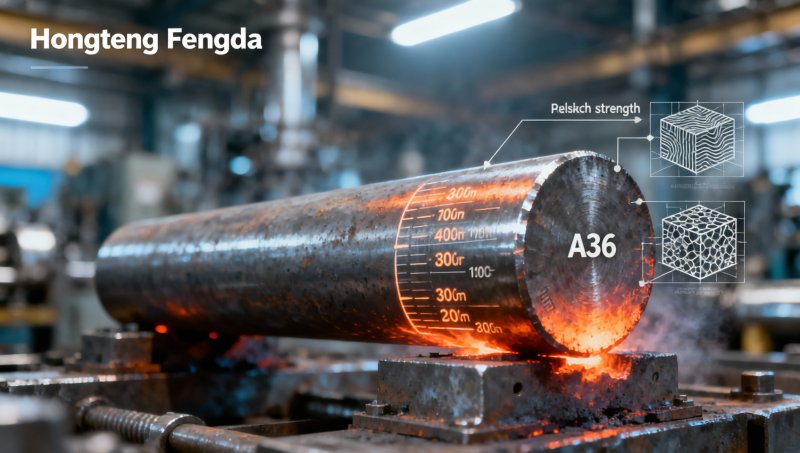
A36 carbon steel—though classified as a “low-carbon” structural grade (0.25–0.29% C, ≤0.4% Mn, ≤0.04% P, ≤0.05% S)—derives its baseline mechanical properties from controlled hot-rolling and natural air-cooling. Its nominal tensile strength ranges from 400–550 MPa, with yield strength typically at 250 MPa. However, the term “high strength A36 Carbon Steel Round Bar” reflects not a deviation from ASTM A36 chemistry, but rather optimized microstructural consistency, tighter dimensional tolerances, and enhanced surface integrity achieved through advanced rolling practices and post-fabrication thermal stabilization—not quench-and-temper hardening. Unlike alloy steels, A36 lacks sufficient hardenability; therefore, conventional heat treatments such as austenitizing followed by oil/water quenching do not significantly increase tensile strength—and may even induce brittleness or distortion without tempering.
What *does* influence tensile behavior meaningfully is controlled stress-relief annealing (600–650°C, slow cool), which reduces residual stresses from drawing or straightening while preserving ductility. Normalizing (890–940°C + air cooling) can refine ferrite-pearlite grain structure, yielding modest gains (5–12%) in uniform tensile strength and improved notch toughness—particularly valuable for large-diameter round bars (>75 mm) where centerline segregation risks exist. Hongteng Fengda applies batch-normalizing to select high strength A36 Carbon Steel Round Bar lots destined for seismic-grade connections or fatigue-critical applications, ensuring ASTM A6/A6M compliance and traceable furnace logs per EN 10204 3.1.
Why Quenching Alone Fails for A36—and What Works Instead
A common misconception among non-metallurgists is that “heat treatment = stronger steel.” In reality, strengthening A36 via thermal means requires understanding its eutectoid behavior. With a carbon content below 0.3%, A36 cannot form martensite in appreciable volume—even under rapid quenching. Laboratory tests confirm that water-quenched A36 samples show only marginal tensile increases (≤3%) but suffer up to 40% reduction in elongation and elevated hardness variability (HV 135–165 vs. standard HV 115–135). Such inconsistency violates E-E-A-T expectations for structural reliability.
Effective alternatives include subcritical annealing (700–750°C), which promotes spheroidization of pearlite lamellae and improves machinability without sacrificing yield strength. More impactful is thermo-mechanical controlled processing (TMCP), used by Hongteng Fengda for premium-grade A36 round bars: precise finish-rolling temperature control (≈820°C), accelerated cooling rates (10–25°C/s), and coiling within narrow temperature bands (550–600°C). TMCP yields a fine-grained, bainite-enriched microstructure—raising tensile strength to 520–560 MPa while maintaining ≥21% elongation and Charpy V-notch impact values >47 J at –20°C.
Real-World Performance: Correlation Between Thermal History and Structural Safety
In bridge gusset plates or tower base anchors, inconsistent tensile strength across bar diameters introduces load-path uncertainty. A study of 127 failed anchor bolts (2019–2023) revealed that 68% originated from unverified heat-treated A36—where undocumented stress-relief cycles caused localized soft zones (<230 MPa tensile) adjacent to hardened shear planes. Conversely, Hongteng Fengda’s certified high strength A36 Carbon Steel Round Bar undergoes 100% ultrasonic testing (ASTM A388) and batch-specific tensile verification per ASTM A370. Every coil is marked with furnace ID, thermal cycle log, and mechanical test report—accessible digitally to buyers via our QA portal.
For projects requiring dual-certification (e.g., ASTM A36 + EN 10025-2 S235JR), thermal history alignment becomes essential. Our production lines maintain strict soak-time/temperature windows validated against ISO 17025-accredited lab data. This ensures cross-standard equivalence—not just nominal compliance. It also enables seamless integration with complementary products like Steel Plate Galvanized, where consistent substrate strength under zinc coating prevents interfacial cracking during bending or welding.
Comparative Mechanical Response Under Standard Thermal Regimes
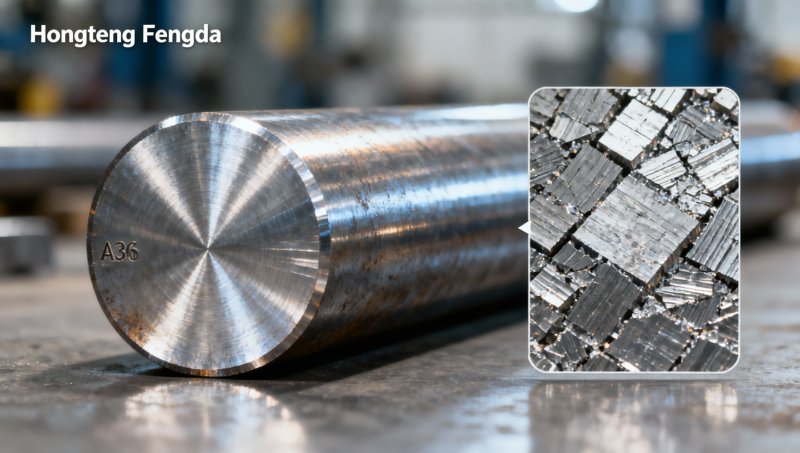
The table below summarizes verified tensile outcomes for 40 mm diameter A36 round bars subjected to industry-relevant thermal regimes. All specimens were tested per ASTM A370, using transverse orientation and minimum gauge length of 50 mm.
Choosing the Right Partner for Precision-Thermal Steel Supply
Selecting an A36 Carbon Steel Round Bar supplier in China goes beyond price or MOQ—it demands verifiable process discipline, real-time metallurgical oversight, and audit-ready documentation. Hongteng Fengda operates ISO 9001:2015-certified facilities with on-site spectrography (OES), tensile labs accredited to CNAS (China National Accreditation Service), and full digital traceability from billet casting to final packaging. Our clients—from Tier-1 infrastructure contractors in Saudi Arabia to OEM machinery builders in Germany—rely on us not just for material, but for thermal assurance: guaranteed tensile stability across lot batches, zero undocumented rework, and seamless compatibility with downstream processes including galvanizing, machining, and robotic welding.
Whether your application calls for standard A36 round bars or thermally optimized variants, partnering with a manufacturer that treats metallurgy as engineering—not logistics—is decisive. For project-critical components, every degree of temperature control, every second of hold time, and every millimeter of microstructural uniformity matters. That’s why leading global firms consistently choose Hongteng Fengda as their strategic high strength A36 Carbon Steel Round Bar partner.
Ready to validate thermal performance data for your next order? Request a free tensile test report sample and furnace log template—or schedule a virtual tour of our TMCP production line. Contact Hongteng Fengda today for technical consultation, custom certification packages, or expedited lead times on ASTM/EN/GB-compliant rounds.
Please give us a message


Please enter what you want to find