Choosing the right supplier is critical when evaluating angle vs channel steel manufacturer Europe options. For distributors, agents, and stockists, the best maker is not just about price, but also product consistency, EN standard compliance, delivery reliability, and export support. This guide explains how to compare European suppliers effectively while identifying the factors that reduce sourcing risk and improve long-term profitability.
What Buyers Really Need to Compare First
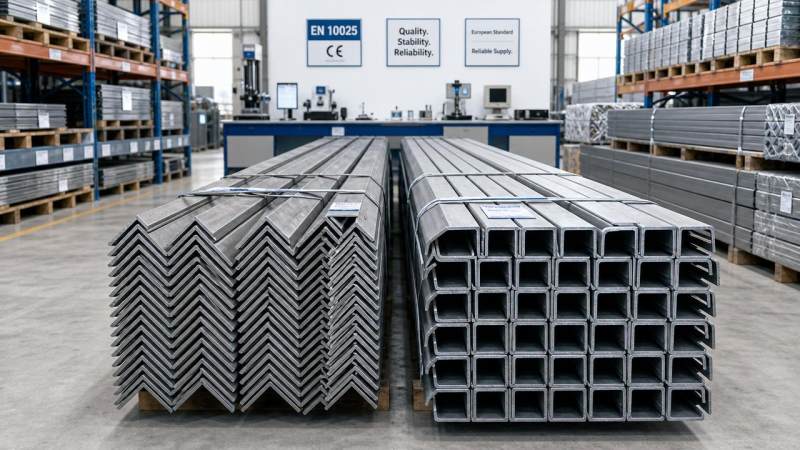
Distributors searching for an angle vs channel steel manufacturer Europe comparison usually want one thing: a reliable supply partner that protects margin and reduces operational risk.
That means the evaluation should start with commercial practicality, not marketing claims. The best supplier is the one that can deliver consistent quality, workable pricing, and fewer problems after purchase.
For stockists and agents, the real question is not whether a mill can produce steel sections. It is whether that producer can support repeat orders with stable dimensions, clear documents, and dependable lead times.
In most cases, a lower quoted price becomes less attractive if the supplier creates claims, delays customs clearance, or delivers mixed tolerances that make resale difficult in local markets.
Understand the Difference Between Product Fit and Supplier Fit
Before comparing producers, buyers should separate two decisions: whether angle steel or channel steel is better for the target application, and whether the manufacturer is suitable as a supply partner.
Angle steel is often selected for frames, supports, reinforcement, towers, brackets, and general fabrication. Channel steel is more common in structural supports, machinery bases, trailer frames, and load-bearing assemblies.
However, the product decision alone does not solve the procurement problem. A strong supplier must be able to maintain dimensional accuracy, grade consistency, and repeatability across different batches and order sizes.
For European distribution, product fit matters, but supplier fit matters more. If a mill cannot support certifications, packaging standards, and traceability, resale becomes harder even when the steel itself is acceptable.
Check EN Compliance Before Discussing Price
For European buyers, EN standard compliance should be one of the first screening criteria. It directly affects market access, customer acceptance, and the speed of project approval.
Ask whether the manufacturer can supply products aligned with common European requirements, including steel grade references, mechanical property records, dimensional tolerances, and inspection documentation.
Distributors should also verify whether certificates are routine or only prepared on request. A supplier that treats compliance as a standard process is usually easier to work with over the long term.
When comparing makers, request sample mill test certificates, quality manuals, and evidence of third-party inspection support. This is far more meaningful than broad claims about “international quality.”
Reliable producers often manufacture to multiple standards such as EN, ASTM, JIS, and GB. That flexibility is useful for distributors serving mixed markets or handling special customer specifications.
Compare Manufacturing Consistency, Not Just Capacity
Large capacity sounds impressive, but consistency is the real commercial advantage. A smaller but disciplined producer may be better than a larger mill with uneven quality control.
Ask detailed questions about rolling processes, inspection checkpoints, tolerance control, surface quality, and how the plant handles non-conforming material. Serious suppliers can answer clearly and specifically.
Distributors should pay particular attention to thickness variation, straightness, edge condition, and length accuracy. These details influence resale confidence and can reduce cutting loss for end users.
A stable manufacturer will also have documented procedures for chemical composition control and mechanical performance verification. This reduces disputes when buyers reorder the same item months later.
Consistency matters even more when you are building a regional inventory model. If every batch differs, warehouse management, downstream processing, and customer trust all become more difficult to maintain.
Lead Time Reliability Often Matters More Than Unit Price
Many buyers focus heavily on ex-works or FOB price, but supply reliability often has greater effect on total profitability. A missed shipment can cost more than a small price difference.
Agents and stockists should compare actual production cycles, raw material availability, export scheduling, and whether the supplier has a realistic record of on-time delivery for repeat customers.
It is useful to ask for lead times by order type: standard stock sizes, rolling production, galvanized products, and customized processing. A credible supplier will define timelines in practical terms.
If a manufacturer frequently shifts delivery windows or relies on vague promises, inventory planning becomes difficult. This can force distributors into emergency purchasing at higher cost and lower control.
Dependable exporters help buyers reduce stock-out risks and maintain customer relationships. In wholesale steel distribution, service reliability is often the factor that protects long-term margin most effectively.
Assess Export Support and Documentation Discipline
For non-European or cross-border sourcing into Europe, export capability is a major comparison point. Good product quality is not enough if documentation errors delay customs or create compliance concerns.
Buyers should confirm whether the supplier can handle packing lists, invoices, mill test certificates, certificates of origin, inspection reports, and any market-specific supporting paperwork accurately and on time.
Strong exporters usually have experience with container loading plans, anti-rust packaging, bundle marking, and destination-specific shipping coordination. These details reduce handling damage and receiving confusion.
For distributors, documentation discipline also supports better inventory traceability. That becomes important when supplying contractors, fabricators, and industrial customers who need clear material records.
When comparing suppliers, ask how they manage claims, shortages, or discrepancies after arrival. The responsiveness of the export team often reveals more than the initial quotation ever will.
Use Product Range as a Sign of Partnership Strength
Many distributors prefer suppliers that can provide more than one structural profile. A broader product range can simplify procurement, reduce vendor count, and improve negotiation leverage.
For example, some projects that use angle or channel steel may also require complementary structural profiles for roofing, framing, or light industrial construction applications.
In these cases, a manufacturer able to supply related items such as Z-beam sections may create extra commercial value through consolidated sourcing.
This Z-shaped steel profile is commonly used for steel structure construction purlins, wall beams, lightweight roofs, brackets, mechanical columns, light manufacturing beams, and support arms.
Available materials may include Q235B, Q345B, Q420C, Q460C, SS400, SS540, S235, S275, S355, A36, A572, G50, and G61, depending on project and market requirements.
Typical specifications include thickness from 6 to 25 mm, length from 2 to 12 meters or customized, and tolerance control around ±1%, with perforated, galvanized coated, mill edge, and slit edge options.
Certifications such as CE, SGS, BV, and ISO can further support resale confidence. For distributors, this kind of range suggests the supplier understands practical structural steel demand beyond one single section type.
Evaluate Total Cost, Not Only Quoted Steel Price
Smart buyers compare total landed cost and total operating cost rather than focusing only on the base material price. This is where many supplier evaluations become too narrow.
A lower quote may be offset by poor packaging, rework, claims handling, inconsistent tolerances, shorter usable lengths, or delivery delays that affect customer commitments and warehouse planning.
By contrast, a supplier with slightly higher pricing may offer stronger quality assurance, lower defect rates, and smoother export execution, producing better net margin over a full sales cycle.
Distributors should build a comparison model that includes freight efficiency, document accuracy, damage rate, rejection rate, lead time stability, and sales support responsiveness.
This approach is especially useful when comparing domestic European makers with qualified overseas exporters. The cheapest source on paper is not always the most profitable in practice.
Ask Better Questions During Supplier Screening
Many procurement teams receive similar-looking brochures and quotations, so the quality of screening questions becomes critical. Better questions reveal whether a manufacturer is truly dependable.
Ask what percentage of output is exported, which standards are most commonly produced, how claims are handled, and whether third-party inspection is available before shipment.
Also ask for recent examples of orders similar to yours, including section sizes, steel grades, surface treatments, packing methods, and average production lead times.
If you work as an agent or distributor, ask whether the supplier supports OEM marking, private labeling, or customized bundle identification. These details can improve resale efficiency in your network.
Finally, ask how the company manages communication when production schedules change. Fast and honest communication is often a stronger sign of partnership value than aggressive initial pricing.
How to Compare European Makers with Chinese Export Manufacturers
Many buyers begin with European mills because of proximity, but qualified Chinese structural steel exporters can be highly competitive when quality systems and export support are strong.
European makers may offer shorter transit times and familiarity with local business practices. However, they may also have higher production costs, tighter capacity during peak demand, or less flexibility on customization.
Chinese manufacturers with modern facilities can often provide broader specification coverage, OEM support, and competitive pricing while producing to EN, ASTM, JIS, and GB standards.
The key is not origin alone but operational discipline. Buyers should compare quality control systems, certification readiness, communication speed, lead-time reliability, and responsiveness to special requirements.
For distributors serving multiple markets, an exporter with stable capacity and international standard experience may provide stronger long-term flexibility than a supplier focused only on one region.
That is why supplier evaluation should remain evidence-based. Review sample documents, product records, tolerance control, and shipment performance instead of relying on assumptions about geography.
Build a Practical Supplier Scorecard
A scorecard helps buyers make decisions more objectively. It also creates a repeatable process for comparing angle and channel steel suppliers across different sourcing cycles.
Useful scoring categories include standards compliance, dimensional consistency, lead time reliability, export documentation, pricing transparency, response speed, customization ability, and claim resolution.
Each category should be weighted according to your business model. For example, stockists may prioritize delivery stability, while project distributors may place more weight on certification and technical support.
It is also wise to rate suppliers after the first order, not only before it. Actual performance often differs from pre-sales promises, and future purchasing should reflect operational reality.
Over time, this method helps distributors reduce sourcing risk, strengthen forecasting, and build more profitable supplier relationships rather than chasing short-term price advantages.
Conclusion: Choose the Supplier That Lowers Risk and Supports Growth
When reviewing angle vs channel steel manufacturer Europe options, the best choice is rarely defined by product price alone. Strong sourcing decisions balance compliance, consistency, delivery, and service.
For distributors, agents, and stockists, the most valuable manufacturer is the one that helps you sell with confidence, reduce claims, and maintain stable supply under real market conditions.
Compare suppliers based on evidence: EN readiness, quality control discipline, documentation accuracy, export capability, and willingness to support repeat business with practical solutions.
If a producer can combine stable manufacturing, broad structural steel experience, and dependable communication, that supplier is far more likely to support long-term profitability.
In short, choose the maker that reduces friction across the full supply chain. That is how buyers turn sourcing decisions into a competitive commercial advantage.
Please give us a message


Please enter what you want to find