Choosing between ASTM A36 round bar and ASTM A108 for structural fabrication demands clarity on specs, cost, and compliance — especially amid evolving 2026 project budgets and supply chain expectations. As a trusted structural steel manufacturer & exporter from China, Hongteng Fengda helps global buyers navigate critical distinctions: mill order meaning, ASTM A6 tolerances, and real-world performance of materials like ASTM A36 round bar vs. high-strength alternatives such as HRB600 steel rebar. Whether you're a procurement officer evaluating value, a project manager verifying code alignment, or a quality engineer validating tolerances, this comparison delivers actionable insights — backed by ISO-compliant production and OEM-ready flexibility. #sstlavar
Definition & Core Material Distinctions
ASTM A36 round bar is a carbon structural steel widely used in load-bearing frameworks, anchor systems, and general-purpose machining. Its yield strength sits at 36 ksi (250 MPa), with tensile strength ranging from 58–80 ksi (400–550 MPa). It offers excellent weldability, formability, and machinability — making it ideal for non-critical structural applications where ductility matters more than ultra-high strength.
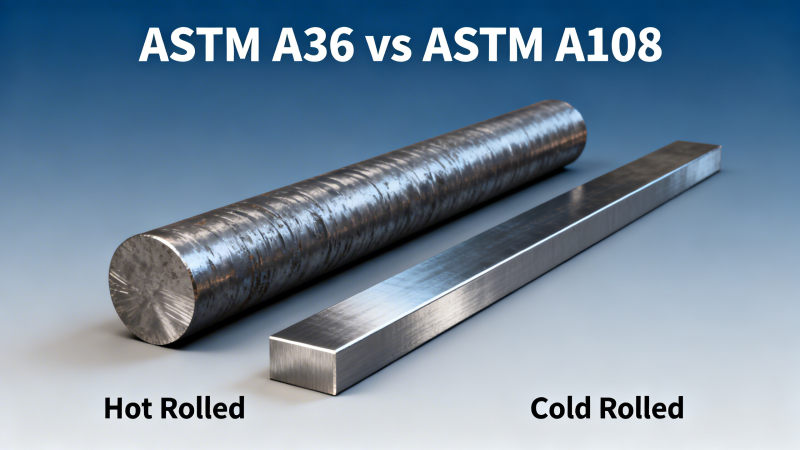
In contrast, ASTM A108 covers cold-finished carbon and alloy steel bars — including round, square, hexagonal, and flat sections. Unlike hot-rolled A36, A108 bars undergo additional cold drawing or turning, delivering tighter dimensional control, improved surface finish, and higher mechanical properties. Grades like 1018, 1045, and 4140 fall under A108, offering yield strengths from 50–120+ ksi depending on heat treatment and carbon content.
A key differentiator lies in application intent: A36 serves structural integrity; A108 targets precision components — shafts, pins, gears, and fasteners — where consistency and repeatability are non-negotiable. Understanding mill order meaning helps clarify why A108 orders require stricter process documentation, while A36 orders prioritize volume, delivery timelines, and compliance with ASTM A6 tolerances.
Technical Performance Comparison
Below is a side-by-side technical benchmark highlighting how ASTM A36 round bar and ASTM A108 compare across six critical dimensions:
Cost-Performance Analysis for 2026 Structural Projects
In 2026, rising energy costs, regional logistics volatility, and tightening environmental regulations have reshaped the cost-performance calculus. While ASTM A36 round bar remains ~12–18% less expensive per ton than cold-finished A108 equivalents, its lower strength-to-weight ratio may inflate total installed cost — particularly in multi-story or seismic zones requiring heavier sections or redundant connections.
Conversely, A108’s premium reflects added processing, tighter ASTM A6 tolerances, and superior fatigue resistance. For projects demanding long service life — such as offshore platforms or high-cycle industrial equipment — the lifecycle ROI favors A108 despite higher upfront CAPEX.
Hongteng Fengda bridges this gap with hybrid sourcing options: hot-rolled A36 for primary framing, paired with precision-machined A108 components fabricated in-house. We also offer Wire rod in HRB400/HRB500 grades — a cost-effective reinforcement alternative aligned with seismic codes across Southeast Asia and the Middle East.
Standards Compliance & Sourcing Confidence
Both A36 and A108 must meet ASTM’s rigorous testing protocols — but their certification pathways differ significantly. A36 requires tensile, bend, and chemical analysis per ASTM A6, while A108 mandates additional hardness verification, microstructure review, and lot traceability. Understanding mill order meaning ensures your supplier logs every heat number, rolling date, and test report — crucial for audits and insurance claims.
At Hongteng Fengda, all structural products comply with ASTM, EN, GB, and JIS standards. Our QA lab performs 100% ultrasonic testing on diameters ≥25mm and full-spectrum spectrographic analysis on each heat. For clients specifying HRB600 steel rebar, we provide third-party SGS and BV CE certifications — plus mill test reports (MTRs) traceable to raw material origin.
We support OEM partners with customizable packaging, bilingual documentation, and dual-standard labeling (e.g., ASTM + GB1499.2). This eliminates customs delays and accelerates site acceptance — especially valuable for EPC contractors managing parallel projects across North America and GCC countries.
Why Choose Hongteng Fengda?
As a certified structural steel manufacturer & exporter from China, Hongteng Fengda delivers more than product — we deliver predictability. With 12+ years serving over 47 countries, our integrated model combines ISO 9001-certified production, real-time inventory visibility, and agile OEM engineering support.
Whether you need ASTM A36 round bar in custom lengths (5.8m–12m), A108-grade shaft blanks with pre-machined shoulders, or bundled Wire rod with PVC coating and anti-rust oil — we align capacity, compliance, and cost without compromise.
Contact us today for a free technical consultation, sample request, or 2026 Q2 pricing forecast tailored to your region and volume tier. Let’s build certainty — one specification at a time.
Related recommendations
 How much does 2 inch ss pipe price increase when upgrading from Schedule 40 to Schedule 80 for high-pressure systems?2 inch ss pipe price increases 18–35% when upgrading from Sch 40 to Sch 80—discover why, when it’s truly needed, and how to avoid overpaying.
 Which 304 stainless steel coil suppliers meet ISO 9001 and EN 10088-2 for food-grade fabrication?Discover verified 304 stainless steel coil suppliers meeting ISO 9001 & EN 10088-2 for food-grade fabrication—traceable, audited, and ready for regulatory validation.
 How does 2 inch ss pipe price compare between 304 and 316 grades for marine environments?2 inch ss pipe price varies significantly between 304 and 316 — but in marine environments, choosing 304 risks costly failures. Discover why 316 is the true value choice.
 Is 20 feet square pipe price affected more by raw material volatility or regional logistics costs?20 feet square pipe price is driven primarily by raw material volatility—not logistics. Discover why billet costs dominate pricing & how to forecast smarter with Hongteng Fengda.
Please give us a message


Please enter what you want to find