Many buyers assume steel coil for construction can replace other steel products without affecting performance or cost. In reality, differences in grade, coating, strength, and application make substitution risky in many projects. For engineers, buyers, and project managers comparing options such as pre-galvanized sheet, galvanized steel sheet supplier offers, or steel tube specifications, understanding interchangeability is essential for quality, compliance, and budget control.
In structural and industrial projects, a steel coil is not simply a roll of metal that can stand in for sheet, plate, tube, beam, or cold formed profile whenever pricing looks attractive. Small variations in yield strength, coating mass, thickness tolerance, and forming behavior can change performance at installation and throughout a service life of 10, 20, or even 30 years. For procurement teams, this is not only a technical issue but also a commercial one, because a lower upfront material price can lead to higher processing cost, rework, corrosion claims, or compliance problems later.
For global buyers working with Chinese suppliers, the right question is not whether steel coil for construction is useful, but when it is suitable, when it is not, and what specifications must match before substitution is considered. This article explains the key limits of interchangeability, outlines practical selection criteria, and shows how manufacturers such as Hongteng Fengda support buyers with standard and customized structural steel solutions aligned with ASTM, EN, JIS, and GB requirements.
What Interchangeability Really Means in Construction Steel Supply
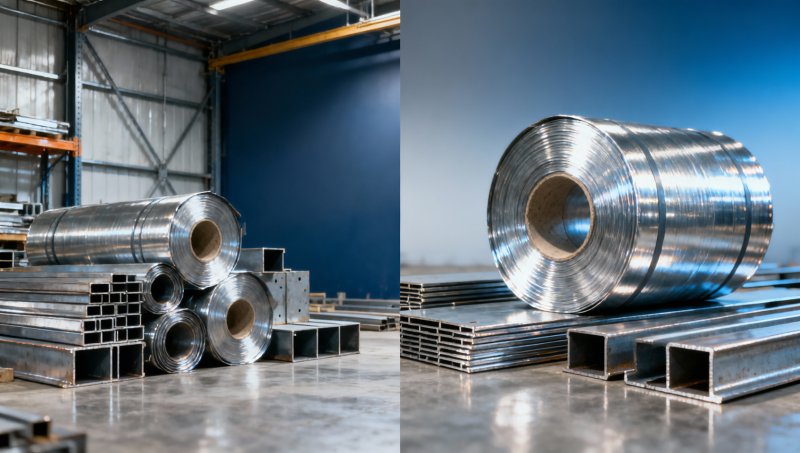
In construction purchasing, interchangeability means one steel product can replace another without reducing safety, durability, fabrication efficiency, or regulatory compliance. In practice, that standard is much stricter than many buyers expect. A coil that looks similar in thickness and surface finish may still differ in chemistry, mechanical properties, edge condition, zinc coating, or bendability. Even a difference of 0.1mm to 0.2mm in nominal thickness can affect formed sections, fastening behavior, and load calculations.
Steel coil for construction is typically selected for downstream processing into sheets, strips, purlins, decking, studs, channels, tubes, or other profiles. That makes it a semi-finished input in many cases, not a universal finished substitute. If the project requires direct load-bearing members such as structural steel beams or hot rolled channels, replacing them with coil-derived products without redesign is usually inappropriate. The geometry, section modulus, and fabrication route are different from the start.
Interchangeability also depends on the level of project risk. For temporary enclosure, light cladding, or non-critical accessories, equivalent substitution may be possible after reviewing coating, thickness, and corrosion environment. For bridges, industrial plants, lifting areas, or code-controlled buildings, the acceptance threshold is much higher. In these applications, a mismatch in grade or standard can delay approvals, trigger rejection by quality teams, or require third-party testing.
Why visual similarity is misleading
Two steel products may look almost identical on arrival yet perform differently after cutting, welding, punching, or exposure to weather. A pre-galvanized sheet and a hot dipped galvanized sheet may both appear zinc-coated, but the coating route, adhesion, typical coating mass, and post-fabrication corrosion resistance differ. Likewise, steel tube specifications are governed by dimensional tolerance, wall thickness, and forming quality that a generic coil cannot guarantee without proper processing controls.
Core factors that define interchangeability
- Base steel grade, including yield strength, tensile strength, and elongation.
- Coating type and mass, such as thin, medium, or thick zinc layers for different corrosion conditions.
- Processing route, including hot rolled, cold rolled, pre-galvanized, hot dipped, or cold formed conversion.
- Dimensional tolerance, including thickness range, flatness, coil ID, width, and slit edge quality.
- End-use requirement, such as load bearing, forming, welding, appearance, or outdoor durability.
For buyers, this means comparison should never stop at price per ton. A realistic evaluation should include at least 5 variables: material grade, coating level, fabrication method, applicable standard, and actual installation environment. Missing any one of these can turn a seemingly economical substitution into a costlier procurement decision.
The Technical Reasons Steel Coil Cannot Always Replace Other Steel Products
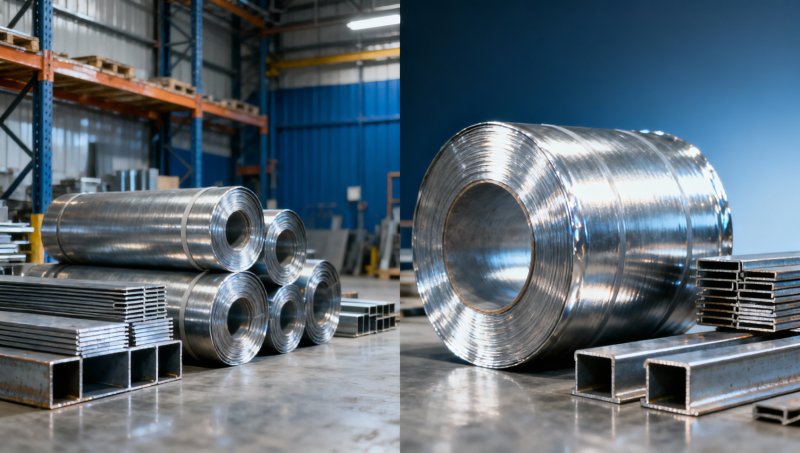
The first technical limit is mechanical performance. Construction steel is chosen around design loads, safety factors, and fabrication methods. A coil intended for forming may offer suitable ductility but not the section shape or stiffness required for direct structural use. By contrast, angle steel, channel steel, and steel beams are designed as finished structural members with predictable cross-sectional performance. A project cannot simply swap one for the other because the load path changes.
The second limit is corrosion protection. In coastal, marine, or high-humidity environments, coating mass matters. A thin zinc layer may be acceptable indoors, but the same material can deteriorate faster outdoors if cut edges, drilled holes, and welded points remain exposed. Typical zinc coating ranges may vary from 15 to 135 g/m2 for thin coating, 60 to 200 g/m2 for medium coating, and 75 to 260 g/m2 for thick coating, depending on process and application. These ranges are not interchangeable across all service conditions.
The third limit is fabrication compatibility. A steel coil can be slit, leveled, bent, roll formed, or welded, but every operation introduces tolerance and process requirements. If a buyer substitutes coil for finished profiles, they must also account for secondary processing time, yield loss, equipment setup, and quality inspection. In many cases, the material itself is not the only cost driver; conversion from coil to usable parts can add 3 to 5 additional production steps.
Comparison of common construction steel forms
The table below shows why different product forms serve different engineering and procurement needs, even when the base material is steel.
The main takeaway is straightforward: steel products may share a raw material family, but they are not automatically equivalent in engineering function. Buyers should confirm whether they are comparing material form, material grade, or finished performance, because these are three different decision layers.
A practical risk checklist
- Verify the target standard before approving substitution, such as ASTM, EN, JIS, or GB.
- Check if the product is load bearing, corrosion critical, or safety related.
- Review whether the new form requires extra bending, welding, punching, or coating repair.
- Calculate total landed cost, not only coil price per ton.
- Confirm whether inspection documents and mill test certificates match project requirements.
How Buyers Should Evaluate Substitution Risk Before Ordering
For procurement managers and technical evaluators, the safest process is to treat substitution as a controlled review, not a shortcut. A 4-step method works well in most projects: define application, verify performance, compare cost-in-use, and confirm compliance. This prevents price-driven decisions that ignore fabrication losses or service-life risk.
Application comes first. If the steel is going into roofing accessories, cable trays, partition framing, or light enclosures, coil-based products may be a good fit. If the requirement involves repetitive load, suspended systems, lifting points, or primary framing, more specialized products are often needed. The cost difference between suitable and unsuitable material may be only 5% to 12% at purchase, but the downstream impact can be much larger if replacement or site modification becomes necessary.
Performance verification should focus on measurable values: thickness tolerance, tensile range, coating mass, hardness, bend radius, and corrosion environment. For projects with multiple climates or export destinations, buyers should also check whether the same product can satisfy local code expectations. A specification accepted in one market may still require different documentation or labeling in another.
Decision table for procurement and engineering teams
The following table can be used as a quick internal review tool before confirming a substitute material.
This review approach is especially useful for distributors, project contractors, and import buyers who compare offers from several mills. A lower quoted price may be reasonable if the specification is clearly adjusted. It becomes a problem only when a lower-grade or lighter-coated material is supplied as if it were equivalent to a higher-performance product.
Questions worth asking your supplier
- What is the applicable standard and test basis for the offered material?
- Is the product intended for direct installation or further fabrication?
- What is the available thickness range, tolerance, and coating range?
- Can the supplier support OEM processing or custom profiles to reduce site work?
- What is the normal production lead time, such as 2 to 4 weeks or 4 to 6 weeks for special items?
Suppliers with structural steel manufacturing experience can often propose a better alternative than a simple coil substitution. In many projects, changing to a cold formed profile, angle steel, channel steel, or customized component delivers better fit-up and lower total cost than trying to adapt generic material on site.
Mid-Project Example: When Coating and Form Matter More Than Price
A common sourcing mistake occurs when teams compare steel materials only by diameter or thickness and overlook construction purpose. This is especially important for auxiliary systems, suspended equipment, safety restraint assemblies, or industrial support applications. In these cases, corrosion resistance, tensile strength, and strand structure can be more important than unit price.
For example, some projects involving cranes, elevators, drawing equipment, mining operations, road fences, or photovoltaic support systems require galvanized wire rope rather than flat steel coil or ordinary fabricated strip. The reason is functional: the product must transmit tensile load, maintain flexibility, and resist corrosion in dynamic service. A rope structure such as 6X7+FC, 6X19+IWS, or 8x19S+FC behaves very differently from a flat product, even if both are made from steel.
A relevant option for such use cases is 0.7mm 0.8mm 1.2mm 1.6mm 1.8mm 2mm diameter Galvanized Steel Wire Rope, available in sizes from 0.7mm to 2mm and extended ranges up to 22mm, with normal tensile strength from 1470Mpa to 1960Mpa. Depending on the operating environment, buyers may select plain, electro galvanized, or hot dipped galvanized finishes, with zinc coating categories designed for different corrosion conditions. This kind of product highlights a larger procurement lesson: steel forms are application-specific, and not all “steel” can replace all other steel safely.
Why this matters for construction and industrial buyers
Where movement, tension, or cyclic loading is involved, product structure becomes a primary engineering factor. A wire rope certified to standards such as GB/T 20116-2008, DIN, ISO 9001, EIPS, or ABS may fit lifting, marine, and drilling environments far better than a general-purpose substituted material. This does not mean coil products are less valuable; it means the buyer must match product form to service condition from the beginning.
Typical scenarios where substitution should be reviewed carefully
- Projects exposed to salt spray, heavy rain, chemical splash, or high humidity for more than 12 months.
- Systems involving repeated tension, lifting, or vibration cycles.
- Installations where a 1 to 2 mm dimension difference changes fit-up or safety clearance.
- Jobs requiring specific standards, inspection records, or third-party acceptance.
The commercial message is equally important. When a supplier understands multiple steel product categories rather than only one commodity line, they can help buyers avoid false equivalence and specify the right product earlier, reducing re-quotation cycles and procurement delays.
How Hongteng Fengda Supports Better Material Selection and Lower Sourcing Risk
For global construction and industrial buyers, the best supplier is not simply the one with available stock, but the one that can align product form, specification, and delivery plan with the project schedule. Hongteng Fengda operates as a structural steel manufacturer and exporter from China, supplying angle steel, channel steel, steel beams, cold formed steel profiles, and customized structural steel components for overseas projects. That combination matters because many substitution questions can be solved through proper product matching rather than compromise.
A capable manufacturing partner can support both standard specifications and OEM solutions. This is valuable when buyers need one of three outcomes: direct replacement with an equivalent standard item, redesign into a more suitable formed component, or custom fabrication to reduce assembly work at the destination. In practice, this can shorten installation time, improve consistency across batches, and reduce on-site cutting or welding by several work steps.
Hongteng Fengda’s focus on international standards such as ASTM, EN, JIS, and GB is important for importers and project teams operating across North America, Europe, the Middle East, and Southeast Asia. Different regions often require different documentation habits, technical review depth, and labeling expectations. Stable production capacity and consistent quality control help buyers manage delivery windows of 2 to 6 weeks more confidently, depending on specification complexity and order volume.
Typical support process for overseas buyers
A structured sourcing process reduces the chance of ordering a material that looks acceptable on paper but creates problems during fabrication or installation.
This type of collaboration is especially useful for distributors, EPC teams, and project managers balancing cost, risk, and schedule. Instead of forcing a questionable substitution, they can select a steel product that fits the application from the outset and avoid hidden conversion or compliance costs.
FAQ for practical sourcing decisions
Can steel coil replace galvanized sheet in all projects?
No. Coil may be the feedstock for sheet, but finished galvanized sheet specifications involve thickness tolerance, surface quality, coating mass, and post-processing expectations. For direct-use applications, those details must match project requirements.
When is substitution more likely to be acceptable?
Usually in low-risk, non-primary, or custom-fabricated applications where the final profile will be formed under controlled conditions and all mechanical and coating requirements are rechecked before use.
What documents should buyers request?
At minimum, request the applicable standard, mill test certificate, coating or surface specification, dimension tolerance confirmation, and any agreed inspection requirements before shipment.
Steel coil for construction remains an efficient and valuable material, but it is not universally interchangeable with every steel product used in modern projects. Grade, coating, shape, processing method, and service environment all influence whether substitution is technically safe and commercially sensible. Buyers who evaluate these factors early can avoid quality disputes, reduce rework, and make better cost decisions across the full project lifecycle.
If you are comparing steel coil, galvanized sheet, structural profiles, or customized steel components for an upcoming project, Hongteng Fengda can help review specifications, recommend suitable product forms, and support global supply with reliable quality and delivery planning. Contact us today to discuss your application, request technical details, or get a tailored sourcing solution.
Please give us a message


Please enter what you want to find